Imperial College Hackathon launched
Applications abound as students take to their screens, writes Sangjin Lee
Imperial College has one of the best Computing and Electrical Engineering Departments in the World, producing the most disciplined and talented software developers and programmers consistently. These programmers often benefit from high salaries and fabulous perquisites from their employers. Imperial College prides itself on this monumental achievement. However, students often observe the lack of ambition for entrepreneurship and technological innovation among Computing Undergraduates – please correct me if I am wrong.
To this rather depressing phenomenon, I have attributed many reasons. There is no incentive for undergraduates to become innovative or entrepreneurial, and the bureaucracy that exists in Imperial College stops any such movement. The administrators are unwilling to help and they themselves do not have any incentives to help either. This has been exemplified by possibly high catering prices on weekends that clubs and societies cannot pay for and many difficulties in booking venues (it would have been very convenient for the participants of Imperial College Hackathon to have stayed in the venue after 11pm to continue coding rather than being dismissed by a security guard). In addition, there is no major software or investment banks led challenges or competitions in Imperial. In Imperial College, there is incredible number of talented students and they are just not given the chance to excel.
Hackathon is esentially the culture that built Facebook, Google and Microsoft
To circumvent this problem and accelerate entrepreneurship in Imperial College, Imperial Innovation launched Imperial Digital Accelerator on January 19th to “facilitate entrepreneurship in the digital space at Imperial College”. Imperial Digital Accelerator aims to provide funding, mentorship and legal and accounting advice. They are organizing seminars with serial and student entrepreneurs to provide real examples of how technological innovations and entrepreneurship proceeds as an undergraduates or as a postgraduate.
This, however, was largely a departmental effort and we still noticed lack of student effort in such technological innovation. The Imperial College Hackathon committee hence decided to organize the first ever Imperial College Hackathon on 25th and 26th of February sponsored by JP Morgan, Facebook and Imperial Innovations. Hackathon is essentially the culture that built Facebook, Google and Microsoft, and Hackathon’s essence is summarized in its first five letters: HACKA. Each letter captures one element of the event: (H- Hidden Needs; A- Associational Thinking; C- Cracking code; K- Killer concept; A- Action Now).
Both participants and sponsors were surprised by the originality of ideas...
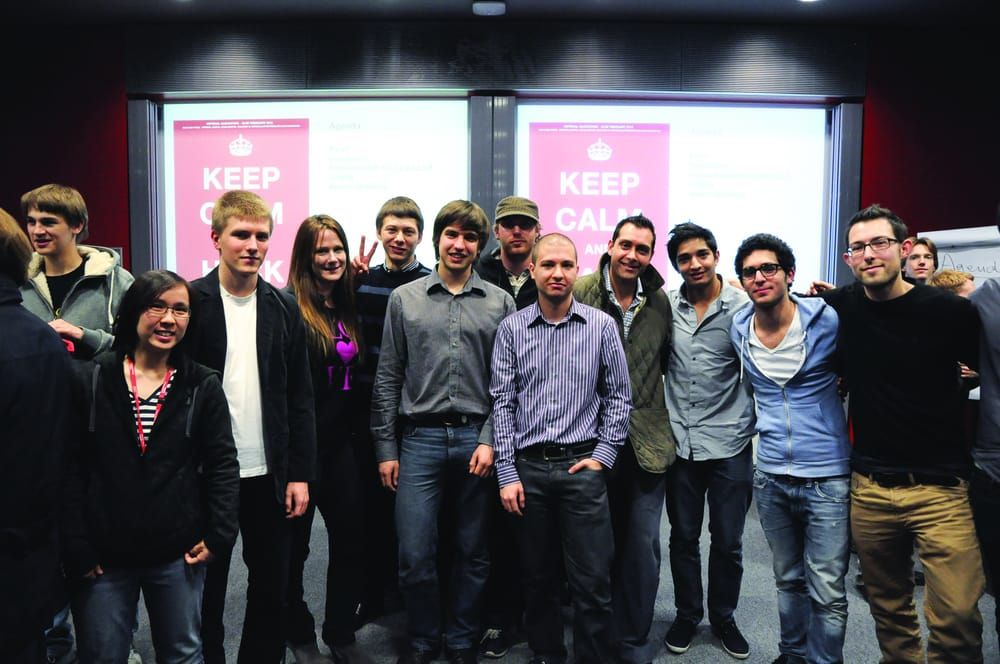
On Saturday morning sixty software developers gathered in 060ABC Skempton Building. They were obviously very excited and the organizers could sense the excitement of participants whether it was induced by redbull or genuine enthusiasm. We also had engineers from both Facebook and JP Morgan, a technology associate and digital accelerator manager from Imperial Innovations to overlook the event. Simon Cross from Facebook explained why Hackathon was such a central part of Facebook and the achievements that it has made such as the development of Timeline and many other applications.
Fueled by presentation by Facebook and JP Morgan, software developers from various parts of Imperial College London and other universities gathered and started to develop applications based on the theme “Improving Imperial College.” With free pizza in one hand and the other hand on the keyboard, programmers in groups of six or seven developed their applications from morning to dawn. The developers were excited about being able to have a role in changing the world and making a dent in Imperial College. After the intense coding, the participants returned again very early on the Sunday morning to continue on their project with intensity and vigor.
Development of the application culminated with a pitch in front of judges from JP Morgan, Facebook, Imperial Innovations, and student entrepreneur and alumnus of Imperial College Milen Dzhumerov. Nine teams presented their work and each idea was not only fascinating but also intriguing in its application. Two teams developed applications under the names Imperial Foodie and IEAT to assist in the digitization for the purchase and payment of food using our swipe cards. If such a system were implemented, students would be able to purchase food much more easily and track their eating habits. This, however, wasn’t the most innovative of the ideas as Duke University and California Institute of Technology (Caltech) have already been at the forefront of digitizing student activities with their swipe cards.
Before lectures start, we often have trouble printing off materials due to overloading of the system and inefficient system that the ITC team has built for our college. In addition, there has been increase in the use of tablets and laptops in the lecture theatre to assist our learning. The two teams that won the Imperial College Hackathon developed an application that allowed instantaneous uploading of relevant lectures on each day. This removes the need to print lectures every day and the need to download lecture notes from blackboard. The application automatically delivers the relevant lecture notes every day based on your course, date and location. Such an application enhances and accelerates the digitization of learning materials and eliminates the need to actually attend a lecture. The second team developed an application named HEATNOTE that allowed live visual presentation of materials that were not understood in the lecture. Such a system allows for the lecturer to identify which part he has to re-clarify and this system does not stop the flow of the lecturer at all. This winning team received five hundred pounds in cash and praise from developers. Other teams also developed fantastic websites and applications such as News4D and IMPEK that could be used immediately.
The first Imperial College Hackathon was not only successful, but also invigorating for organizers to watch. Both participants and sponsors were surprised by the originality of ideas and how much they could actually do in a limited time of 24 hours. Now the participants have to move their ideas forward to make it commercial and implementable in a school environment. This would definitely need help from both the faculty members of all departments and administrators. Without their help all these fantastic ideas would be buried and would never rise again. If the administrators could only help to push such technological innovations in our school, Imperial College Undergraduates and Postgraduates would become more and more innovative and entrepreneurial, and that will tremendously benefit our school. This could possibly happen by arranging meetings between participants of Hackathon and ICT department, and having the Rector push our ideas.
After Imperial College Hackathon, Facebook and JP Morgan took all the contact details of the participants to possibly recruit all these talented participants to their firm. Imperial Digital Accelerator took in three teams to its program to provide mentorship and finance. JP Morgan and Facebook and other software companies are willing to sponsors this event next year. In fact JP Morgan wants to have their own Hackathon with Imperial College students after the success of our event. Next year, the event will be not only bigger, but better. You better join it or you will regret it.