FELIX

"Keep the Cat Free"
20/05/13

Doctor Who in plot-hole drama... again

It's time to pick holes in the Doctor's nebulous, wibbly wobbly, timey-wimey thread
Sharing
Impossible Astronaut.jpg
Was this series up to scratch, or does it need regenerating?

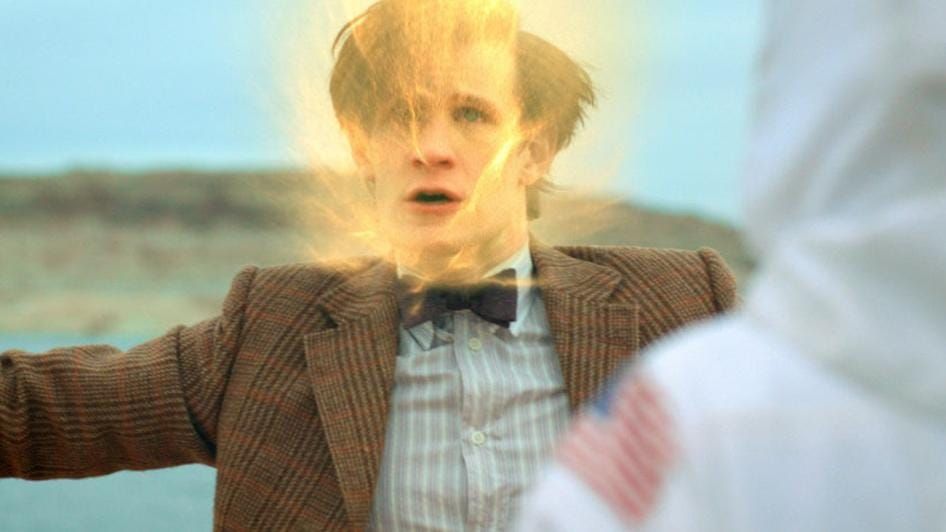
Given that this is Imperial I’m sure that few of you will be unaware that last Saturday saw the broadcast of ‘The Wedding of River Song’ - the final episode of the latest series of Doctor Who. This has been probably one of the best series since the 2005 revival of the show. Starting with the chilling image of a future version of the Doctor being killed in ‘The Impossible Astronaut’ it included the wonderful exploration of the Doctor’s companion Amy that was ‘The Girl Who Waited’ and the near perfect ‘Let’s Kill Hitler’. It’s not surprising that I had high hopes for this episode.

‘The Wedding of River Song’ begins with the Doctor finally resigned to his impending death and the mysterious River Song trapped by the Doctor’s enemies, the Silence, in a mechanical spacesuit which is trying to force her to shoot him. She manages to resist, thereby disrupting the fixed point in time that was the Doctor’s death and causing all of history to become compressed into a just a few moments and begin to collapse. The rest of the episode sees the Doctor trying to convince River to kill him in order to save time while River tries to find a way to save him. Needless to say by the end of the episode our heroes had managed to save both the Doctor and time.

While this was certainly a passable ending to the series, with the manner in which the Doctor manages to survive being quite clever, I can’t really say that that I wasn’t disappointed. It’s not just that there were plot holes (why did the Silence even need River - couldn’t they have just used a fully robotic spacesuit to kill the Doctor?) and that many of scenes when time was compressed were frankly ridiculous (with flying cars supported by hot air balloons and Churchill as the leader of a Holy Roman Empire which apparently has London as its capital).

It’s just that the entire episode felt a bit thin on the ground. Whilst the ultimate solution was pretty good, it’s clear that the writer, Steven Moffat, had no idea how to translate this into 45 minutes of drama –resulting in an episode full of filler. The titular wedding between River and the Doctor is a prime example – it comes almost out of nowhere. While it is the case that River has been obsessed with the Doctor her entire life, the Doctor himself hardly knows her at that point – making it all the more surprising that it is he who proposes the marriage. No, I don’t know what I would have done better myself, and Moffat has probably done the best job possible but that doesn’t stop me feeling a bit let down!

Near peerless entertainment for the target age group

Thinking back on the previous series, however, ‘The Wedding of River Song’ is actually well above the average quality of a Doctor Who episode. While it is easy to be blinded by the few gems, the fact is that even series six contained its fair share of sub-par episodes such as the completely forgettable ‘The Curse of the Black Spot’ and the dreadful two-part ‘The Rebel Flesh’ and ‘The Almost People’ which has guest characters whose motivations change every twenty minutes and ends with the Doctor killing somebody for no good reason.

While ‘The Wedding of River Song’ failed because it couldn’t live up to the impossibly high standards expected of it, far too many others fail because of lazy or simply incompetent writing. Episodes are so often filled with deus ex machina endings and meaningless technobabble while every series finale seems to threaten the end of the universe, or even time, thus completely devaluing the level of danger.
The question is, therefore, why is the show so popular? The answer is quite simple. In essence, Doctor Who is a childrens' or – to use a typical BBC euphemism - a ‘family’ show.  It irrefutably offers near peerless entertainment for the target age group, whilst remaining largely watchable for adults. But ought it be judged by the same criteria as a mature show?

Yet it so often is, and usually favourably. It has a massive adult following and I have even seen some of the more significant episodes discussed on the main pages of national newspapers. Its popularity can probably be explained in two ways. I imagine that for many the reason is nostalgia, which is of course helped by the show having been on our screens for so long. Even the show’s revival has already been going for a not insignificant six years – indeed I was only thirteen when I started watching it.

For the more serious SF fan, however, or at least for myself, the attraction is the show’s great potential. The premise of having a machine that can take you anywhere in space and time allows for a literally endless variety of stories and the show’s long running nature allows for a depth, both of character and plot, rarely found anywhere else in television. Of course the full potential will never be reached. That’s not to say that family programming can’t be eminently entertaining, series six proved that, but it means that there will always be topics that won’t be touched and simplifications that will be made. I, however, will keep watching for those glorious moments where the show transcends both standard science fiction and family programming and comes so close to all that it could be.

Comments (6 comments)

Post a comment

Simon Worthington

Saturday October 08 2011 11:59

Overall a good review, and you get to the crux of the matter (poor writing) quite well, and I liked your analysis at the end regarding how you think the show'll never reach it's potential. But I find your opinions on individual episodes totally bizarre!

You said 'Let's Kill Hitler' was near perfect. Seriously? It was by far the worst episode in the series, and it's a contender for the worst episode in the entire DW revival. There was just nothing to it. It was a prime example of something that is unfortunately becoming commonplace in DW: a "story arc" episode. If you're an intelligent writer you weave this plot stuff elegantly into your episode, not just plonk it all in the middle of your series. Plus, for an episode with such a provactive title, it would have been nice for Hitler to feature for more than like 10 seconds and for the fact we're in WW2 Germany to have actually been used in any meaningful way at all - we could have been in space and the script would have been identical.

Simon Worthington

Saturday October 08 2011 12:01

I also can't believe you disliked the time compression scenes - it's that sort of visual imagery which makes Doctor Who such an interesting show to watch. If you think it's ridiculous that's because it's meant to be - not everything has to be about realism!

But you're still right about it having some pap episodes (in fact, no episode was truly a masterpiece) but not the ones you mentioned: 'Closing Time' (the one with Corden) was useless and probably only there to remind people to buy Cybermen merchandise, 'God Complex' was interesting but with a confusing mix of violent monster and psychological warfare. The Flesh double-parter, while not really dealing with any of the moral issues it tried to present, did at least maintain it's pace and excitement throughout it's episodes.

So I think while your points about the series as a whole are entirely accurate and well-said, your opinions on individual episodes are way off!

Maciej Matuszewski (Author)

Saturday October 08 2011 20:18

I probably agree with you on 'Closing Time' and 'God Complex', though I did prefer them to the episodes I mentioned.
I was, also, perhaps to harsh in my criticism of the time compression scenes. It was an imaginative complex and there was a lot of very fun imagery: I especially enjoyed the pyraminds being repurposed as "Area 52".
There's just one scene that really annoyed me. I know that I'm being exeptionally petty but I just can't get over the fact that while Churchill is Holy Roman Emperor the banners on Buckingham Palace, where he resides, read SPQR - despite the Holy Roman Empire having been a collection of mainly German states and not the ancient Roman Empire. Now, I know that the Holy Roman Empire in the episode is nothing like the real one and that the episode was meant to be full of anachronisms but I just can't stop this annoying me on an emotional level. I guess this just blinded me to the merits of the rest of the sequence.

Maciej Matuszewski (Author)

Saturday October 08 2011 20:33

I can't, however, agree with your analysis of 'Let's Kill Hitler'.
I've seen a lot of people complaining about 'story arc' episodes and I just can't figure out why. I'm sure that few people would argue against having story arcs at all: they allow for longer and far more complex stories to be told. While stand-alone episodes are certainly still very much necessary having a story arc necessitates devoting at least a few episodes to it. Even the most skilled writer could not have managed to deal with the vital arc story plot developments of "Let's Kill Hitler" in an episode that was noy wholely devoted to them without them losing some of their weight and the episode itself feeling a bit spread thin.
Even if you forget its significance to the arc story I'd say that its humour and the character development that River Song gets make it a good episode in its own right. As to making more use of the setting: what would you cut from what's already there to achieve this? ...

Maciej Matuszewski (Author)

Saturday October 08 2011 20:34

... I actually thought that disposing of Hitler so early on was pretty funny and that the title was a clever red herring.

Annonymus

Sunday May 20 2012 23:58

I appologize that this is a late reply to this, but I wanted to say that I agree with Simon on "Let's kill Hitler". For one thing, just plopping in Mells for the first time like that is poor writing. If she was such an important character, or so close to Amy and Rory, you'd think she may have at least been mentioned in passing. For example in the episode when Amy is havin her wedding, she could have dropped a reference to having invited her but she was serving a prison sentence or refused to come. Another is the idea that by introducing her like this and making her River etc. it would be a sufficient resolution to Amy's missing baby problem. An, “Oh look! She was with us the whole time! We now don't need to find her.” Add that to the idea that she was trained as an assassin who hates the doctor when she was little, when? If she was spending the time with Amy and Rory or in trouble when did she do such a thing? Let's forget all of that then and believe for a moment she hates the doctor and was trained to kill

Comment anonymously or log in

Anonymous comments are moderated before appearing on the website. Comments posted while logged in appear immediately and are moderated later. Read our commenting policy for more information.

Commenting Policy

Felix is fully supportive of fierce and frank discussions. We will generally allow comments that are on-topic and avoid personal attacks; criticising someone's decision is allowed, criticising their weight, for example, is not.

Comments may be deleted/rejected if they:

  • are off-topic
  • contain ad-hominem attacks
  • are potentially libellous
  • use excessively foul language
  • are obviously spam

Email article

Doctor Who in plot-hole drama... again
(Seperate multiple address with a comma)