Are we happier when the weather is good?
A beautiful day makes you feel good, right? Now we have the large-scale evidence to prove it.

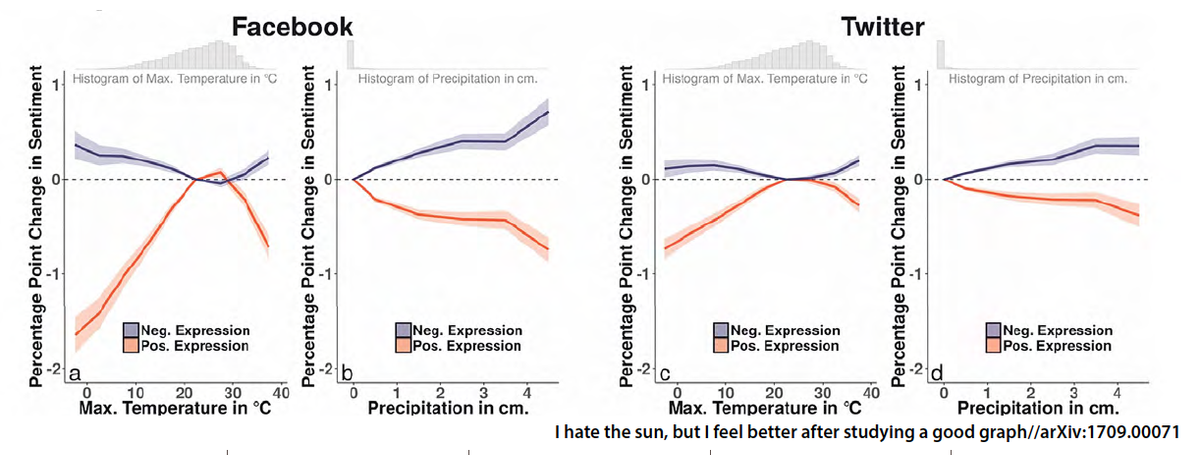
t would be pretty easy to assume from anecdotal evidence that humans prefer warm sunny days rather than cold wet ones. But what empirical evidence is there for this? Patrick Baylis and his colleagues at Stanford University have carried out the largest investigation into the relationship between meteorological conditions and mood. They did this by analysing how the sentiment of geolocated social media posts changed with the weather.
Baylis and colleagues measured the sentiment of 3.5 billion social media posts from tens of millions of individuals on both Facebook and Twitter between 2009 and 2016. They did this by counting the number of positive and negative words each post contained, assuming that this was good proxy for our mood.
Then they compared this to the daily meteorological data from each location. They found a significant increase in negative sentiment when the weather was both too cold or too hot and when it was too wet, too humid, and cloudy. But how large is this effect? To make a direct comparison, the team measured the change in sentiment associated with specific events - earthquakes and terror attacks. And they found the change in sentiment was of a similar magnitude to that associated with freezing weather. From their results weather appears not to have a mild effect on mood, but be a scorcher.