A dinosaur on Regent Street: Coach's case on organic growth
Examining the intersection of creative bravery, D2C capabilities, and new audience acquisition.
“Our latest campaign (Courage To Be Real) is an invitation to channel your inner child and fearlessly explore new adventures.’’ - Coach via Instagram
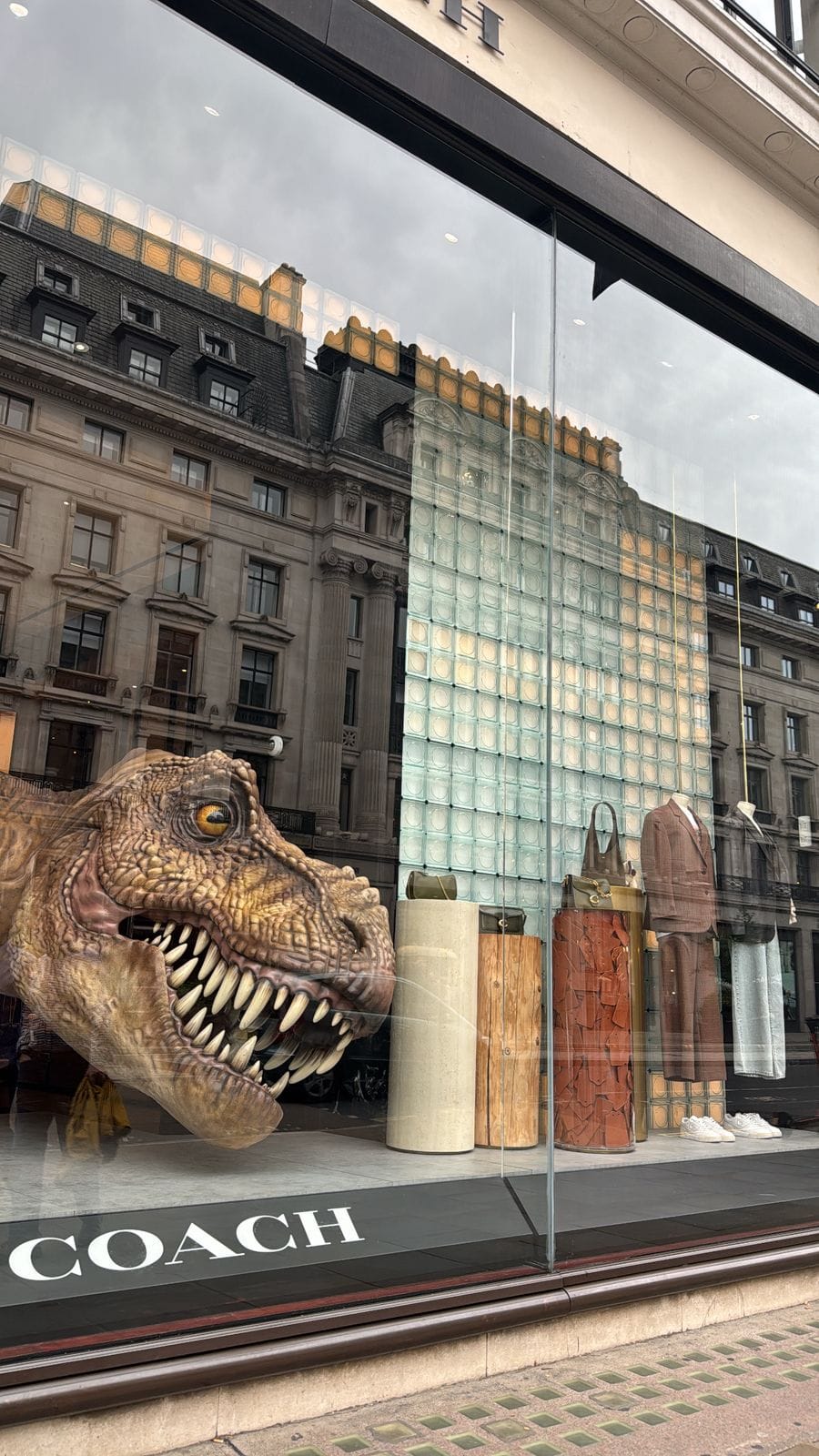
During my first weeks in London, I visited Regent Street as my very first shopping destination. I walked steadily past storefronts I can no longer recall while writing this article. However, one disruption appeared: an imposing dinosaur, realistic and several feet tall, completely taking over the area. It was not something I expected to see, and even less to discover that it belonged to a luxury handbag store, Coach.
Is this Jurassic Park? I thought. Who, in this hyper-technological digital era, turns to prehistoric creatures to connect with their audiences? This was exactly what I needed to see. The installation, created by StudioXAG and awarded the WindowsWear Best Prop Award, took over the space with confidence, demanding attention from every passerby. I remember standing there, amazed by the creature, when a family of five walked by. They also had to stop. The children were impressed; the parents followed.
Discovering this execution sparked a deeper curiosity in me to understand how it responded to a broader strategy, and whether that strategy was actually working. Creative bravery often comes in moments of change.
Rexy the dinosaur is not new to Coach; it has long been part of the brand’s visual universe. What is new, however, is the creative approach, one that places handbags within authentic, deconstructed realities while still maintaining elegance, identity, and a sense of the sublime. “Courage to Be Real,” introduced in September 2025 and starring Elle Fanning, reaffirms the brand’s willingness to challenge the ordinary and the monotonous, allowing adventure and courage to drive a journey of self-exploration.
Coach is one of the core brands within Tapestry, a global house of modern luxury that also owns Kate Spade and Stuart Weitzman. Beyond the “wow” factor of Coach’s recent marketing platform, the question becomes more strategic: How have these creative actions contributed to Tapestry’s financial performance, and has Coach delivered measurable positive results?
Across FY25 and into Q1 FY26, Coach has been the primary growth engine within Tapestry, offsetting sales decline in the group’s other brands. At a group level, Tapestry delivered record revenues and earnings in 2025, closing the year with approximately $7.0 billion in net sales, a 5% YoY increase, and record adjusted EPS of $5.10.
When disaggregating performance by brand, the source of this growth becomes very clear. Since Q1 2025, Coach has consistently delivered quarter-over-quarter growth. In its FY25 report, management described 2025 as a “breakout year” for Tapestry, explicitly crediting Coach’s double-digit YoY growth of 10% as a key driver of the group’s performance.
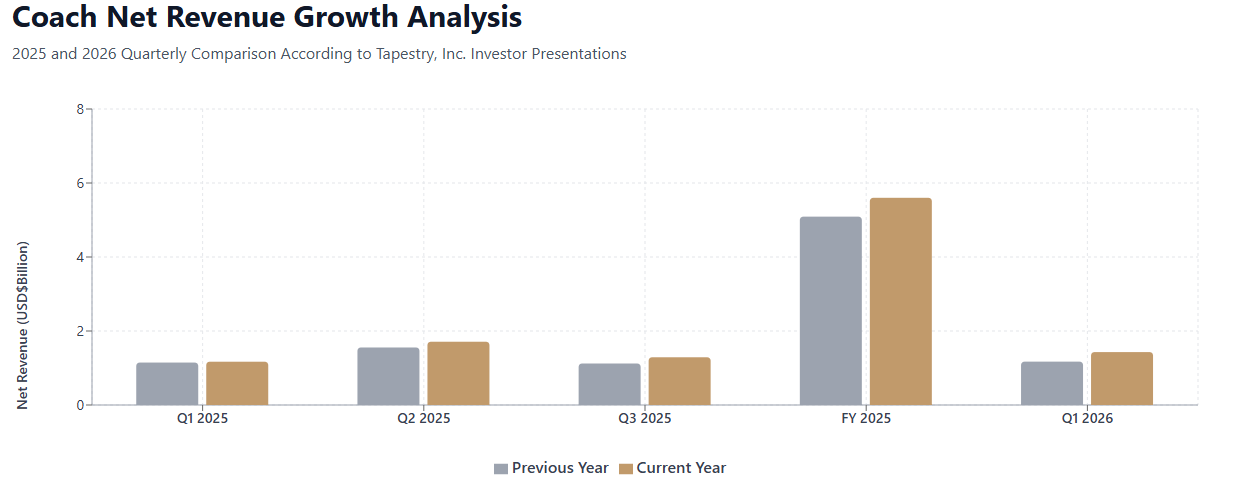
According to the firm, what makes Coach’s contribution particularly relevant is the quality of its growth. Strong Gen Z acquisition, with younger consumers transacting at higher price points, combined with growth driven primarily through D2C channels (Which account for approximately 87% of Coach’s sales) has been key in accelerating the brand’s net revenue.
“Coach, before then, was the brand that all the moms were getting their bags from.” - Hannah Krohne, via Instyle.
For a long time, Coach wasn’t trying to be “cool” or speak to the next generation. The brand was built around heritage leathercraft and timeless designs meant to last, attributes naturally skewed toward adult professionals. An inflection point in Coach’s evolution occurred around 13 years ago, with the appointment of Stuart Vevers as new creative director, which represented the beginning of a long-term strategic shift in how the brand would express itself. Vevers articulated this vision from the start, telling British Vogue in June 2013:
“My passion is for brands with heritage. Throughout my career, every brand I've been drawn to has a strong heritage.” He continued, “My style is to take that heritage and to play it against modern references, youth culture, references that take things to a different place and make them relevant now.”
Over the years, this shift expanded to strategic use of pop-culture icons, the contemporary reimagination of archival bags (such as the Swinger), and a clear move toward identity-driven storytelling rather than a functionality-driven approach. By 2026, Coach reflects a deliberate balance between its classic design DNA and a more youthful, expressive energy.
As a Gen Z consumer myself, platforms such as Courage To Be Real transformed how I perceived Coach from a passive, legacy handbag brand into one that feels culturally relevant and aligned with the contemporary artistic and expressive expectations of my generation, to the point that I am now creating earned media for the brand, as evidenced here. The question, then, is not whether creativity alone can fuel growth, but what system is required to make it thrive in today’s context. Coach’s case suggests that quality growth emerges from the combination of strong D2C online channel capabilities, empowered and visionary creative talent, and, crucially, targeted audience clarity, alongside the ability to meet them at price points that maximise value and capture the potential of their willingness to pay. Once these fundamentals are in place, a decisive winning factor becomes the ability to surprise consumers with experiences they did not yet know they wanted or needed, much like an unexpected dinosaur on Regent Street.