Breaking down Imperial’s annual report
Student headcount ebbs and selectivity rises.

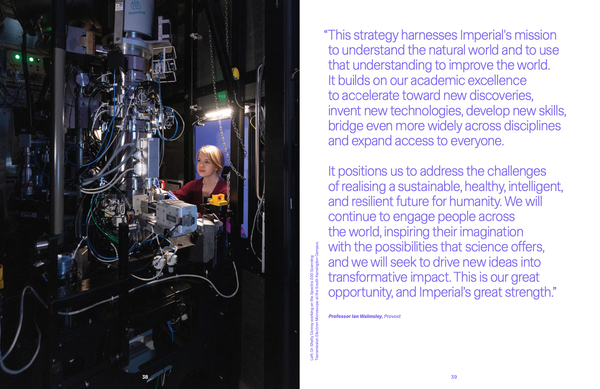
In mid-December, Imperial released its 2024-25 Annual Report, which records key events and data from the past academic year. In line with the College’s “Science for Humanity” strategy, the report was framed around Imperial’s mission to “make the world a better place,” in the words of College President Hugh Brady.
The document celebrated Imperial’s expansion, both within London with the WestTech corridor and internationally through its global hubs, and shed light on some key scientific research with a marked focus on health, space, and artificial intelligence (AI).
Emissions trends
Imperial’s scope 1 emissions, which cover CO2 released directly by on-campus activities, have risen by 72%, while its scope 2 emissions, which are indirect and include the impact of electricity used by the university, decreased by 47%. Imperial attributed these trends to the summer 2024 completion of the removal of the South Kensington campus steam network in favour of district heating – which should decrease emissions in the long term – as well as unusually low scope 1 and 2 emissions last year.
Scope 3 emissions, which account for emissions upstream or downstream of the College’s activities, encompassed 82% all emissions this year and rose by 6%. Imperial said higher emissions from procurement activities due to changes in its “pattern of spending” and methodolical changes explained this higher figure.
Gender and disability pay gaps
While the median gender and disability pay gaps decreased by 2.9 and 3 percentage points respectively, the mean gender and disability pay gaps increased. The mean gender pay gap inched by 1 percentage point to 15.8%, and the mean disability pay gap rose by 3.7 percentage points to 11.9%.
Imperial noted that means are “sensitive to extremer values” and wrote: “We remain committed to closing these gaps and will continue to review and refresh our plans across the university.”
Student headcount and nationality
For the first time in 20 years, the total student headcount decreased slightly in 2025, down to 23,248 from 23,311 a year earlier. Imperial put this decrease on account of the graduation of the larger student cohorts admitted during the Covid-19 pandemic.
The ratio of application to enrolled student numbers, a metric of intake selectivity, reached 9.8, higher than at any point since the pandemic.
Most students (39%) come from the United Kingdom, followed by China at 23%, India at 4%, and Hong Kong at 2%. Imperial intends to “diversify” its student intake, identifying India as a “strategic market”.
Overseas tuition fees represented 80.7% of the total tuition fee income, up from 78.8% in 2024.
No increase to President’s salary
The President’s total renumeration remained unchanged at £461 thousand, with a £10 thousand increase in basic salary offset by a lack of pension contributions. The President’s renumeration as a multiple of median pay for all other employees decreased compared to 2024.
Funding and endowment struggles
Imperial invested £110.8 million in 2024-25, of which 77% was funded internally. This contrasts with the year 2022-23, where half of the College’s capex was externally funded – Imperial recognised it was becoming “increasingly challenging to secure external funding for capital projects.”
The College’s Unitised Scheme, a vehicle containing a portfolio of diverse assets worth over half a billion pounds in 2025, missed its ten years’ annualised return target of 8.5, delivering only 6.9%.