
Fibres and spaghetti
The world’s thinnest spaghetti has been made by Chemists at UCL using nanofibre technology.

Chemists at UCL have recently cooked up the world’s thinnest spaghetti. Made at the nanoscale, the spaghetti has a thickness of 372 +/- 138 nm. Usual spaghetti has a thickness of roughly 2mm. For comparison, Capelli d’Angelo – a remarkably thin type of pasta translated as “angel hair” from Italian – has a thickness of 900 µm.
The nanofibres are made out of a starch-rich ingredient like flour – the basis for pasta – though the fibres themselves are not intended to be eaten as food. They were instead created by the team due to the wide-ranging applications that these nanofibres have in medicine and industry.
Due to the nanofibres being highly porous – which allows water and moisture in but any form of bacteria out – it has potential uses as a bandage to aid wound healing. The nanofibres may also be used as scaffolding for bone regeneration and for drug delivery.
The team’s findings were published in the Nanoscale Advances journal as a paper entitled, “Nanopasta: electrospinning nanofibers of white flour”. In the paper (which featured several figures designed with a particular Italian theme), the team used a technique called electrospinning to create the fibres. This takes threads of flour and formic acid and pulls them through the tip of a needle by an electric charge, akin to making spaghetti where one pushes a mixture of water and flour through metal holes. The only difference is that the tip of the needle spins during the process fibre-making.
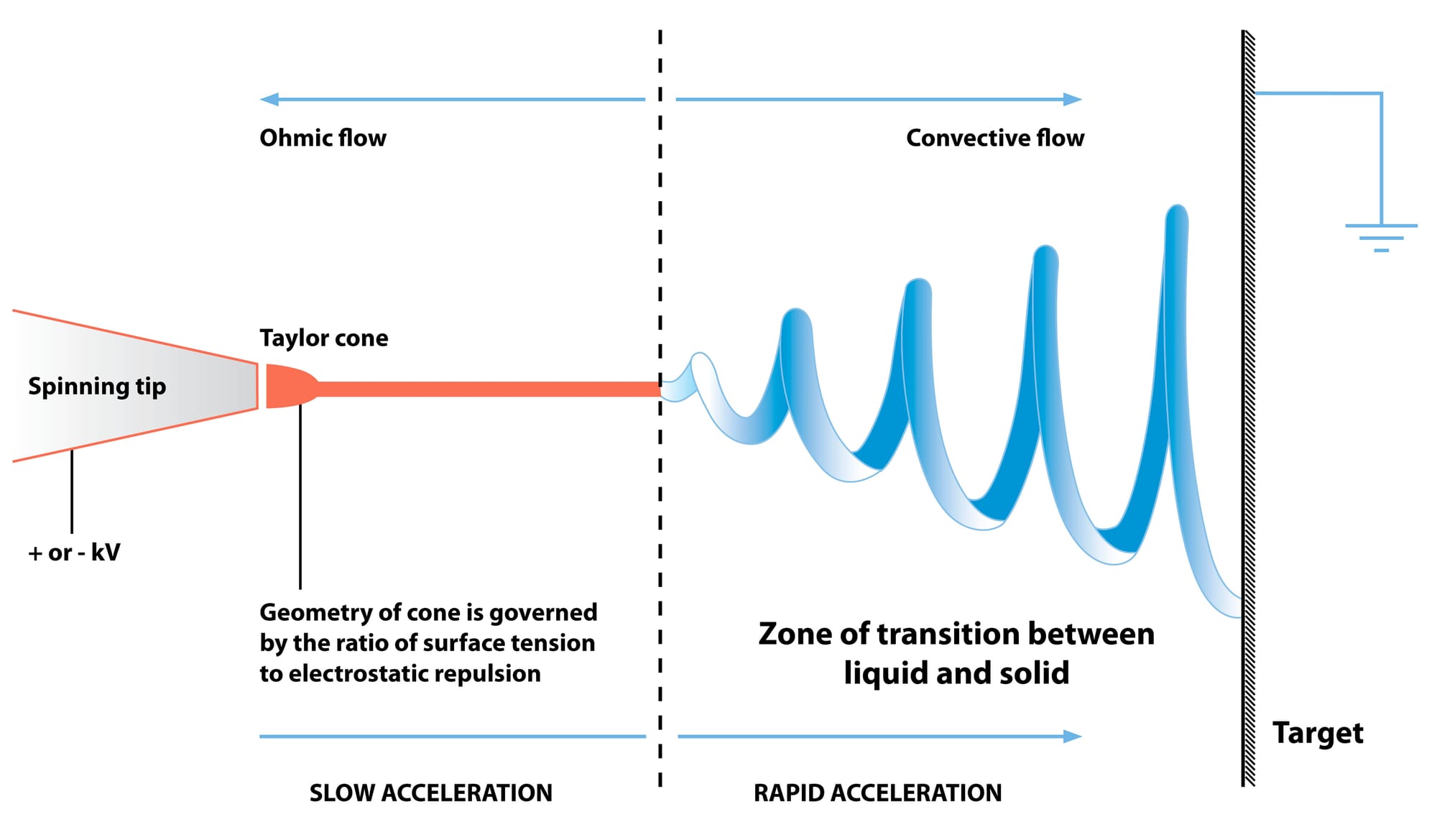
Electrospinning has gained a lot of attention in the last decade. This is not only due to its versatility in spinning a wide variety of polymeric fibers but also due to its ability to consistently produce them in the submicron range – which is otherwise difficult to achieve using standard mechanical fiber-spinning techniques.
Sadly, the nanofibres are unlikely to be useful as pasta. The team claim the fibres would overcook in less than a second, before you can even take it out of the pan.