Peptides are leaving the lab
The peptide craze is spreading from pharmaceuticals, to cosmetics, to online “shadow markets,” raising environmental and safety concerns.

There’s a high chance that the word “peptide” has featured on at least one of your local Tube station’s billboards in the last month. You’ll likely have been promised benefits like anti-aging, plumping, firming, and smoothing by the peptide-infused skincare products being advertised.
Peptides – short chains of amino acids which can be engineered to impact hormonal and metabolic processes – have long been a feature of our lives: insulin and GLP-1 are examples of widely-used peptides.
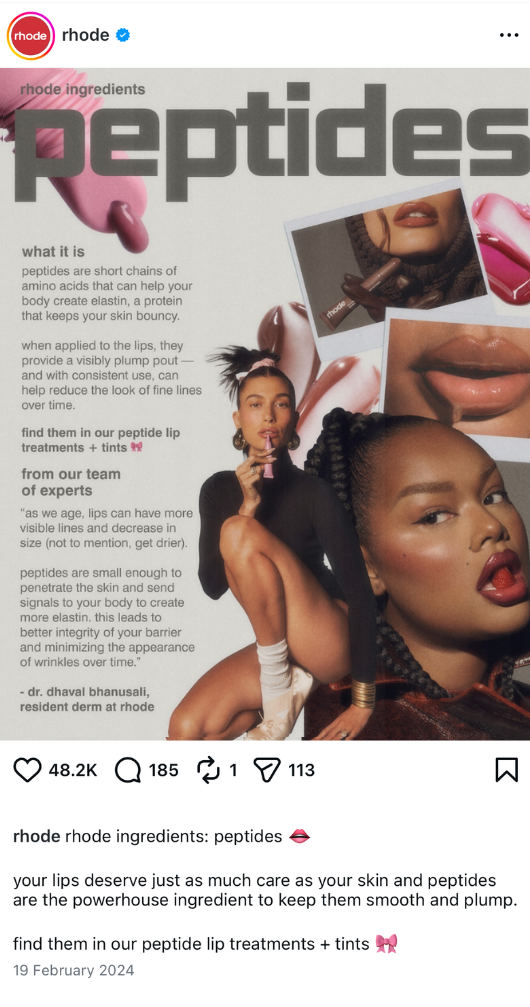
However, in recent years this growth in the pharmaceutical industry has spilled over into cosmetics. rhode, Hailey Bieber’s skincare brand, is a prime example of a brand going allin on peptides. It has capitalised on, and arguably magnified, the “clean girl” skincare trend, which emphasises “naturally” flawless skin, minimalist beauty routines, and ingredient-led marketing. rhode’s website features peptides as their top “research-backed ingredient,” promising to “visibly plump skin and reduce the look of fine lines.”
Ties to palm oil
rhode and many of its competitors champion their products as vegan, cruelty-free, and “clean” solutions. However, few brands mention that a large portion of their peptide ingredients – called palmitoyl peptides – are typically derived from palm oil, a material notorious for its contribution to global deforestation and environmental damage.
This is no surprise for the cosmetics industry: around 70% of products contain palm oil or palm kernel oil derivatives. However, reliance on the crop also exposes brands to reputational risks linked to deforestation and labour abuses, requiring additional steps to be taken (such as verifying compliance with sustainable palm oil certification standards) to mitigate these risks.
Croda Beauty Actives, one of the leading specialty chemicals companies that manufactures peptide ingredients for skincare companies like The Ordinary, Paula’s Choice and Medik8, states in its annual report that “palm oil derivatives form a significant volume of [its] raw materials and this trend is expected to continue.” It primarily sources its palm oil from Indonesia, a country that regularly makes headlines for widespread deforestation caused by its palm oil industry. Though UK-based Croda has a sustainable palm oil sourcing strategy, this can be a high bar for the growing peptide market to adhere to, especially in markets where sustainability regulations are less stringent.
Leaving the lab
Cosmetics brands like rhode already benefit from looser regulatory standards than their peptide-loving pharma counterparts. However, exploding demand for peptides in both markets is leading to another, more dangerous spillover: peptide solutions are now being sold through fully unregulated channels, with dangerous administration methods promoted on social media. Sports influencers have called for at-home injections of peptides to heal injuries; “looksmaxxers” are advocating the same, promising weight loss, hair growth, and bigger muscles.
The result of this exploding demand is an apparently vast “shadow market” of informal, low-cost Chinese peptide exporters, shipping their product to Western buyers in powder format. The origin of these untested peptides is often unknown to the traders, and domestic sales of the products has been banned by the Chinese government due to safety concerns.
Regulated peptide manufacturers must follow rigorous processes to remove harmful reagents and chemicals and purify their products to ensure their safety, says Nathaniel Chesworth, an Imperial researcher focused on synthetic biology and peptide therapeutics. For example, lithium can often be present in early stages of peptide synthesis, which can cause multiple organ damage if administered to the body. “You’ve got no guarantee that the powder you’ve received is the powder that they set out to make,” he tells me, “And you have no idea what these would do to the body if injected.”
Peptides aren’t going anywhere. But as their influence continues to bleed beyond the pharmaceutical industry into cosmetics and underground injections, regulators and brands may soon have to do more to back their “miracle” status.