Rabbits (2002)
A David Lynch feature: "In a nameless city deluged by a continuous rain... three rabbits live with a fearful mystery."
David Lynch’s 2002 series, Rabbits, is a reconfiguration of the sitcom format. Across nine episodes, three humanoid rabbits exchange fragmented dialogue inside a dim 1950s-style living room. The show mirrors sitcom conventions only to distort them; the oppressive lighting, stagnant blocking, and unsettling laugh track turn comedic form into something cryptic and uncanny.
Throughout the viewing, I was reminded of Richard Kelly’s 2001 masterpiece Donnie Darko, where the titular hero is haunted by a humanoid rabbit, Frank. He states that “destruction is a form of creation”, in reference to Graham Greene’s short story, The Destructors. This sentiment of X being the opposite of Y, but Y being necessary for the perception of X is reflected in the structure of Rabbits.
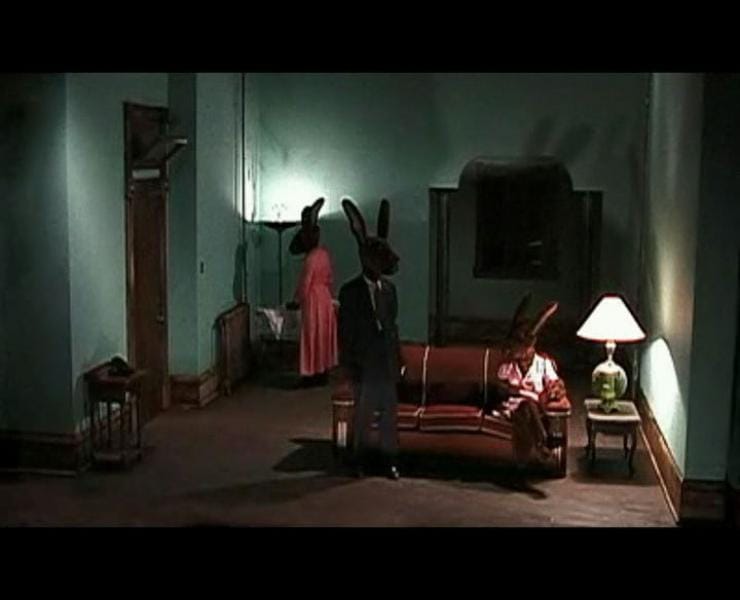
For one to understand why Rabbits is a surrealist work that disassembles the conventions of sitcoms, recognition of its place in the system of sitcoms is required. The dialogue exemplifies this refusal: a single conversation appears to have been cut apart and rearranged, leaving complete sentences in incoherent sequence. Though disorienting, the intentional fragmentation creates unity across episodes. The laugh track further critiques sitcom norms – its arbitrary eruptions highlight how sitcom audiences are cued to laugh rather than laugh at something genuinely humorous.
The three-character soliloquies, performed by Jane, Jack, and Suzie, emphasise performance over narrative. They recycle lines, expand on each other, and collapse meaning by ending with bows, revealing that these monologues serve not story but theatrical expectation.
Although told in nine ‘episodes’, the nonlinear, context-scrambled dialogue makes conventional sitcom chronology meaningless. Time references (“today is Friday,” “what time is it?”) trigger laugh tracks rather than clarify anything, reinforcing the erasure of temporal structure.
As a sitcom, Rabbits contains the necessary components – recurring characters, a central apartment, a laugh track – but empties each element of its usual narrative or emotional function. Where we would usually get character development, we get archetypal blanks; where we want plot resolution, we get ambiguity. Yet, the final image of the cast, together on the couch, imitates a typical sitcom wrap-up without revealing the supposed mystery that haunts the series.
In the end, Rabbits becomes both a sitcom and its critique: a minimalist, surrealist exploration of how far a form can be stretched before it dissolves. By pushing sitcom conventions into unfamiliar territory while retaining their outlines, Lynch creates a work that is simultaneously defamiliarising, humorous, and unsettling – an experiment in destruction as creation.