The impact of your daily coffee
While plant-based products are often have a lower environmental impact, coffee is one of the highest-emitting foods we consume at Imperial
Last year, Felix estimated the greenhouse gas (GHG) emissions Imperial generates from its food purchases. While plant-based products are often perceived to have a lower environmental impact, coffee stood out as one of the highest-emitting foods, in terms of both total emissions and emissions per kilogram.
On average, most studies estimate that producing 1 kg of coffee beans generates 28.5 kg of carbon dioxide or equivalent amounts of other greenhouse gases (kgCO2eq). In contrast, producing 1 kg of beef emits 99.5 kgCO2eq and 1 kg of chicken emits 12.3 kgCO2eq. Thankfully, individuals seldom consume this much coffee daily – a standard cup of black coffee is made with 15 g of beans, so your daily cup of coffee can be estimated to contribute 0.4 kgCO2eq of emissions.
But given the amount of coffee we consume collectively, it still bears questioning exactly how coffee production generates emissions. The processes accounting for the majority of emissions are: land use change, the use of synthetic fertilisers, and wet processing of coffee cherries.
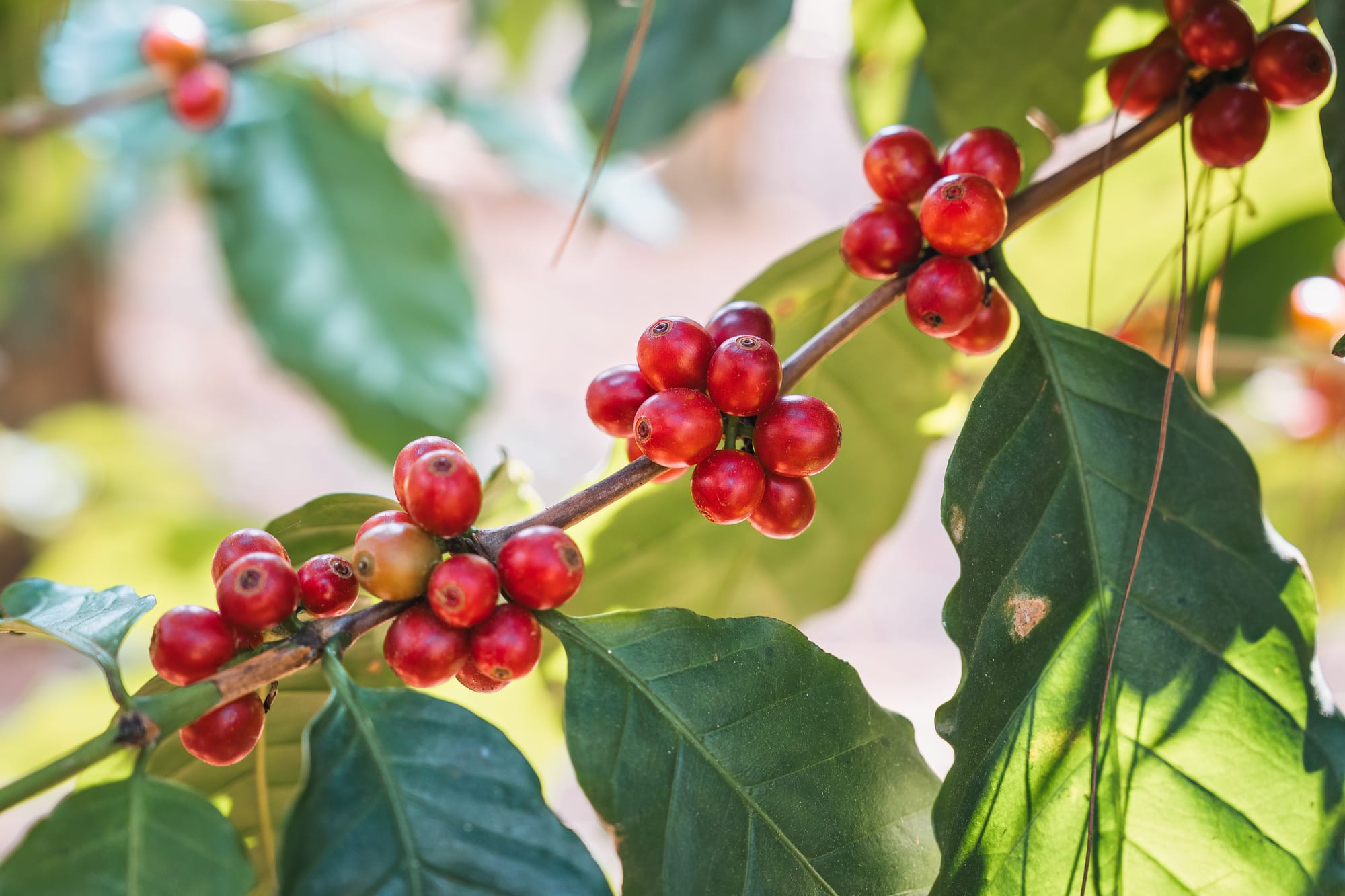
Land use change refers to clearing existing habitats, often forests, to farm coffee. Trees and soil store significant amounts of carbon which is released when land is cleared. Coffee production exacerbates this as it often occurs in the tropics, threatening rainforests, which have greater biodiversity and carbon storage capability.
Synthetic fertilisers generate emissions through their manufacture, transport, and use on fields. In particular, synthetic nitrogen fertilisers are partially taken up by soil microbes which then release nitrous oxide as a byproduct. Nitrous oxide is 265 times stronger than carbon dioxide as a greenhouse gas.
Wet processing refers to the extraction of coffee beans from coffee cherries, involving stages like fermentation, pulp removal, and washing, processes which generate significant amounts of wastewater. Wastewater accounts for most of the GHG emissions generated from wet processing, in addition to drawing on large amounts of water.
However, there can be significant variations between estimates of the emission intensity of coffee from different life cycle analyses – from 4.4 to 95.7 kgCO2eq per kg of beans. Some variations are methodological, for example in land use change modelling or the inclusion or exclusion of emissions from crop residue, but others are due to the diverse ways coffee is produced, demonstrating that changing production processes offers opportunities to reduce negative impact. Hence, these life cycle analyses highlight the impacts of different processes, allowing for better decision making.
Studies have explored the impacts of different systems, such as comparing agroforestry, where coffee is planted amongst other trees, to conventional industrial monoculture. The type of agroforestry also has important implications for environmental impact, depending on whether native trees are retained on the plantation or other tree species are introduced. Many studies have found that agroforestry that retains native trees results in better outcomes for biodiversity and carbon storage. Post-harvest, dry processing is a lower-emission alternative to wet processing for extracting coffee beans from coffee cherries.
Beyond coffee bean production, coffee roasting, brewing, and packaging also generate different amounts of emissions. Pod coffee and canned coffee were found to produce greater impacts than other forms of packaging. Although most studies and this article focus specifically on coffee, the milk that is often consumed with coffee also generates significant emissions, especially if dairy milk is used.
To reduce the environmental impact of coffee consumption, the more impactful changes are limiting land use change and fertiliser use, and switching from wet processing to dry processing, so these should be prioritised. Roasteries and cafes or brewers should choose to source from producers adopting lower-emitting practices and use renewable energy to reduce emissions from fossil fuels. For consumers, the Rainforest Alliance symbol certifies that deforestation has not occurred in the production process, amongst other sustainable production practices. Choosing coffee without milk or with plant-based milk also limits the additional emissions that milk contributes. Actions adopted by all players can shift the industry towards reducing its emissions and environmental impact.
Imperial’s new Sustainability Strategy (2026-2031) will come into effect this spring, outlining sustainable procurement in its Sustainable Food and Drink Policy. This strategy includes a sustainability criteria which makes up 20% of the scoring on major contracts, aimed at prioritising environmentally responsible suppliers.
Imperial has several coffee suppliers including Cafeology, Illy, Starbucks, and Change Please, a charitable organisation supporting people experiencing homelessness. These companies were chosen following ‘ongoing reviews’ with ‘reasons includ[ing] ethical and sustainable practice and sourcing; quality, flexibility and range of produce; competitive pricing; staff training, and equipment provision and ongoing maintenance.’
Cafeology is a Sheffield-based sustainable coffee company. They source their coffee primarily from smallholder farms in countries such as Colombia, Costa Rica, and Brazil. They roast their coffee in-house using low-gas heating methods and energy from the UK grid, which was 54.7% renewable in December 2025. Cafeology has previously stated their ambition to become carbon-neutral by 2025 in their scope 1 and 2 emissions although we don’t know if this target has been met yet. Furthermore, Cafeology have not disclosed their scope 3 emissions, leaving their climate impact not wholly understood.
Starbucks, another one of Imperial’s suppliers, was recently accused of unethical supply chain sourcing, following a 2025 lawsuit alleging ‘slave-like conditions’ in their Brazilian farms. In response Starbucks reaffirmed their sustainable and ethical sourcing commitments, setting out Coffee and Farmer Equity Practices developed with the support of Conservation International. However, repeated lawsuits against Starbucks over labour conditions suggest that these commitments need to be tightened and their implementation strengthened. For Imperial, having greater visibility down to the farm level where coffee is sourced may reduce risks of unethical sourcing.