
The transformation of venture capital for incumbents, entrants, and aspirants
The economics of venture capital has transformed fundamentally in the current AI investment cycle, how does it affect everyone in it?

AI startups have raised over $407 billion in venture capital funding in the first half of 2026, and in Q2 alone they captured more than 70% of the industry's capital. Crunchbase has hinted at the possible start of a "new venture cycle", a sign of strength demonstrated by funding increasing across every stage and liquidity increasing from IPOs and M&A. Yet, a deeper look reveals a less rosy landscape.
According to PitchBook, deals of $100M+ took more than 87% of H1 US venture dollars, and median valuations of Series A AI companies were at an 84% premium over their non-AI peers in Q1 2026. In parallel, the cost and pace of building have also dramatically changed in the era of AI tools. Carta has cited that the share of solo startups has doubled to about 36% in the last decade, and Supabase has found that 61% of startups have over half of their codebases generated by AI. The collapse in the cost of building, coupled with the soaring valuations as the market invests as if most AI companies are outliers, presents a unique change in the economics of returns for venture capital firms.
Additionally, the typical US fund launched in 2019 has only returned four cents for every dollar invested. This may have become a point of concern for limited partners (the passive investors in venture capital funds), as they have concentrated their capital on funds of $100M+ in the past year. Consequently, first-time fund formation is on pace to be the lowest since 2016, suggesting that the barrier to entering the industry has risen.
AI has changed what it costs to build a company and how a company is valued, while investors are also concentrating on top venture firms where most of the money already flows into AI. So how does the industry evolve with thinning capital for new entrants and the change in economics of startups?
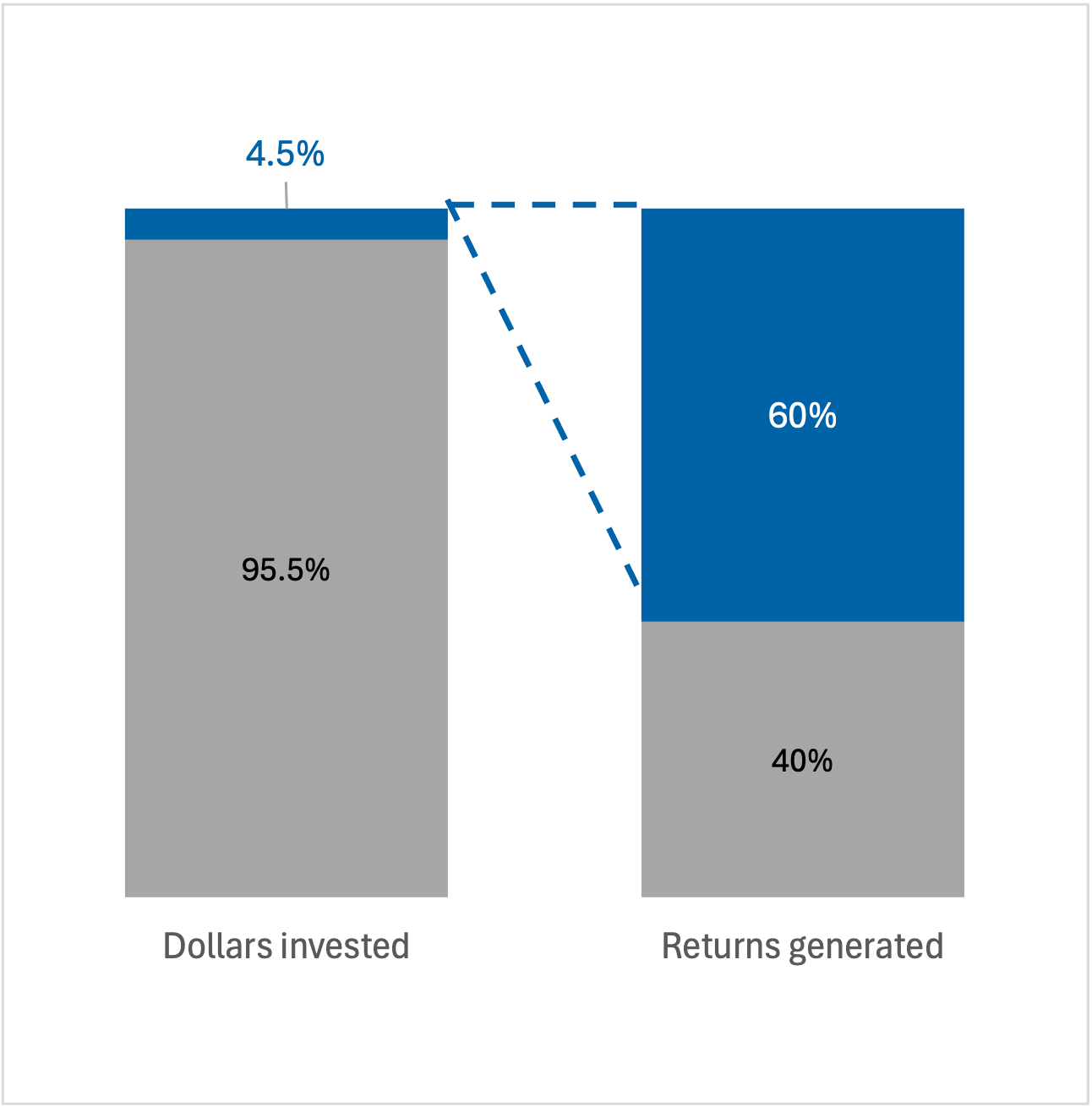
Each venture capital firm raises individual funds from limited partners and invests (through ownership and direct funding) across multiple companies with the goal of a couple of home runs (whose returns they redistribute periodically as they exit these investments through IPOs or M&A). a16z popularised this phenomenon with Horsley Bridge's data, labelling it the "Babe Ruth effect", where about 4.5% of dollars invested generate 60% of returns. The different investment rounds (pre-seed, seed, Series A, etc.) often correlate with the milestones that the company has hit, such as the first prototype, product-market fit, revenue scaling, and eventually an exit for the founders and investors. However, Mike Arpaia, Managing Partner of London-based Moonfire Ventures, highlights that "the fundamental supply and demand economics of how much capital it takes to build" changed rapidly, and a reckoning may be approaching.
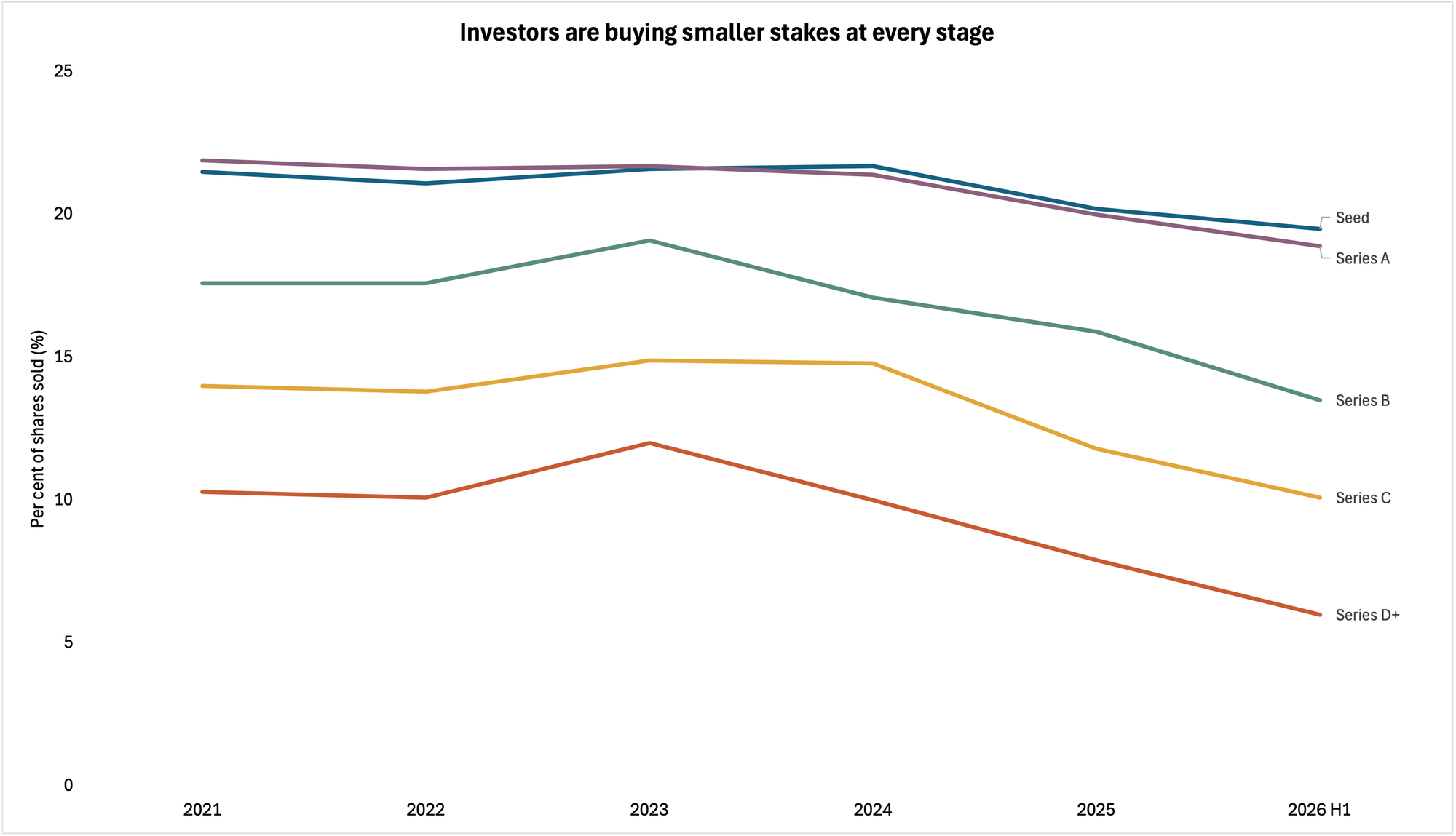
According to Carta, the share of the company sold in every round has dropped since 2021, by about 9% at seed and about 40% at Series D and above. So even if a fund invests in a winner, the company's exit must be bigger to return the fund. Additionally, fund returns have been increasingly concentrated at the top. Carta's Q2 2026 fund data showed that the top decile's total value to paid-in capital (which compares paper gains and cash returned with capital from limited partners) rose about 25 per cent in the past two years, while the median fund's TVPI barely moved. This presents a change in economics for both incumbents and new entrants, but the data shows that the pressure is much gentler at the earliest stages and early investors will also be diluted less in the future. The key becomes trying to identify the winners as early as possible.
Alongside the speed of identifying opportunities, the traits of traditional venture capital winners have also changed. A software startup that ships and iterates quickly is no longer enough. Many argue that the moat of a startup requires additional components that link to the physical world, such as biology or robotics.
As picking winners early becomes increasingly important for better exits, and moats become more difficult to defend, sourcing new deals becomes a core skillset that can no longer rely on traditional methods of network and word of mouth. From Arpaia's point of view, Moonfire's goal is to take the best venture capitalists in the world and the best machine learning technology to make a "team of four venture capitalists behave like a team of 400... or 4,000." Arpaia explains that Moonfire has developed a platform named "Launchpad", which aids heavily in their sourcing workflows. The company maintains several data pipelines using a proprietary multi-player orchestration system where colleagues can propose changes to how they source or evaluate founders and companies. They then have a library of screeners and evaluators that leverage machine learning and go beyond just LLM-based evaluation. Ultimately, the idea is that each colleague should "be able to select a saved query for a set of founders, add the default evaluators, and then add [their] specific founder evaluation mechanism." As the founders get filtered through the mechanism, the platform shows users opportunities and flags companies that need screening or outreach. This tech stack has allowed them to review up to 50,000 companies every week, which they claim is "600 times more than the average traditional VC". This AI-native approach allows their investors to rapidly test their hypotheses based on their own intuition, amplifying both the speed and reach of their work.
This system is an example of the next step that goes beyond the abundant surface-level AI tools. A notes summariser or AI-enabled CRM enrichment is now the state of play, but the biggest benefits come "when external data [is] augmented with internal data from the investors themselves," according to Daniel Wroblewski, former Chief Architect of EQT Group.
As the industry has evolved over the past few years, established funds have won more LPs due to a flight to safety, while some newer entrants have become lean and technologically amplified teams. But what does this mean for aspirants? Arpaia explains that "the thing that young people should strive towards is just being really well-rounded... and becoming really good at multiplying their capabilities with AI." Arpaia encourages people to become more "T-shaped," with deep expertise in a certain area along with a general well-roundedness. Each person in the Moonfire team brings something to the table that "levels up everyone around them," whether as a founder and operator or as someone with deep academic training.
Ultimately, Arpaia states that "even in a world with superintelligent artificial intelligence, there's always going to be some empty space between the limit of human understanding and the limit of AI understanding," and the most valuable people will be those who are the furthest ahead in understanding "the research frontier that the AIs have pushed us towards."