Our loyalties lie with the future, not the past
On our architectural legacy
Any group of students enjoying a pleasant summer’s day on the Queen’s Lawn would be encouraged to look around them at the surrounding architecture. It is fair to suppose that bewilderment and dissatisfaction will be more common reactions than, say, appreciation for a consistent architectural style.
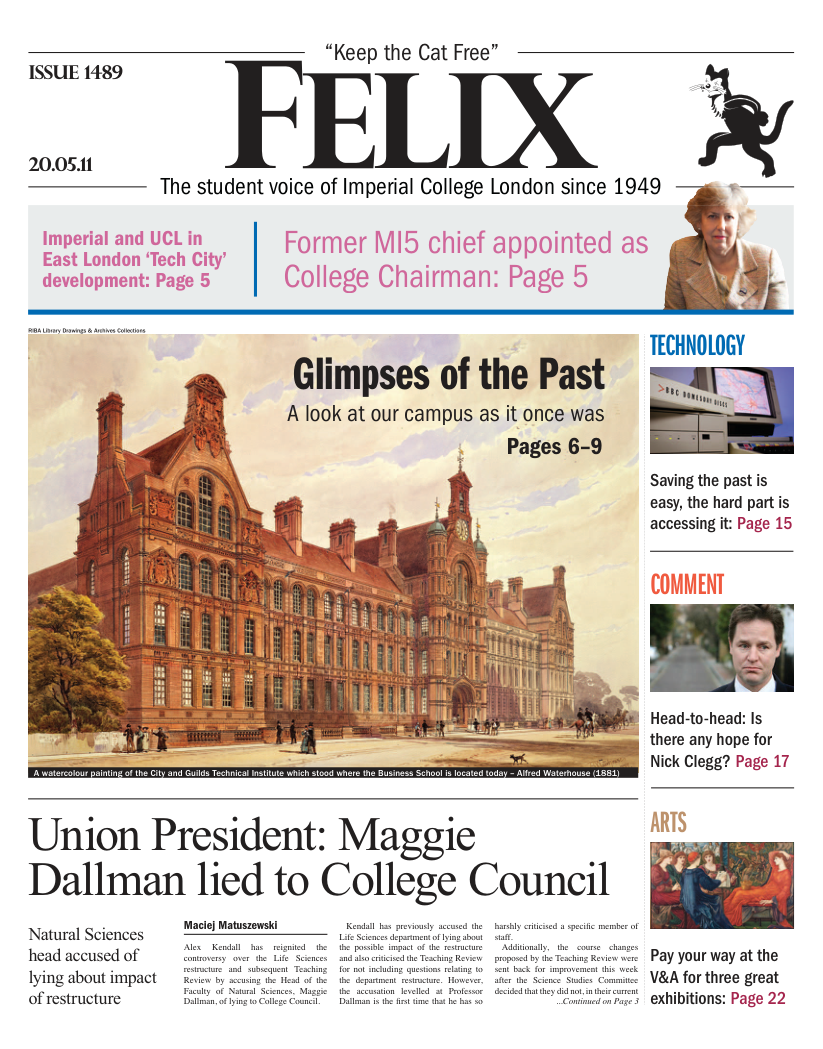
A common lament among students and staff at this university is that the administration must have lost its head halfway through the last century, when the awful folly was committed of tearing down most of the original campus. Nowhere is this visual mismatch more evident than on Prince Consort Road. The Royal Albert Hall, the Royal School of Mines, and the Royal School of Music, all fantastic specimens of Victorian architecture sit incongruously alongside the dreary Roderic Hill building and the Blackett Laboratory (the prefix ‘Royal’ would seem to be a convenient indicator of architectural worth).
It is worth understanding why the imposing buildings that once occupied our campus were dismantled and destroyed. Otherwise we might be inclined to entirely dismiss our predecessors as reckless Modernists, ignorant or uncaring of the cultural crimes they were committing.
Imperial College London was an institution of approximately 1,500 students, at a time of an emergency shortage in technical university places. The government at the time decreed that the College would expand to meet this national need, with little concern for the feasibility of such an increase. In particular, the buildings bequeathed by the Victorians were not fit for purpose.
What role could ageing though beautiful Victorian museums of outdated laboratory equipment play in the functioning of a modern university? Far better to decide, as the College administration of the time seems to have done, to spare no expense in building, say, the finest Physics department in the country.
There is indeed a touch of nobility in the arrogance with which this university decided that it had the authority, at that moment in time, to decide that such splendid architectural works were disposable in the name of progress.
This irreverence for irrelevance sharply parallels the aims of science itself: a scientist should have no regard for the toes stepped on in the search for truth.
The nature of science, after all, is to search for the depth of complexity which underlies the apparently simple. How perversely ironic would it be for us to pursue those aims in buildings whose facades were beautifully preserved but whose interiors were outdated and inefficient?