News

15.6 students fighting for each library seat

Analysis shared with Felix has revealed that Imperial College has a student per library seat ratio of 15.6, the second highest demand within the Russell Group. Imperial students are also more likely to visit the library to study compared to other Russell Group students.

Universities of a similar calibre and reputation to Imperial have much smaller student to seat ratios: LSE has a ratio of 6.8, the lowest in the Russell Group, Cambridge has a ratio of 9.6, and Oxford and UCL have ratios of 10.7 and 10.8 respectively. UCL and LSE are also part of the University of London, meaning students can access library spaces across the confederation. Imperial’s high demand is also 50% greater than the mean Russell Group student to library seat ratio of 10.4.
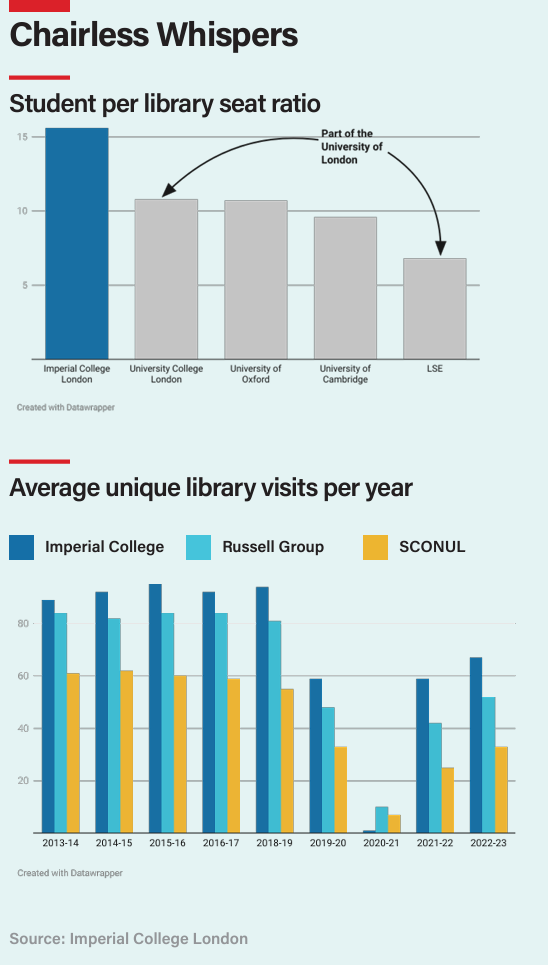
Demand for seats is much higher at Imperial as well. Despite a dip during the academic years 2019-20, 2020-21, and 2021-22 due to COVID restrictions, Imperial students on average tend to visit library spaces nine more times in an academic year relative to their Russell Group peers, and 33 more times per year than visits across the Society of College, National, and University Libraries (SCONUL), the professional association for academic and research libraries across the UK and Ireland.

The lack of library space is recognised as a problem: Imperial has increased library spaces across its campuses over the last few years, with the introduction of the GoStudy spaces within the Chemistry Building. In 2024, the Abdus Salam Library opened a new group study area on its 4th floor, and more solo and group study spaces were added to Hammersmith Hospital. Imperial plans to add library space to the Principal Academic Building in White City.
Feature image: Shadowssettle via Wikimedia Commons (CC-BY-SA 4.0)

Tagged in:

From Issue 1861

6th Dec 2024

Discover stories from this section and more in the list of contents

Explore the edition

Read more

Westminster Council holding consultation on changes to rent licenses

Westminster Council is holding a consultation on changes to rent licenses until January 2025. The consultation is on proposals introducing a selected licensing scheme for landlords to improve the quality of housing available within the areas of borough. The Council is proposing creating checks for landlords to ensure they are

By Mohammad Majlisi

Former Australian PM Julia Gillard at Imperial

Julia Gillard, Chair of the Wellcome Trust and former Prime Minister of Australia, delivered the Institute of Global Health Innovation’s Special Lecture in the Sir Alexander Fleming Building on Thursday 28th November. She examined the outlook for science and politics, tackling the implications for global cooperation on pivotal issues

By Nadeen Daka and Isabella Duchovny
Extinction for Sale: Neoliberalising Nature in Venomous Lumpsucker

Environment

Extinction for Sale: Neoliberalising Nature in Venomous Lumpsucker

The neoliberalisation of nature is an ideology that considers biodiversity and ecosystems as assets that can be priced, traded, and privately managed. It uses markets rather than public protection to mitigate the biodiversity crisis. Increasingly, this approach is being applied to climate and nature policy. For example, in July, the

By Bea Waters
TWIS 1/9/2026 Imperial quantum sensors tested in the Arctic

Science

TWIS 1/9/2026 Imperial quantum sensors tested in the Arctic

Global Positioning Systems (GPS) have become an essential part of modern lives for making travel convenient. Along with aiding navigation to unfamiliar places they also help understand real-time route diversions, delays, and congestion. However, this system is not fool-proof yet. Losing signal while walking into a subway, underground railway station,

By Radhika Dharap