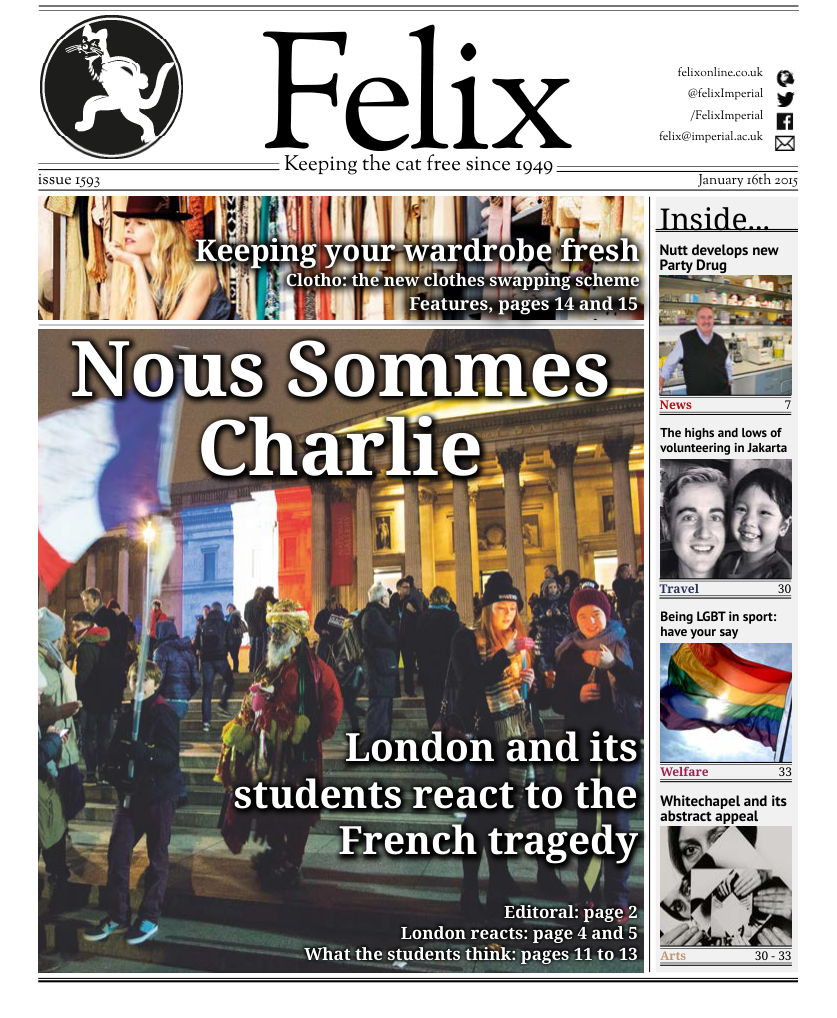
Most of us aren’t Charlie Hebdo
As a student newspaper, is it our role to offend our readership?

This week’s Charlie Hebdo poster features a cartoon man portrayed as the prophet Mohammed, crying and holding a sign reading “Je suis Charlie.” Above is the slogan “Tout est pardonné” (You’re forgiven).
Many Muslim people find this offensive. Not just because Islam forbids portraying the prophet in image, but because of the stereotyping of the image itself. A dark-skinned man with a skinny face, long thin nose and hagged beard – it’s a cliché. A stereotype. It’s reminiscent of drawings of Jewish people with big noses hoarding money drawn in 1930s Germany. It’s not subtle, just deliberately offensive, and very French.
In an open and free society you can say and draw what you want. In practice we all live with a certain degree of censorship, whether self-inflicted, culturally instilled, or by a government’s laws. In the UK it’s illegal to incite hatred against someone because of his or her religion. It’s illegal to defame or slander people. We self-censor – when _Felix _ran a Hangman article a few years ago about Chemistry students using Rohypnol to get a date, it was quite rightly slammed. As a student newspaper, is it our role to offend our readership? No – we’re supposed to represent the student community of Imperial; produced for the students, by the students.
This is why, along with mainstream media outlets, we’re not reprinting the images of the prophet. It’s needlessly offensive and if you want to see them a quick Google search throws them up.
This doesn’t mean it’s ever wrong for anyone to publish them. A design blog I follow reproduced it. It’s not possible for a design blog to ignore what is to become one of the most iconic magazine covers of the year and discuss why it is so, without also showing it; you can’t review offensive literature without reading it, or a film without watching it.
Should Charlie Hebdo be printing these images in the first place? If they want to, it’s their right. But as they are fully aware, they open themselves up to being justifiably criticised, often offensively. Interestingly, few seem to be doing so. Ironically, being violently attacked seems to protect them from insults themselves: no one wants to satirise murders.
Most of us aren’t Charlie Hebdo. We go through life thinking about what we say, being tolerant of others’ views, and doing our best to get on. If we truly were all Charlie Hebdo, then the world would be a worse place. In our global society it’s more important than ever to get on with each other. The internet, cheap travel, and growing economies are throwing cultures together and many of us are still learning. We’re a long way from the anti-Semitism of the 1930s, but we still have much to do. Recent polls of Jewish people living in Paris and the UK shows significant numbers of people fearing they have no future.
We all need to embrace the global culture we’re faced with. It’s important now, more than ever, that we are tolerant of the views of others, and also show respect for them. We need some Charlie Hebdos to remind us of our flaws, but it’s far more important to embrace one another’s own humanity.