40 year search for rare particle decay at CERN reaches a milestone
What does finding a Bd to µ+µ- (Bd to mu mu) decay mean?
The LHCb collaboration at CERN revealed in a seminar that they had found evidence of a Bd to µ+µ- decay, on 3 November. To most, that probably reads like some sort of code, but to a room full of particle physicists, it’s reason to celebrate. Particle physics is a a field where useful observations are a matter of minuscule probability, and equivalent to anomalies unless they are observed enough times to be statistically significant. Significant evidence of a decay that is effectively one in a billion is a milestone is how we collect evidence and it’s capabilities! And that is exactly why the above is so important.
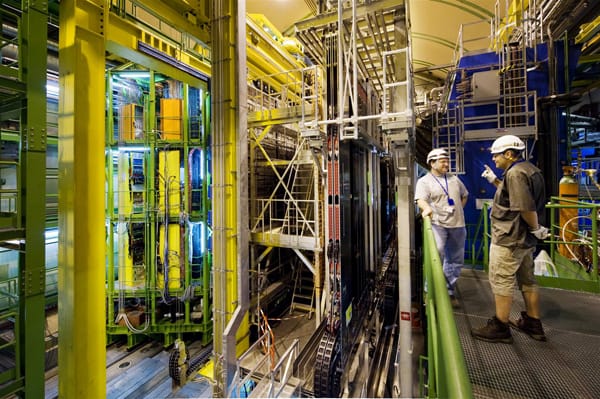
But to understand what this means, we need to talk about what CERN is searching for when they get readings from their twenty-seven kilometre particle accelerator . At the centre of particle physics is what physicists call the Standard Model, which describes the smallest particles that make up the universe. Smaller than an atom, and even smaller than protons and neutrons, there are quarks, two or three of which together could make a larger particle, and there are leptons, particles similar to or smaller than the electron, such as neutrinos or muons. Each of those particles has an antiparticle, which has identical mass, but the opposite charge. Finally, there are bosons, which appear during an interaction between these particles. If those sound familiar, you might be thinking of one of the biggest discoveries in Physics in recent memory: the Higgs boson! If so, you might be surprised to hear that the existence of Higgs boson was actually proposed in the 60s, as a particle to fit into the Standard Model that gives everything mass.
Each phenomenon that physicists study is some combination of particles that are in the Standard Model. It can be described by describing their each and every property, and the interaction between them through the bosons, which appear as fleeting carriers of the forces between the particles when they collide. In this way, it’s a very powerful model. We can use it to make highly accurate experimental predictions, from that of a collision between two particles, to the interactions that initiated the expansion of the universe.
Despite our reliance on the Standard Model, it’s still considered an incomplete theory. There are several phenomena that it fails to describe. Chiefly, it has no candidates for dark matter, which there is much more of in the universe than matter. It also doesn’t explain the abundance of matter compared to antimatter in the universe, which is incompatible with physics as we know it, but is in fact the reason we exist! Because of this, physicists continue to search for extensions to the model, theorising new particles and probing particle collisions.
The Large Hadron Collider beauty or LHCb experiment specifically probes the decay of beauty (otherwise known as bottom) quarks. Particles that go unobserved might not be detectable with our current equipment, but their interference in smaller interactions allows us to determine their presence. Many of the particles in these collisions are unstable, causing them to decay and transform into other particles. The reason for observing b-quarks is twofold: they take slightly longer to decay, which means they travel away from the collision and are easy to isolate, and even more so, they’re the subject of some extremely rare decays. The rarer the decay, the more sensitive it is to interference by undiscovered particles.
For this reason, the discovery of Bd to µ+µ- (which we can now understand as a beauty quark interacting with a down quark and decaying into a muon and its antiparticle) is a reason for celebration – it happens only about every 1 in 10 billion particle decays. Prior to this experiment, there was slowly mounting evidence that it existed, but as a result of a scientific effort to upgrade the LHCb’s precision and rate of data collection, the team has found evidence to support its existence with a statistical significance of 3.2 sigma (the standard for declaring a new phenomenon) within just one experiment. This outcome is extremely positive; it shows that the LHCb collaboration has reached a level of precision and a data collection rate that allows them to observe decays far more sensitive to unseen particles, and possible extensions to the Standard Model that could solve the universe’s greatest mysteries.