Above and Beyond
The journeys behind the Imperial team that produced NASA’s IMAP magnetometer, now probing a million miles from Earth.

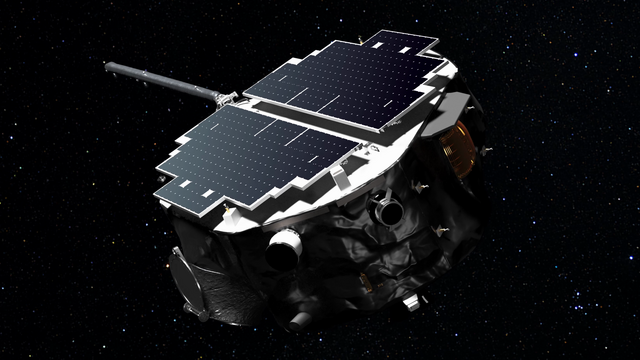
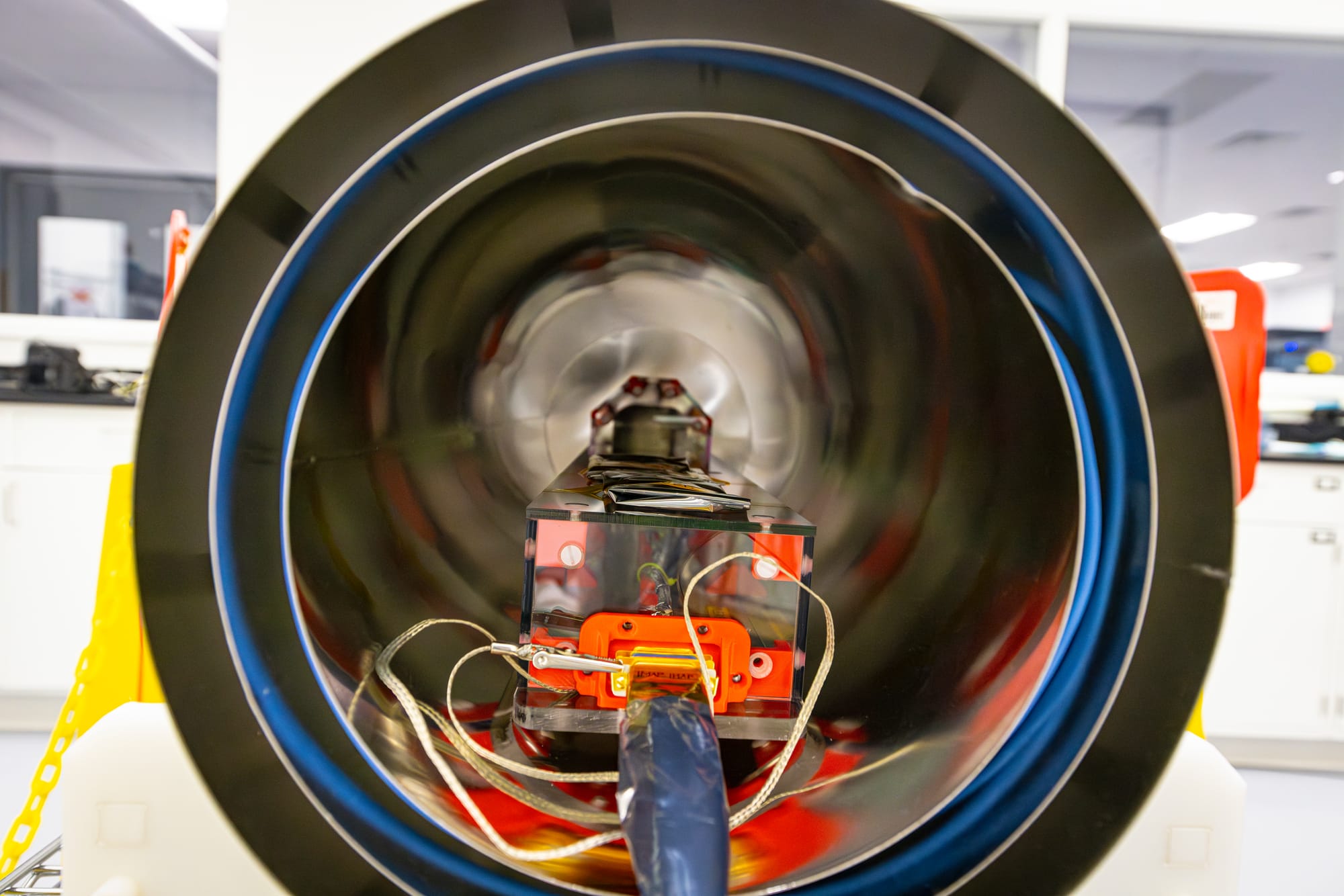
Last September, a SpaceX Falcon 9 rocket lifted off from the NASA Kennedy Space Center in Florida, carrying the Interstellar Mapping and Acceleration Probe (IMAP). IMAP contains a set of ten instruments, one of which, the magnetometer (MAG), measures magnetic fields in space and was developed by engineers and physicists at Imperial. The probe has since reached its destination one million miles from Earth towards the Sun and has begun its two-year probing mission on February 1st.
Tim Horbury, Project Lead and Imperial alumni: life around engineering
Horbury came to Imperial in 1989 and has been working here in most of the time since. The first space mission he was involved in was Ulysses, a joint NASA and European Space Agency (ESA) mission that launched in 1990. Horbury also worked on the Cluster mission, an ESA mission which launched in 2000 and studied the space environment of Earth.
Data from the Cluster mission was relayed very promptly back to Earth: “I remember I used to sit every morning on the train on the way to work and look at the data,” Horbury recalled.
Solar Orbiter, the first high-profile project he led, launched in February 2020 as a NASA and ESA collaboration, and in 2021 Horbury and his team started working on the IMAP mission. The team’s next project is an instrument for HelioSwarm, a NASA mission set to launch in 2029.
“There’s quite a lot you can learn from engineering for the rest of life as well,” Horbury explained. The team uses Gantt charts for project management to visualize their workflow. The critical path, which is the thing that’s slowing everything else down, runs through the middle of the chart. “Get off the critical path. It’s always the mantra.”
MAG Instrument Manager Helen O’Brien reflects on big missions in small rooms
O’Brien has been working at Imperial for over 20 years, after completing a degree in aeronautic engineering and briefly working in the oil business. Her first mission at Imperial was Double Star, a collaboration between ESA and the Chinese National Space Administration (CNSA), where she worked as an instrument engineer. She later transitioned to her current role as instrument manager. “It’s good in that I’m kind of in charge, but it’s bad in that I’m kind of in charge,” she said with a laugh.
She remembers the IMAP launch fondly, and recalls being most struck by the sound and vibration from the launch. “The light you see instantly, but it takes probably 20 seconds or so for the sound,” she recalled. “So, you see it go and then there is this real pause before you hear it and feel it. Your whole body shakes because it’s pretty powerful sound waves.”
She pointed out how impressive it is that the team builds hardware that explores the Sun and travels towards Jupiter and Saturn from just two rooms. “I think as a group we punch above our weight a bit really,” she said. “There aren’t many people that build things that go into space, and you can also build it in quite a small space. We do a lot per square meter of raw space here.”
Making it work: quality assurance and systems engineering
Chris Greenaway studied Physics at University and joined the team as a Systems Engineer and Operations Manager: “it’s a bit of a generalist engineering role...having a look at all the different parts of the system and making sure that everything fits together,” he explained as he described his position.
His most memorable moment was the first time they visited the Applied Physics Lab at Johns Hopkins University. “It’s the first time I’ve seen a spacecraft that I worked on up close, so it makes it real when you see it in the clean room, and you see everyone in their bunny suits walking around up to it,” he recalled. Bunny suits are worn in the clean room to prevent contamination: “it really puts it into perspective.”
He enjoyed the IMAP launch as well. “I thought I’d be nervous, but actually when you’re there, there’s absolutely nothing you can do, so it’s either going into space or it isn’t,” he said.
Mihir Bharatia works as a Product Assurance engineer, ensuring the instrument is reliable, functioning, and meets the necessary criteria. He worked for five years at Martin Baker as a Quality Assurance Engineer after graduating in Electronics. “I saw the job vacancy [at Imperial] open,” he recalled. “And [I thought] it would be nice to work [on] something that’s going to go into space.”
The launch represented a very special, tangible moment to reflect the extensive effort invested by the whole team: “it’s probably one of the best things I’ve ever done. It was unbelievable. Unexplainable.” One of the main challenges is traveling by plane to different testing sites, carrying the instrument in a briefcase with extreme care. “It’s the most careful I’ve been with anything in my possession,” he said. “My own laptop, I’m not that careful with it.”
Alan Roberts, Electronic & Electrical Engineer, reflects on the long road to space
Roberts studied computers and communications at Essex University. “I had a BBC Microcomputer that my grandparents bought me, and not many people had one of them in those days,” he said about his time at university.
He worked in research and development at Sterlite Technologies Limited for 18 years, until the telecoms bubble burst in 2000. “I survived 11 rounds of redundancies, but on the twelfth round, they got my whole department,” he said.
Due to this crisis in the engineering industry, he completed a plumbing course, but eventually got offered a job at E2V where he worked on thermal imaging, specifically regarding infrared cameras for the fire service. “The thing about infrared is if this room was full of smoke, your eyes couldn’t see, but you could see somebody [using an infrared camera]” he explained. “Do you mind if I just show you?” R
oberts opened a book on his desk and placed his hand on the first page. The infrared camera picked up his handprint, even as he started flipping through the book. The image started to fade only on page 21.
E2V sold the thermal imaging camera department, and he moved into designing devices that take pictures from satellites and spacecrafts. He started working with Imperial to help them solve some issues with the Solar Orbiter magnetometer. Ultimately, he transitioned to full time work at Imperial.
The launch felt like a real milestone and taught him to enjoy his successes. “It’s very easy to get sucked into the critical path and worry about the next thing,” he said. “But actually, sometimes, just go and have a pint. This is a moment. Do that more now.”
Michele Facchinelli, Madie Tomes, Alastair Crabtree, and Edward Fauchon-Jones are also part of Imperial’s magnetometer lab but were not available when Felix stopped by for interviews.