David Attenborough’s Wild London
Are London’s foxes, falcons, and frogs really intruders?
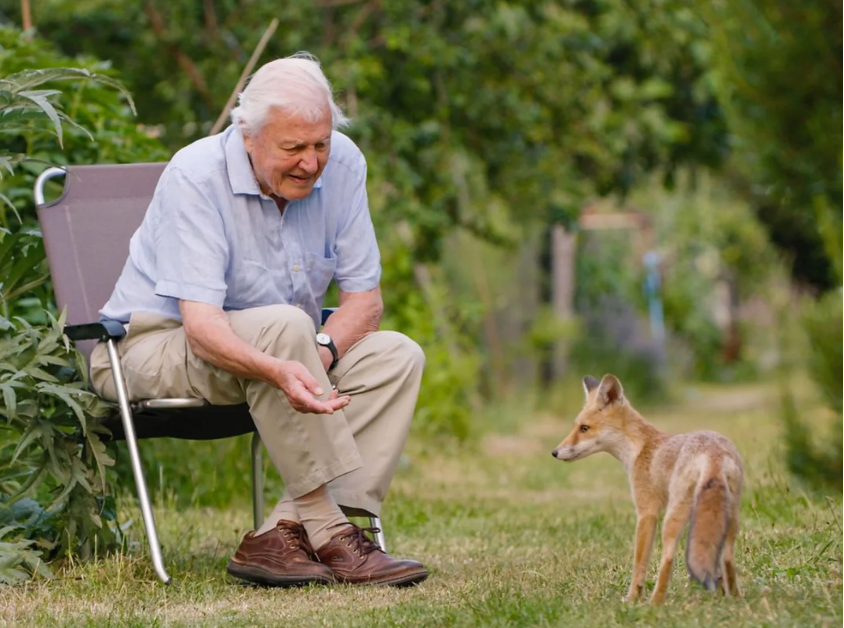
On New Year’s Day, the BBC released Wild London, a documentary narrated by Sir David Attenborough about wildlife in London and how it has adapted to live among us. Attenborough is known for taking viewers to the farthest corners of the planet, but this documentary challenges the notion that nature and cities are opposing forces, prompting us to rethink how cities can coexist with and support biodiversity.
Wild London presents the city as a mosaic of habitats, beginning in Tottenham, North London, and focusing on the city’s most recognisable urban animal, the red fox. Often dismissed as pests for rummaging through garbage, Wild London portrays them as highly intelligent and adaptive animals. These “experts operating under our radar” navigate London’s streets, gardens, and housing estates with a remarkable ability to survive and grow their population. They thrive in high-density areas such as London due to their behavioural flexibility, nocturnal habits, and the large amount of food provided by the city. By reframing foxes as cohabitants rather than intruders, this documentary asks us to reconsider our relationship with urban wildlife and step out of the mindset that nature only belongs in distant or untouched landscapes. It further illustrates that cities are not devoid of nature but selective environments that reward adaptability. Wild London shows how wildlife continually finds new ways to survive, reminding viewers that adaptation continues even in a human-dominated landscape.
The documentary later shifts its focus upward to the peregrine falcon. Large and powerful, this bird is one of the fastest in the world and resides in high buildings, including Charing Cross Hospital and the Houses of Parliament, which mimic natural cliff faces, providing ideal nesting sites.
These falcons have an inspirational conservation story: they were close to extinction due to the use of pesticides, but their population has now grown to over 50 pairs nesting in London, more than any other city in the world. Their recovery is directly due to the banning of pesticides and the London Peregrine Partnership. Unlike foxes, whose success emerged informally, the return of the falcons was driven by human intervention, proof that conservation efforts can be effective, especially in dense urban areas.
Similar success is seen in the native harvest mouse, which has a body length of 5-7cm and weighs about as much as a 20p coin; the documentary finds them in the Perivale Wood in Ealing. Through regular monitoring and rewilding with help from the public, they too can thrive in our city.
Beyond individual species, Attenborough reminds us that London is “one of the greenest cities in the world” with parks, canals, and gardens being vital habitats, allowing wildlife to thrive in plain sight. We should pause and recognise that the wild is not distant or necessarily exotic but is embedded in our daily lives. He teaches us a simple lesson: to learn about and appreciate the ecosystem around us.
For students living in the city, Wild London offers a grounding perspective on how environmental action does not only take place in rainforests or at global summits, but also happens in our local neighbourhoods and shared green spaces. It shows us that coexisting with wildlife is not only possible but already happening, should we only notice it. Overall, Attenborough’s Wild London is quietly optimistic and worth watching.