Does free entry truly democratise art?
This winter break was my first spent staying in London. A friend from abroad came to visit – an avid lover of art, happily unaffiliated with expertise – and I found myself playing the role of guide, leading him through the city’s museums and galleries. At each entrance, he paused, slightly disoriented. There were no ticket queues, no prices to consider. Tate Modern, the Design Museum, the Victoria and Albert Museum, the National Gallery: all free. His surprise reminded me how unusual this arrangement is elsewhere, and how quickly I had stopped noticing it myself.
Like Imperial students who pass the Natural History Museum or the V&A daily without lifting their eyes, I had grown accustomed to a privilege so embedded in the city that it had become invisible. Only through my friend’s astonishment did it regain its strangeness – and with it, a question that lingered throughout the week: does free entry truly democratise art?
London’s free museums are often framed as a moral achievement. Culture, once guarded by ticket prices and institutional exclusivity, is now made publicly available. Yet this openness did not emerge naturally. It was the result of deliberate political choice, sustained public funding, and a reframing of museums as civic rather than commercial spaces. Following the UK government’s decision to reinstate free entry in the early 2000s, admission charges were gradually removed, and free access to permanent collections became the norm. Over time, free entry came to feel less like a policy than a fact of life – an assumption folded into the city’s rhythm.
The effects were immediate. Visitor numbers rose sharply, and museums became part of everyday movement rather than special destinations. On the surface, this appeared to be an unequivocal success. Art was no longer something one had to justify spending money on. You could step inside for ten minutes, drift through a room, and leave without obligation. Culture became casual.
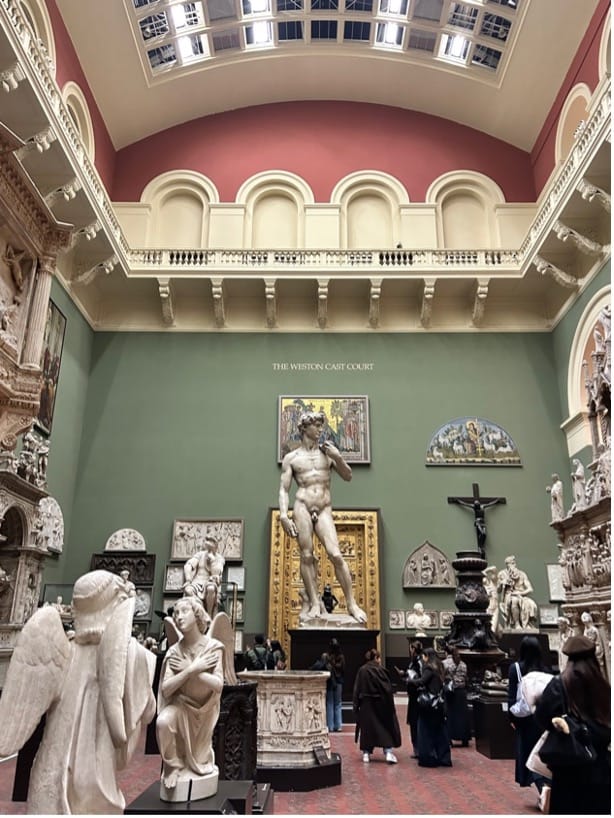
Yet, beneath this apparent openness, something more resistant remained unchanged. Despite the dramatic increase in footfall, there was only a limited change in the audience that museums were actually reaching. Studies consistently showed that the social profile of visitors shifted little, even as attendance climbed. Removing entrance fees did not dismantle deeper barriers. For many visitors, museums continued to feel intimidating: defined by monumental architecture,hushed atmospheres, and unspoken rules about how to behave, how long to look, and how much to know. The barrier was no longer financial, but psychological. Art belonged to everyone, but not everyone felt equally addressed by it.
Philosophically, this tension is not new. For Kant, aesthetic experience belongs to a realm beyond necessity: it is grounded in disinterested pleasure, where attention is freed from immediate utility. Art is not required for survival, yet it shapes how the world is felt rather than merely used. Schiller extends this idea further, arguing that aesthetic experience is not a luxury added once material needs are met, but a condition of human freedom itself. Only through the cultivation of sensibility, he suggests, can individuals move beyond mere labour and necessity into a genuinely free relation with the world. To encounter art fully, therefore, requires more than access – it requires time that is not borrowed from exhaustion, and a disposition slowly formed rather than abruptly demanded.
Seen from this perspective, it becomes clearer why other societies have approached cultural accessibility differently. In some countries, art is introduced early and routinely, woven into education so that it becomes familiar before it becomes intimidating. Elsewhere, accessibility is pursued less through museums than through public space – through architecture, design, and public art that accompany everyday movement rather than interrupt it. In such contexts, art does not announce itself as something to be interpreted correctly; it simply exists alongside daily life.
By contrast, London’s free museums can feel paradoxically concentrated. They gather vast collections into singular, monumental spaces and ask visitors to summon attention, energy, and cultural fluency all at once. For those unaccustomed to these environments, the museum does not feel like a continuation of daily experience, but a separate performance: one that requires preparation as much as curiosity.
London’s free museums, therefore, reveal both the ambition and the limits of cultural democracy. They stand as powerful symbols of openness, generously funded and widely admired, while quietly reflecting inequalities in education, leisure, and time. Art may be free to enter, but not everyone arrives with the same capacity to pause, to linger, or to feel addressed by what they see.
Perhaps the question, then, is no longer whether museums should be free. That feels settled. The more difficult question is whether we have learned how to build a culture around them: one that distributes aesthetic experience more evenly across life itself, through education, public space, and design.
This complicates what we mean when we say art should be accessible. Accessibility is not simply a matter of entry; it is also a matter of time, familiarity, and confidence. It assumes the freedom to linger without urgency, to misunderstand without embarrassment, to look without feeling watched. For someone working long hours, with limited leisure, and little prior exposure to art through education, a museum visit after work may feel less like an invitation than an extravagance. In that sense, free entry does not level the ground – it merely removes the gate.