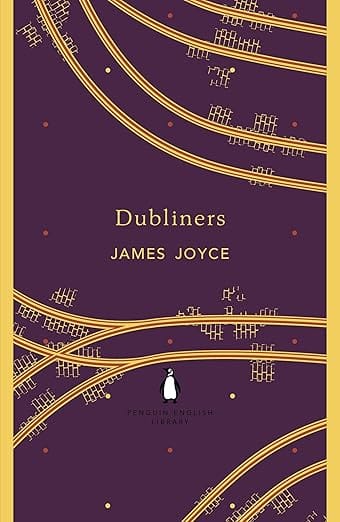
Dubliners
Few authors in the Western canon are as inaccessible yet enjoyable as James Joyce.

Few authors in the Western canon are as inaccessible yet enjoyable as James Joyce. Notwithstanding the insanity of Finnegans Wake – his final work atttempting to reconstruct language, and taking modernism through what I suppose is its natural progression, but also beyond the pale of readability – Joyce is a great author, one of the few essential authors to read. He is funny, intelligent, freaky (read the fart letters to his wife, and the chapter Nausicaa in Ulysses), and full of allegory and metaphor.
To read Joyce feels like opening up a bottomless treasure chest, blinding one with its lustre. One wants to understand, to comprehend as much as possible, and his command of the language is beyond brilliant: author Vladimir Nabokov, another master of English prose, described Ulysses as “a splendid and permanent structure.”
Dubliners is the easiest and most accessible book for the modern reader. Comprised of 15 short stories with relatively simple prose, one can pick up each story and finish a story each day, even across their commute.
Intended as a cross section for the lives of the Irish middle classes in the 1910s, every story is extremely, almost painfully at times, human. One reads about drunkards, lovers, priests, and more in brief snippets of their lives. The complex intricate webs of their lives are presented without comment by Joyce, who withholds judgement, purely presenting their actions and masterfully introducing the context for the tragic paralysis gripping many of them.
The Dubliners across the collection are for the most part gripped, almost frozen in their lives and actions, without any chance of salvation or escape from the cycles they are trapped in. Dubliners is beautifully tragic in this regard: take “Araby” for example, where a young boy who is infatuated by his friend’s sister first tastes the pangs of disillusionment; or “Clay,” where Maria, an old maid, grapples with the pangs of loneliness as her former charges have grown up and had children of their own. Themes of religion and religious disillusionment are discussed in “The Sisters” and “Grace,” both used as vehicles to discuss Joyce’s disillusionment with the Catholic Church.
Through his 15 stories Joyce manages to create a comprehensive world and picture of Ireland at the turn of the century, and manages to so eloquently and perfectly capture the sadness associated with the human condition. He exhibits his mastery of the short story form. It is essential reading, and is a great way to access James Joyce, purely to experience great literature.