Greenland: Donald Trump’s latest real estate deal
Comment writer Bahaar discusses what happens when strategic necessity trumps international law.
Are you a global superpower looking to expand your influence in a newly opened Arctic? Look no further than Greenland! The last two years have been big for this island – an autonomous territory within the Kingdom of Denmark – which serves as a gateway to the Arctic Ocean.
The United States’ interest in Greenland is not a recent development; the location proved optimal to widen their growing empire and to spy on the Soviets during the Cold War. The US convinced Greenland’s (then) colonisers, the Danish, to help evict an Inuit community so they could develop airbases and even hold nuclear weapons there. This expanded to multiple bases across Greenland over time.
As the Cold War ended, the US mostly abandoned Greenland, retaining only their key air base – Thule Air Base – which now serves as the base of their Space Force. The US even closed off their consulate in the capital, Nuuk, in 1953, but re-opened it in 2020, after President Trump first considered purchasing Greenland during his first term.
Greenland has been attracting growing attention as ever-increasing global temperatures cause Arctic Sea Ice to melt, creating new trade routes, new access to resources and thus new geopolitical influences. Greenland is being transformed from a desolate frozen island to a perfectly located opportunity for enticing shipping lanes, with territorial waters filled with resources and a repository of rare earth elements (REE).
With over 1.5 million tonnes of proven resources and estimates of a further 36 million tonnes, it’s clear that the US is fighting for control to eventually diversify supply chains of REE from the current near monopolist, China.
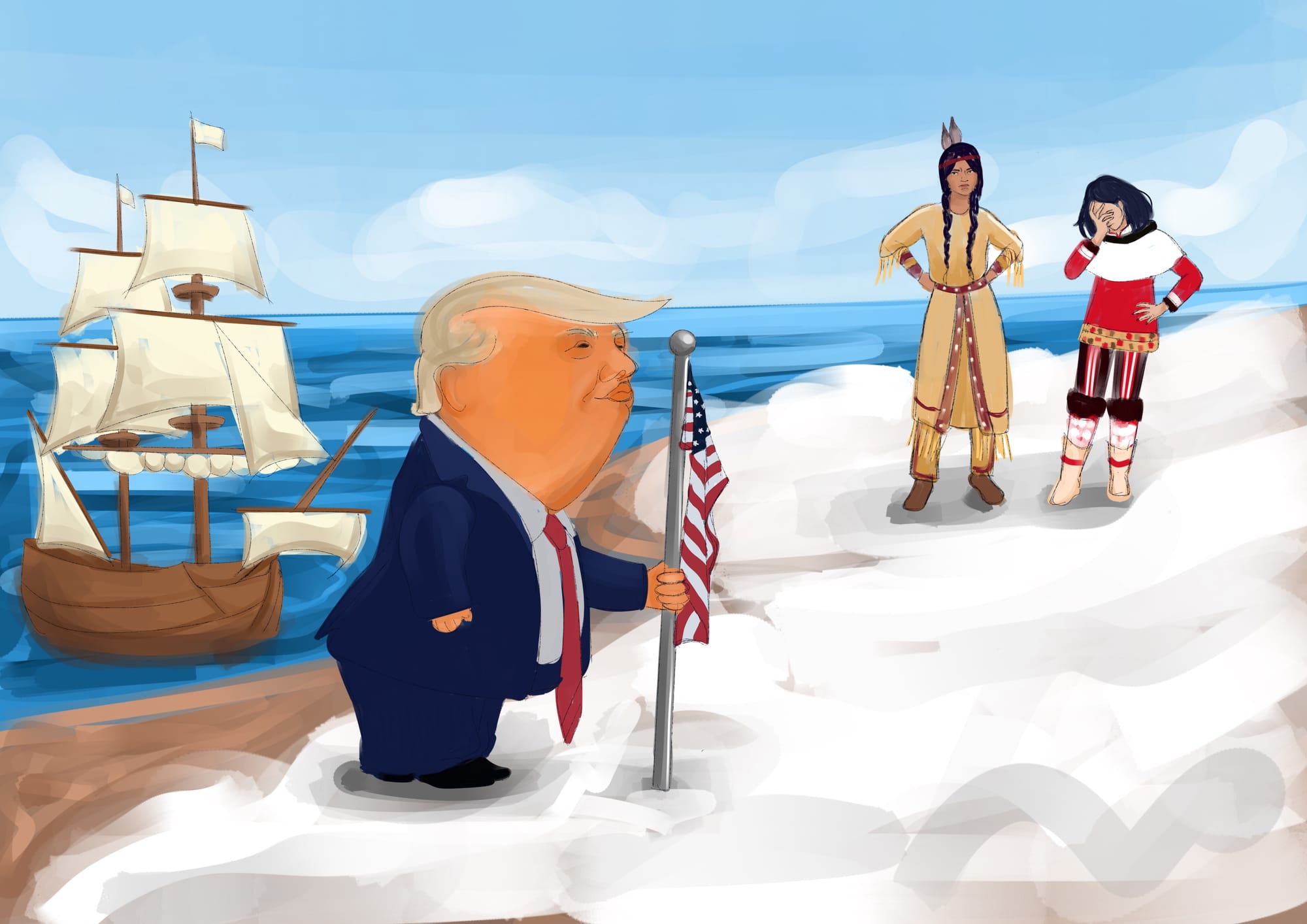
Trump’s passion for acquiring Greenland should therefore come as no surprise – he spent most of his life finding real estate deals on land that was about to become valuable!
China’s growing efforts to establish a presence in Greenland are a clear motivating factor behind the Trump administration’s interest in the island. From sponsoring airport construction in 2017 to funding zinc and lead mining projects in northern Greenland, China has been consistent in its efforts to get a foot in the door. Both initiatives were shut down after the US exercised its veto power. The US even successfully applied diplomatic pressure in Denmark to revoke mining licenses held by Chinese companies in 2021.
Since the beginning of Trump’s second term, the president has been doubling down on the comments he made in 2019 regarding the acquisition of Greenland. But the US using its position and power to advance its imperial worldview everywhere is nothing new, and it is striking to see Denmark not just panicked but surprised.
For years, Denmark has been complicit in US efforts to reshape regions under the aegis of international peace and security. From justifying the unlawful invasion of Iraq in 2003, to the most recent example of this hypocrisy seen in Gaza, Denmark has actively helped the US dilute the arguments for international laws time and again. Along with Denmark’s continued silence regarding the injustice that destroyed Gaza and the spirit and life of those residing there, in the name of Jewish allyship, Denmark has also been one of the biggest war machinery suppliers via companies like Terma.
Clearly, Denmark has played a significant role in embodying the conditional nature of international laws and the so-called “rules-based international order” on power and influence. The only difference is that this time, Denmark is on the receiving end of the imperial violence. With the US using the same arguments once used to justify the conflicts in the Middle East, from ‘strategic needs’ to ‘security concerns’, this seems to be a moment that should serve as a lesson for Denmark on the limits of moral selectivity.