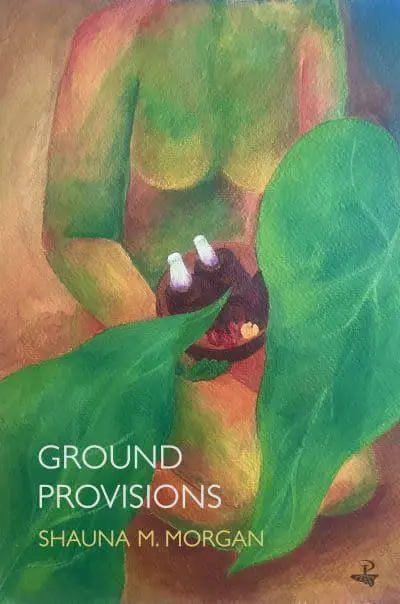
Ripples and Waves in Ground Provisions
Imbued with language reminiscent of vibrant flavours, golden hues, and a warm breeze, Ground Provisions tackles ancestry, culture, sensuality, and family. Shauna M. Morgan grew up in Clarendon, Jamaica, before relocating to the United States for university and becoming a celebrated academic in the realm of Africana literature.
Throughout her first poetry collection, she manages to describe the conservation of her culture in a foreign, unsympathetic territory. In the poem “Growing and Weeding”, this adjustment can be interpreted in imagery that describes the growing of a new home while dealing with losses of everything that hallmarks our ancient home. Sensory imagery renders every verse succulent; part of the challenge can be deciphering the beautiful language and looking past its richness to establish a personal connection to the poems.
reminiscent of vibrant flavours, golden hues, and a warm breeze
Morgan underscores her concern with “aesthetics”: “I do spend a lot of time in a space where I’m thinking about words, looking at the words, seeing and hearing how they sound, and finding ways I can use sensory elements.” These elements masterfully transport the reader to a blossoming garden or a dark street corner, and they frame messages of inheritance resistance, and of new traditions harbouring remnants of ancestral rituals.
“A Mum Brings Her Daughter Home” speaks of a divide in culture between generations, expressing the confusing, intermediate feeling of coming home a new, changed, almost foreign self in the description of “a mother’s alien home.” The oxymoronic new familiarities of a return are so understandable to members of an international community like Imperial.
Reconnection with home through others is also explored in poems that deal with migration; borrowing memories and appropriating them to stitch them into the worn patchwork of one’s own fading remembrances of home is delicately expressed as fireflies and wooden porches serve as reminders of ancestry. Natural elements furthermore eloquently symbolise family dynamics in “Triveni Flow”, where the flow of a river is reminiscent of a brooding paternal silence, smoothed and shaped by a maternal ripple.
When not handling familial connection, Ground Provisions tackles issues of race and police brutality. Scars of trauma and their generational impacts get portrayed in an image of an innocent snowball fight getting distorted from a playful childhood memory into a thawing terror; “Perpetual Winter” reminds readers of the pains endured by youth in a divisive social setting.
There is little this collection does not handle: connection between mind and body inter- and intra-personally is another major theme. Landscapes of a human body are paths followed by parents and lovers to establish intimacy. Maternal affection, for example, is characterised in “Mirror Song”, a poem dedicated to parents of all nonverbal children, partially through the physical resemblances, and partially through uplifting descriptions of a communicative “song.” The laughter, claps, facial expressions, and hums are presented as a language more intimate than spoken words; a parent sees themselves in the crevices and bends of their child’s features and develops a connection infinitely profound with them – “The mirror laughs, dainty hands clap a knowing beat.”
Ground Provisions is raw and honest, as intended by Morgan; it conveys a truth about interpersonal relationships, alienation, and love, leaving just the right amount of abstraction for the reader to connect their story to the author’s. “I engage nature and there are ways I try to render nature on the page in beautiful ways, but that’s not enough; there is some truth that must be told,” says Morgan, and every line in Ground Provisions is proof that she means it.
A copy of this collection was sent to Felix by the publisher, Peepal Tree Press, for review.