Exploring Imperial students’ relation with internships
Survey run by Felix finds that while students tend to enjoy summertime work experience, seeking opportunities is a highly stressful deed.


At the end of last term, Felix circulated a survey asking students about their experiences with internships, and collected 112 answers between November 7th and December 12th, 2025.
93% of students who answered studied at the faculties of Engineering or Natural Sciences, and 88% were undergraduates.
Although the survey was only advertised on our channels, responses were anonymous and whether all respondents really were Imperial students cannot be verified.
For the purpose of the survey, an internship was defined as “temporary work experience undertaken between academic years”. Students referred to a range of experiences, from mandatory internships to UROPs.
The pipeline
Overall, 82% of students reported applying for an internship of any kind in the past, while only 63% reported obtaining one. This is higher than the national average – a January 2025 report by the Sutton Trust found that 51% of UK graduates reported ever doing an internship.
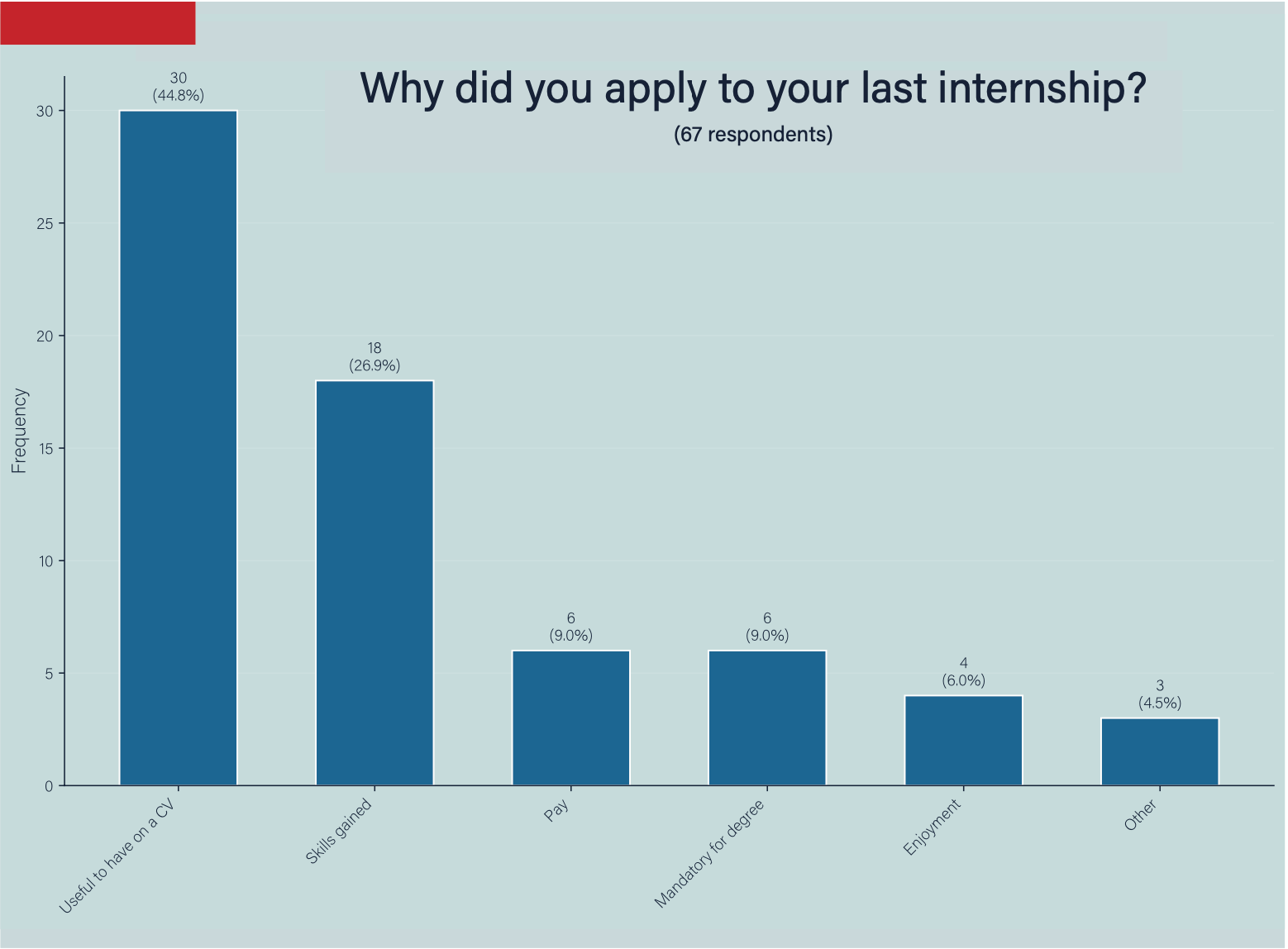
The survey’s following section focussed specifically on respondents’ most recent internship. Most students applied to their last internship because it was “useful to have on a CV”. The next most common incentives were acquiring new skills and financial incentive. Less than one in ten of these internships were mandatory degree requirements – industrial placements are compulsory in Imperial courses such as the Computing MEng.
On average, students waited for approximately 3 months after applying for an internship before obtaining it. Where interviews were required, students typically went through 2 rounds.
The 87 respondents who applied for an internship in 2025 submitted a cumulative 1132 applications for internships. Our first plot shows the experience of our respondents last summer at each stage of the internship pipeline: application, interview, offer, and acceptance. The most perilous stage of the pipeline proved to be the initial selection, with less than one in five applications receiving an interview. (22% of students noted that their last internship had no interview stage.)
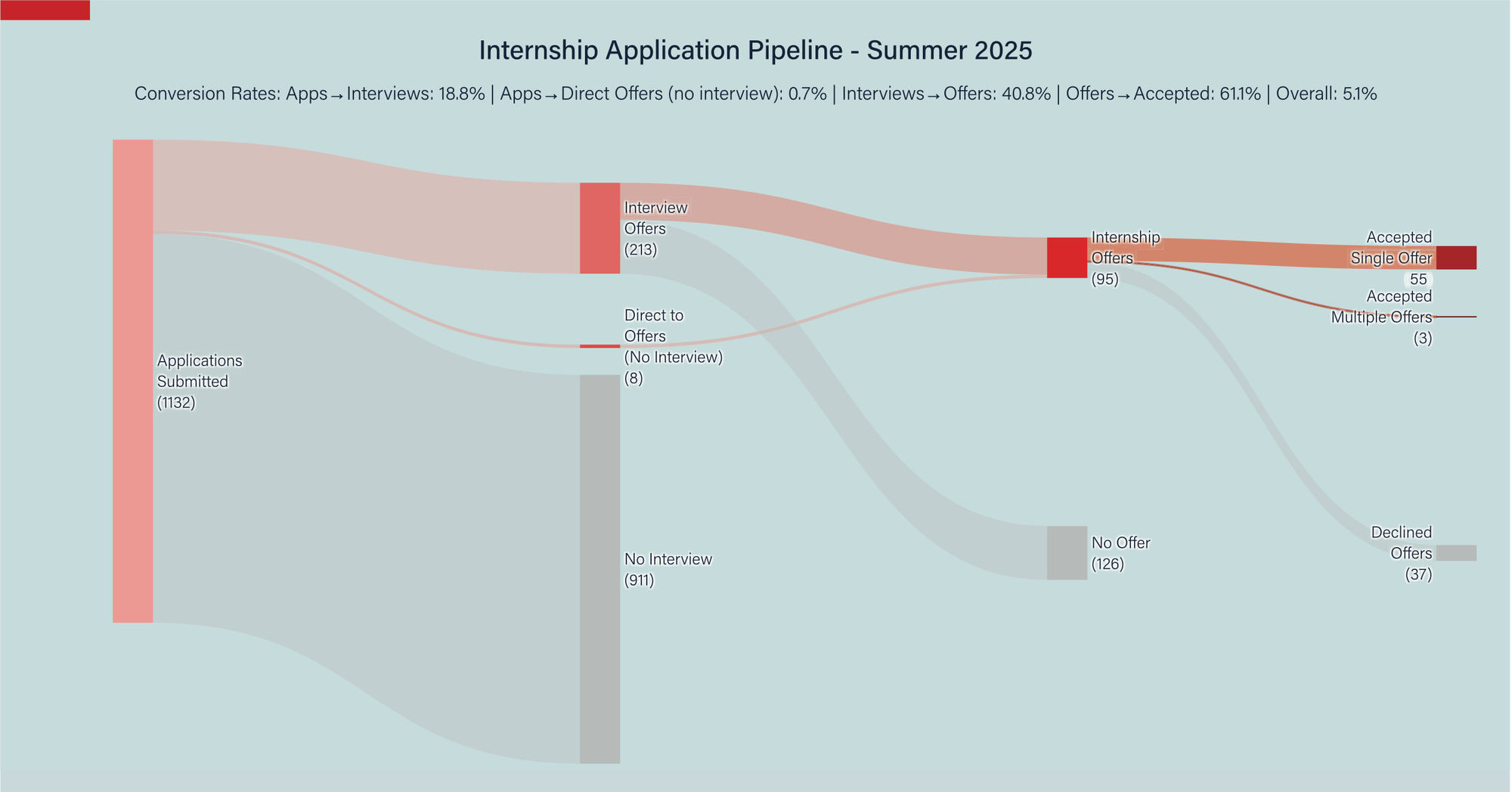
As applications move along the pipeline, the chance of getting to the next stage only increases. Having made it to the interview stage, applicants have a 2 in 5 chance of receiving an offer. Further, only 61.1% of offers received were accepted, suggesting that internship offers were unequally distributed among applicants, with some receiving multiple.
CVs were required in 90% of cases, and interviews in 78%. Students were only asked for cover letters in 46% of cases. In spite of psychometric tests being largely uncommon (27%), they are least likely to be required when a cover letter is required too.
22% of respondents said they obtained an internship through their family or family friends at some point in their life.
At work
56% of respondents had a positive experience during their last internship, with only 10% reporting they didn’t enjoy it. 52% felt useful during the internship, while 21% did not.
Almost a quarter of respondents (24%) said they interned in a different field to that of their degree. With a single exception, all students who interned in financial services or consulting (companies such as Jane Street, Bain & Company, or Goldman Sachs) were engineers. Two students said they interned at Imperial College spinout startups.
87% of respondents said that their last internship was paid. In the UK, interns are entitled to receive the National Minimum Wage (NMW), except if their internship is a mandatory part of their degree, or if they intern at a charity under specific circumstances. The 2025 Sutton Trust report found that 35% of graduates overall have completed internships for which they were unpaid or paid below the NMW.
Workload, pressure, and stress
Roughly 32% of respondents report spending more than 6 hours a week preparing for and applying to internships opportunities, with 13% even reporting as much as 11 hours a week or more. To put this into perspective, Imperial recommends that 125 hours be spent, in total, when studying a 5 ECTS module. Assuming such a module is run over approximately 10 weeks, this corresponds to a recommended 12.5 hours of work per week. Therefore, roughly a third of respondents spend at least as much time applying to internships as they would for working for half a module. Internship preparation and applications is therefore a significant addition to the workload of the average Imperial student.
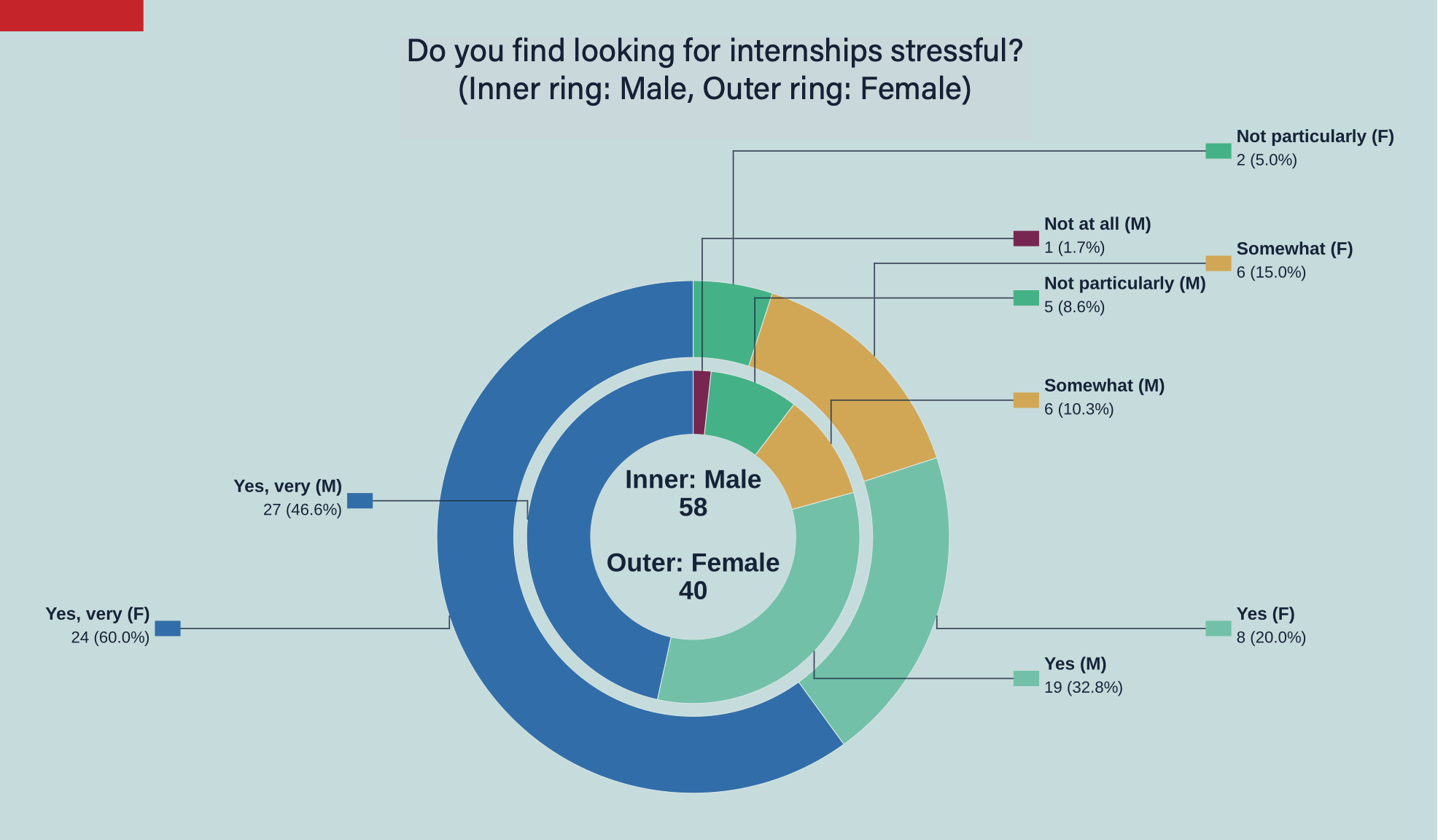
78% of students found that looking for internships was “stressful” or “very stressful”, and 69% reported that talking about internships made them anxious.
Interestingly, women find the search more stressful than men. 59% of females said looking for internships was “very stressful” and 32% said talking about internships made them “very anxious”, compared to only 42% and 16% for males, respectively.
“Internships can be difficult to secure, but there are many other valuable ways to use the summer,” Richard Carruthers, the Deputy Director of Imperial’s Career Service, told Felix. “Casual work in retail and hospitality, volunteering with community groups, short courses with LinkedIn Learning, virtual work experience through providers like Forage, or personal projects can all help students develop skills such as communication, teamwork and problem solving. These experiences can be just as powerful as internships when presented well, showing employers adaptability, motivation, and potential.”
6 out of 64 respondents said they had quit an internship in the past.
Artificial intelligence
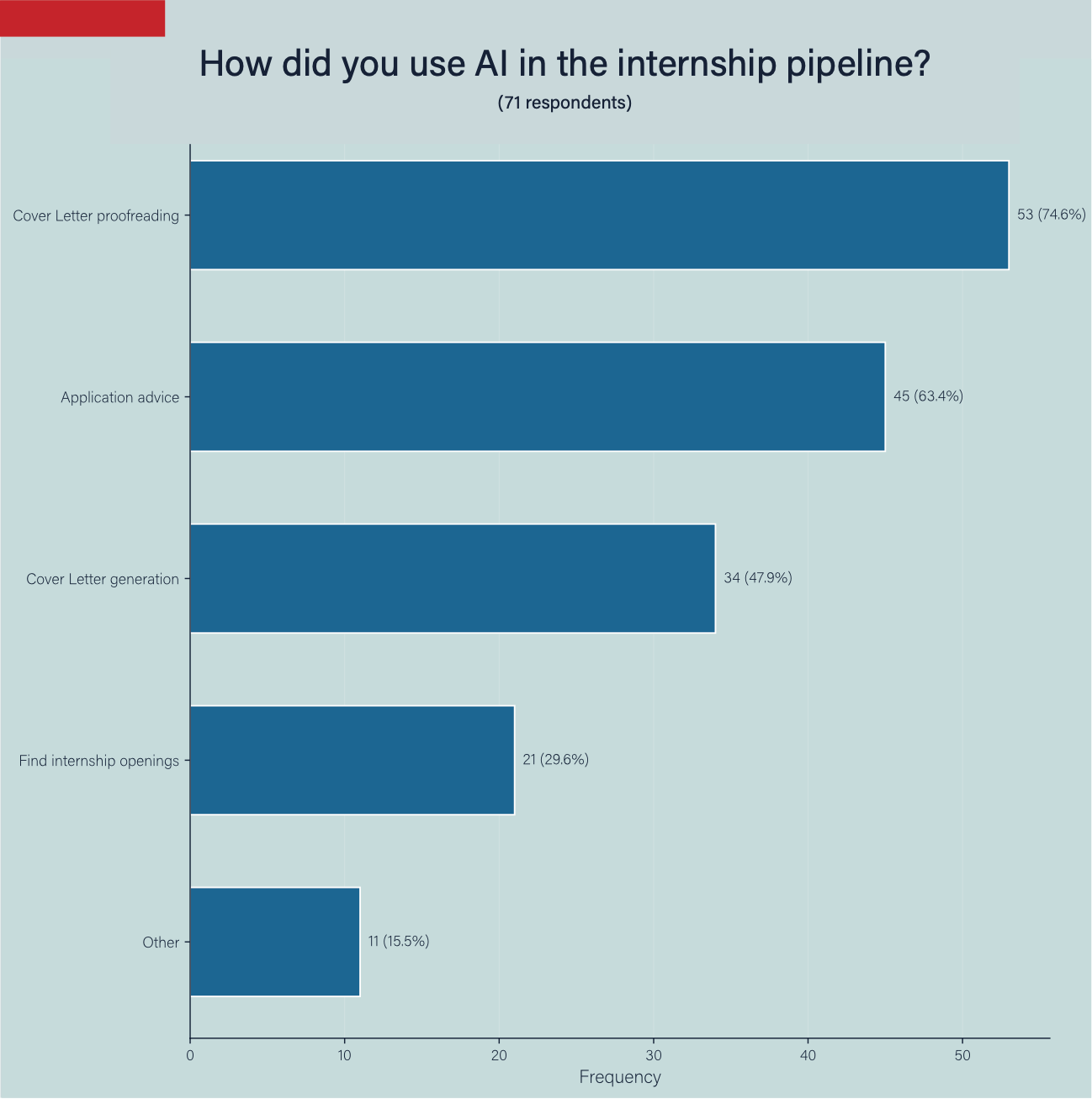
63% of all respondents reported using artificial intelligence (AI) in the internship process. AI use was six percentage points higher for students who had done an internship in the past.
The most popular uses of AI were to proofread cover letters (47% of respondents) and to provide application advice (40% of respondents). More than half (54%) of applicants who used AI in their last application found that it made them a “better candidate”, against a minority of 36% for all applicants.
“The media is filled with stories about a competitive job market and recruiters using AI to process large volumes of applicants,” Carruthers told Felix. “As a result, we’re seeing more students respond by sending many applications, often using AI to “speed up” the process. Unfortunately, generic applications tend to perform poorly with recruiters which leads to rejection and can reinforce the idea that the job market is ‘bad’ which can create a negative cycle affecting an applicant’s wellbeing.”