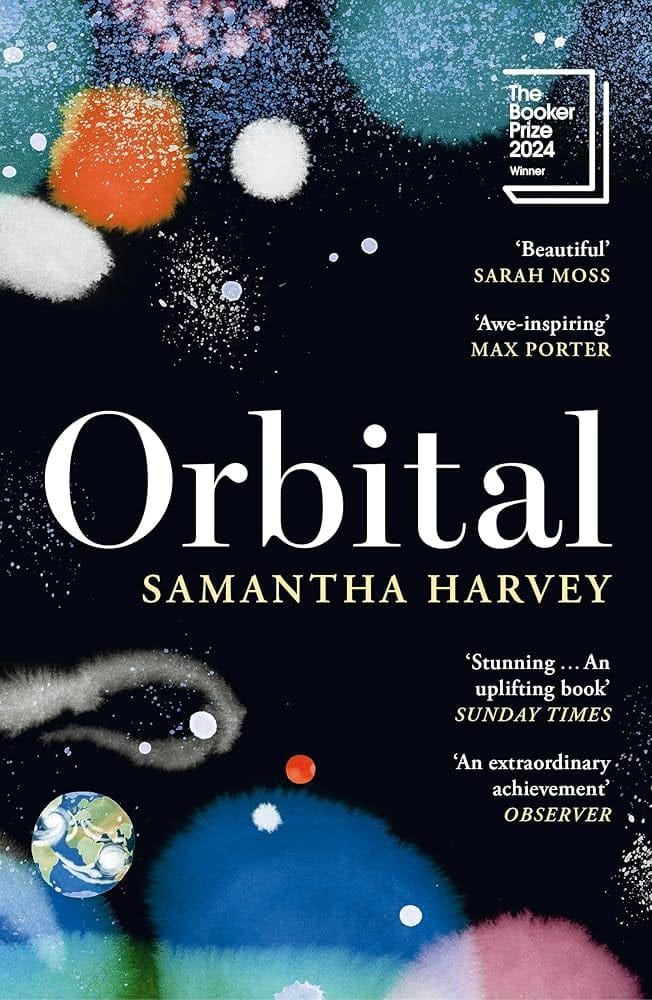
Orbital

Orbital is Samantha Harvey’s love letter to Planet Earth.
I was fortunate to begin the novel in my own orbit of sorts, on an airplane accompanying the rising sun from Singapore to London. Looking out, I felt the same strange sense of privilege that mirrored in its pages. This coincidence only amplified my experience of the novel. The premise – four astronauts and two cosmonauts (Russian astronauts, as distinguished) aboard a spacecraft that orbits our planet sixteen times in one “Earth day” – gives rise to a novel that falls nothing short of devotion.
From space, the crew are witnesses to everything, over and over. Orbital constantly returns to what we take for granted: the planet itself, through its shifting landscapes and weather patterns; the connections that make us human, enriched through a lens that sees the entirety of humankind below; and the miracle of our existence, granted by a perfect orbit of the sun.
The novel is stunningly technical with ease. Descriptions are like fresh water: crystalline, punching, and endless, turning knowledge into wonder and poetry. Themes cycle through physics, biology, climate science, meteorology, culture, music, art – you name it – without hesitation, so much so that I had to look up if Harvey had expertise in any of the domains. She doesn’t, nor has she been to space. You wouldn’t be able to tell.
Beyond the technicalities, though, Orbital is deeply introspective of humanity. On an individual level, we don’t just learn about the lives of our astronauts but tangibly feel their humanity by absorbing and appreciating the little things that make them human. Harvey explores their universal afflictions of dealing with grief, nostalgia, and an incumbent sense of purpose.
On a collective level, she questions the made-up-ness of borders, boundaries, and immigration. What is division, she asks, if not imaginary lines drawn across the planet that separate from each other; imaginary lines that feel absurd from above yet remain so real because of the palpable fragmentation they create.
Small and large questions are examined from a macroscopic distance with thoughtfulness and beauty. As such, we are left feeling both small and large ourselves. On one hand, we are forced to recognise that humans are a blip in the history of the universe. We will not make it out alive, and neither will Earth. Ultimately, we are slaves to nature.
On the other hand, our minuscule lives are still our lives. Seizing every opportunity, moment, and second is all we can do, and the fleeting chances to do so make our existence all the more meaningful.
Orbital is an ode to nature and confrontation with time. Though short, it is incredibly dense, full of the multitudes that we can and should approach life with. It was my first book of 2026, and a most, rather ironically, grounding start to the year.