Scientists on Survival & "Civil Disobedience"
A reflection of my experience reading Scientists for Survival amid our political climate; a book not about climate change, but who we could be in the face of it.

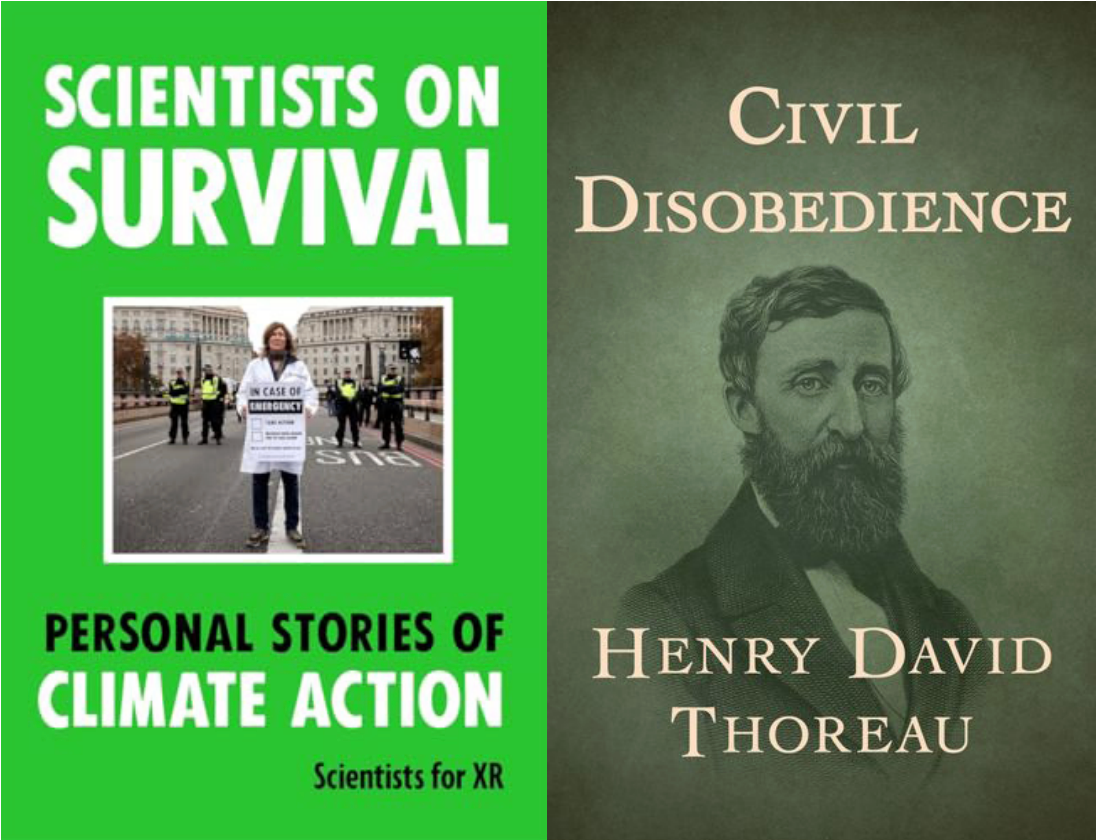
Scientists on Survival: Personal Stories of Climate Action is a collection of essays written by scientists who joined the activist group Extinction Rebellion (XR) in an effort to unite against the incumbent forces of climate change. Rather than focusing on data or policy, Scientists on Survival presents personal experiences that compelled these scientists to partake in climate activism.
Shortly after finishing the book, I listened to an archive podcast episode of David Runciman's "Past, Present, Future" which analysed Henry David Thoreau's political anti-slavery essay, "Civil Disobedience". The timing was oddly fitting.
Thoreau's critique of democracy is that it dilutes a civilian's moral agency. He argues this in a few ways. First, that the individual's vote counts only if it aligns with the majority opinion - even if the majority opinion is unjust. Second, civil servants enact policies, which detaches individuals from the state's wrongdoing (and realisation of their own agency). Lastly, the democratic state demands material support and to obey the social contract, forcing the civilian to underwrite policies they may not support.
These are not mandates for the reader to uproot their life. They are, however, human stories.
Thoreau concedes that "there are thousands who are in opinion opposed to slavery and to the war, who yet in effect do nothing to put an end to them." Ultimately, he contends, it is up to the individual to resist the majority.
Like the scientists for XR, Thoreau reminds us of our "right of revolution... the right to the right to refuse allegiance, to resist, the government, when its tyranny or inefficiency and great and unendurable".
XR activists have been known to glue themselves to public property, an experience a few scientists detail taking part in in the later chapters of the book. I had previously wondered what merit societal disruption, especially to the average person, can achieve. However, in conjunction with "Civil Disobedience", I am beginning to understand how and why this kind of activism can be beneficial.
Runciman also nods to the power of these actions, admitting we can laugh them off, but they are ultimately a form of re-capturing our autonomy, right, and duty as individuals to act on conscience.
This occurred in early April, right when the repercussions of Trump's "Liberation Day" were in full swing, markets in a tizzy, and decision-makers at a loss for what to do. I noticed all the news had disappeared - the non-financial news, that is.
Climate, conflict, and culture; they were displaced from the news cycle with ease. Thoreau observed the same, of those "more interested in commerce and agriculture than they are in humanity... cost what it may".
At that point, it really struck me what people - those who lead the institutions "in charge" of, or who report about the world - truly care about. With immediate monetary threat comes a blindness to reality beyond it. In that sense, I realised our "world" is a synonym for capital.
The essays in Scientists for Survival do not present unprecedented ideas. But that is not their objective. Laura Thomas-Walters highlights the power of conversation about climate change and action; Caroline Vincent shares why she became vegan despite growing up a practically carnivorous diet; Pete Knapp explains his difficult decision to stop taking planes. These are not mandates for the reader to uproot their life. They are, however, human stories. Stories of individuals trying to make incremental change: civil disobedience.
"Let your life be a counter-friction to stop the machine," Thoreau writes. Today, I increasingly see why that needs to be true.