The Agony of Eros by Byung-Chul Han
Can love survive the modern world?

The Agony of Eros is about the modern threats to love. Not generic love, but Eros - one of seven types of Greek love defined as “desire, passion, love”.
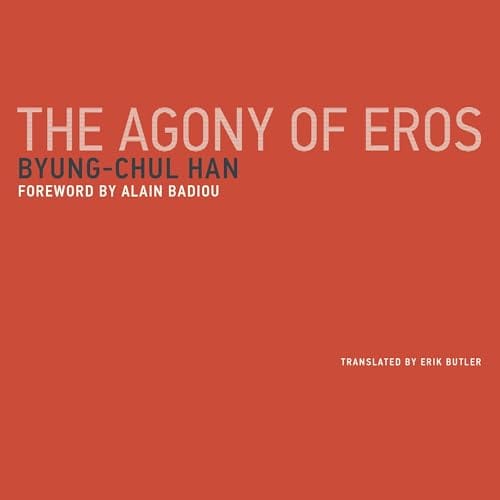
Byung-Chul Han argues that Eros is entangled with the “unknowable Other”. The “Other” is not merely a lover, but someone who allows you to see beyond yourself; who enables growth, imagination, and connection, all in a transcendent manner. The modern threats that are dismantle Eros, prevent meaningful interaction, and even ameliorate finding the “Other” are the usual suspects: social media, the internet, and capitalism.
Byung-Chul Han makes several claims throughout the book, a particularly striking one being that love requires pain. He argues that Eros is sacred because of the strangeness it brings alongside its generic positives. The “Other” requires negativity to exist as this ensures they are not an extension of ourselves. In fact, we are increasingly uncomfortable with the thought of discomfort, especially when consoled by the arms of our devices, and this impedes our bandwidth for the challenge and growth which the “Other” brings.
Another concept that particularly stuck with me was that of our current “information-thick” era. With access to knowledge of lived (or fictitious) experiences available ad nauseam on the internet, we actually lose our imagination. In the context of Eros, hypervisibility removes desire as we sit on the precipice of anticipation. We live in disappointment, waiting for the “Other” to meet our expectations, and these impossible standards are never met.
Although only some 70 pages, The Agony of Eros sometimes comes off repetitive, and in places where Han raises tangential arguments (such as that of Eros and politics), I was either unconvinced or became disinterested.
"I felt the “Other” a character whose importance was overstated, entrenching traditional ideals of “the other half”"
While intriguing, my main criticism of Han’s arguments are his general opposition to modernity, in that many of his qualms were inherently tied to how modern society functions. Despite that being the point of the book, I often find one-sided texts difficult because I come away feeling helpless.
Yet I felt the “Other” a character whose importance was overstated, entrenching traditional ideals of “the other half”, even if Han argues this other half is not meant to meet fantastical desires. What about friendship? Or more importantly, what about ourselves? This was the agency I felt was lacking in The Agony of Eros, and why I think it is best left to provoke one’s thoughts rather than inform them.