Who gets to design the world?
Design and Disability: a probing V&A exhibit interrogating design justice
Not an afterthought, not an accessibility requirement, not society’s footnote, but an actual consideration; Victoria & Albert’s exhibition on Design and Disability reframes the narrative on the idea of disability: from a medical condition to an identity. The exhibition is shaped in three parts — Visibility, Tools, and Living — capturing the creativity and ingenuity of the disabled community. Apart from the 170 objects on display narrating this story of communal solidarity, the exhibition itself embodied the “access beyond a ramp” approach with tactile displays at wheelchair height, detailed audio descriptions of every object, and seating areas woven throughout the space to rest and just take a minute. Why can’t every exhibit do the same?
Identity? What is that.
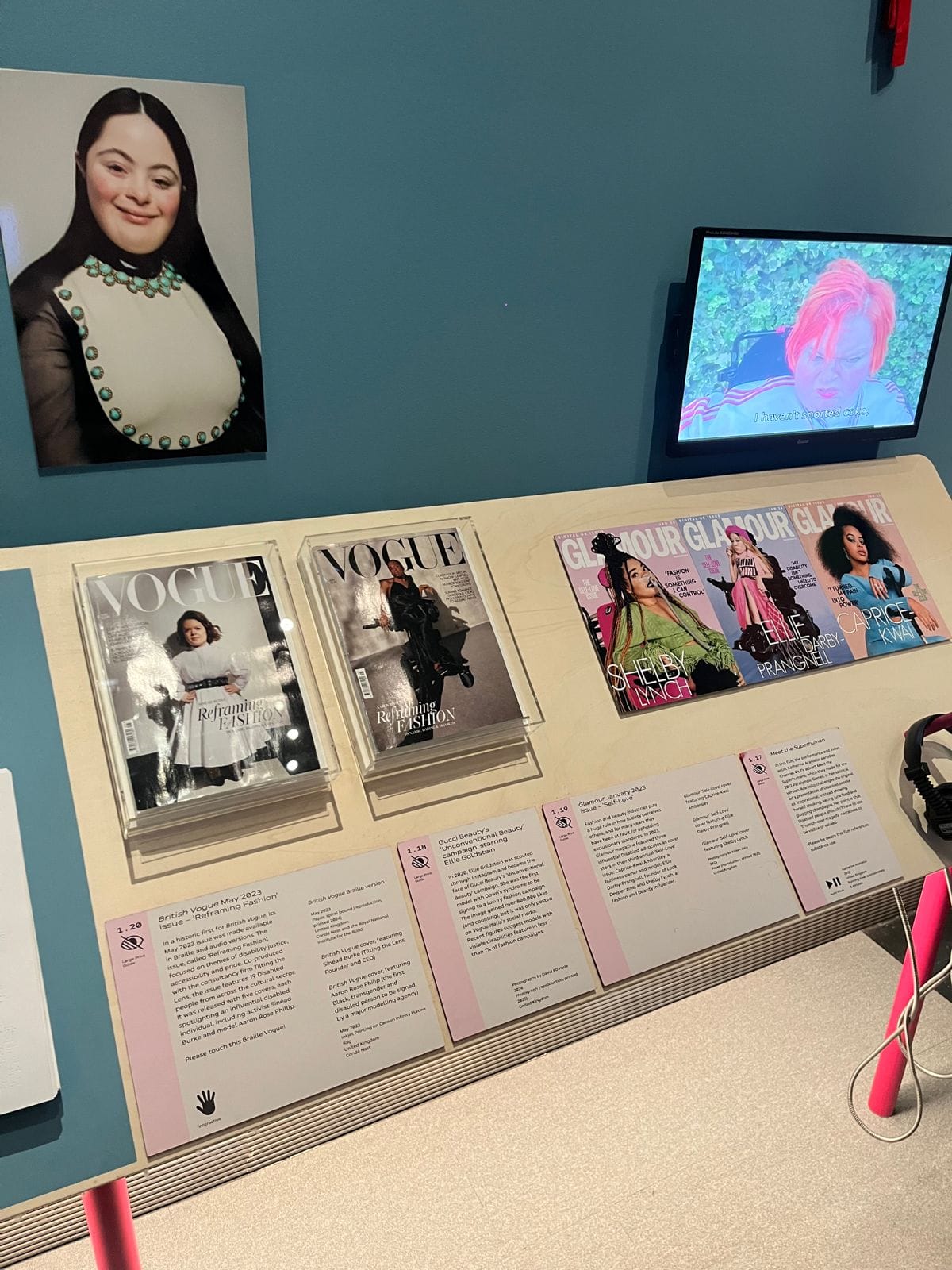
In Visibility, we are immediately lifted from the all-too-sterile assumption of fashion for the disabled. Immediately, you are greeted with dense walls of protest signs and t-shirts: “Piss on Pity” boldly printed on one rejecting the infantilizing view of the disabled. Underneath it, Katherine Araniello proudly munches on chips, parodying the London 2012 “Meet the Superhuman” campaign. Pity? No, thank you. Right beside this, Vogue reframes fashion with a disability campaign starring disabled models: less than 1% of fashion campaigns have a model with disabilities. Opposite this, Christine Kim shows a musicality of ASL. I ask, “If English can write poetry, why cannot ASL make… visual music?”
Why the world suddenly felt… a bit inconsiderate?
The simplicity of Tools was hacking. People have hacked almost every tool you could imagine, and it makes you realise the ableism embedded in everyday life. Why should a hearing aid stop you from wearing jewelry? Why can’t one wear a shoe without knowing how to tie laces or fasten a strap? Why can’t I use a simple fork if I have mobility issues? Why shouldn’t sex toys be more accessible? Why can’t I protest on the streets for my rights if I am unable to leave my house? Why can’t I play football? Why can’t I listen to music at concerts? Why can’t I type on a computer? Why can’t I party at a club till late at night?
Live or Survive: you force the latter
Living is geared towards architecture — not just physical but also social. A minute-long Coordown campaign wants you to Assume that I CAN, advocates for No Decision without US, and mocks the Ridiculous Excuses not to be Inclusive. It offers a solution that modifies architecture to move a bit beyond the codes and standard rules to make the space just that much more inclusive. It asks why graphical information from newspapers cannot be made tactile. A unique concept is the “Unlimited Cards” randomising a situation through Where, What, and Barriers, prompting you to question whether your space is truly accessible. “What good is a society if it doesn’t work for its people?” My favorite exhibit lies here, at the end, where you sit and hear. Hear the words of a silent pottery clip described in a trichotomy of screens. Each screen with the same clip, the same audio description, but presents a unique subtitle. The grey area that subtitles cannot capture through verbatim words holds enough ambiguity to make you second-guess, to feel unsure. The persons are rarely disabled by their physicality but often by society where you must bargain with the world around just to “live” (survive).
From the stereotyped expectations of a disabled person’s social life to the hidden ableism in a plastic straw ban, the world presents a lot more challenges to the disabled community. Yet, the exhibition shows you what inclusive design can look like. It shows you what access truly means while putting a deeper meaning to deconstructing our embedded ableism. Yet, it also makes me wonder why the accessibility of this exhibition is limited to this space, just there until 15th February, and just isn’t part of V&A’s own general museum.
After all, Design and Disability is not just about what you make, but who you make it for.