Boris: Resolute Vertebrate Jelly Part II
Eoghan should probably have a chat to Boris next week...
“If the ball came loose from the back of the scrum, which it won’t of course, it would be a great, great thing to have a crack at.”
These were the words of Boris Johnson on a hypothetical bid for The Conservative Party leadership, speaking to the BBC’s Michael Cockerell for a May 2013 broadcast. Their light-hearted flippancy is somewhat endearing but they also conjure images of the home counties. This cannot be avoided. One cannot fault the apparent gusto with which Boris Johnson approaches his mayorship. His “9 point plan for a Greater London” was both succinct and pragmatic. Perhaps (in my view) this is the crux of any criticism that might be directed towards him. His delineation of London’s foibles may prove to be a gross oversimplification of a vastly complex social and economic focal point; Boris Johnson tends to focus on the latter. While his pledge to create 200,000 jobs as a conduit for raising citizens out of poverty is a noble endeavour it could be misconstrued as clandestine and disengaged.
London is not a fictional metropolis like Gotham City, where criminality is asphyxiated and bludgeoned into submission. Neither will a punctual transport network remedy all problems. These are isolated solitudes in themselves. They are desirable but without a focal point their full impact will be lost. In London complications are not black and white. There is only grey.
Consider Mr. Johnson’s pledge to create more ‘green space’ for Londoners. It makes sense. By defining regions for respite, city hall can provide more opportunities for the average ‘Londoner’ to withdraw from a myriad of pressures. This may catalyse social cohesion, promote tolerance and encourage patience. My criticism of the measure is its lack of focus. Green spaces are a means to an end: they are not an end in themselves. Any benefits would need to be led by the people. An inherent social link to the land would need to be forged. Green space in Peckham, Lewisham or Lambeth will solve nothing in isolation. Instead, by fashioning a cultural link to the localised community, the benefits could prove boundless.
A recurrent characteristic of these social links is longevity. This is something that London typically lacks. As a burgeoning hive of causality, activity is both fluid and dynamic. Continuity of Government, justice and equality will not maintain itself without the intervention of city hall. The Mayor’s 200,000 job pledge is noble. Despite this one might choose to note Boris Johnson’s support of free markets and energetic capitalism. There is no doubt that the jobs will come. My concern is that the enterprising entrepreneurs and businesses will glaze over the disenfranchised or impoverished Londoner. The spider’s web proves to be a most fitting analogy. Canary Wharf, Pall Mall and Mayfair may lie on the strands of the web but other areas fill the void. Without an egalitarian effort to bring jobs to one and all this may continue to be the case. By 2015 city hall may run the risk of morphing a sizeable income disparity into an irrecoverable void.
This leads into City Hall’s endeavours to rejuvenate transport. The Crossrail project, in combination with the proposed airport on the Thames estuary and the hypothetical ‘Heathwick’ rail link show that efforts are both concentrated and efficient. In particular, with the Crossrail tunnel having reached the half-way house under Gospel Oak, Boris Johnson can now exhibit active substance to complement his initiatives. Once again I bring you back to the ‘web’ analogy. The projects serve as conduits to speed financiers, scientists and the well-endowed among us onto bigger and better things. The poor are left in idleness. The counterpoint to this might be that such an approach serves as a stepping stone to outreach. I suspect that this won’t happen. Soaring London Underground fares may serve as substance to this instinct. The lines may have been rejuvenated and the trains made punctual during Boris Johnson’s premiership but this has happened in line with such fares. The poor man is short of options and finds his way barred.
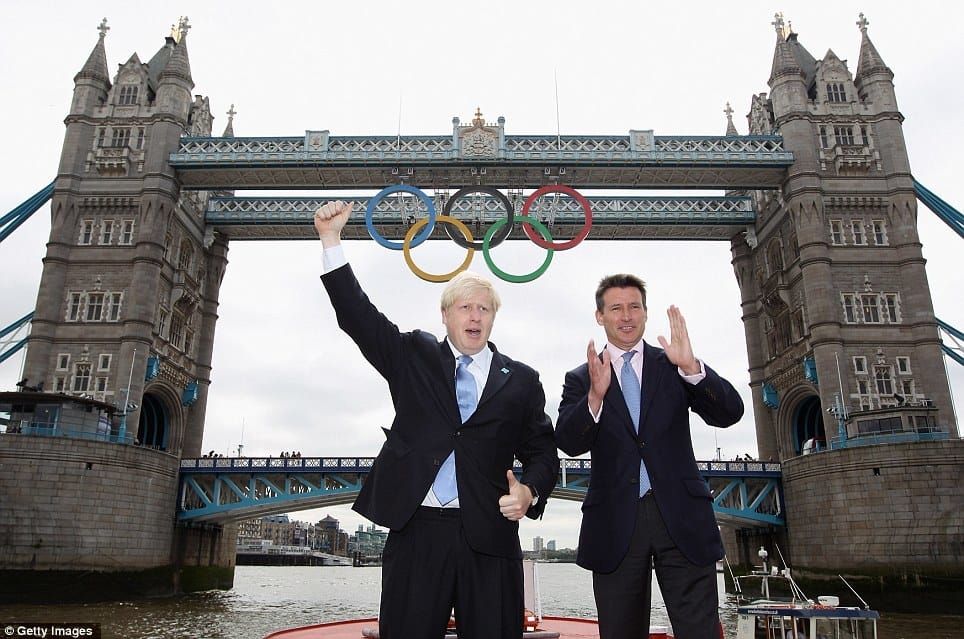
Reflections on the London 2012 Olympic Games serve as a suitable closing point. I once referred to their legacy as ‘flat-packed’. At the close of the games the gates were locked and barred and decommissioning began without pause for breath. Bike lanes became a thing of the past and bidding for the Stadium gathered force. This might be regarded as a missed opportunity for City Hall. There was an opportunity to fashion a utilitarian model for London centred on cycling, culture and sport. It was a shame that short-term pragmatism took precedence over a deeply-rooted legacy. It is not too late. If anyone can pull it off, it is Boris Johnson.