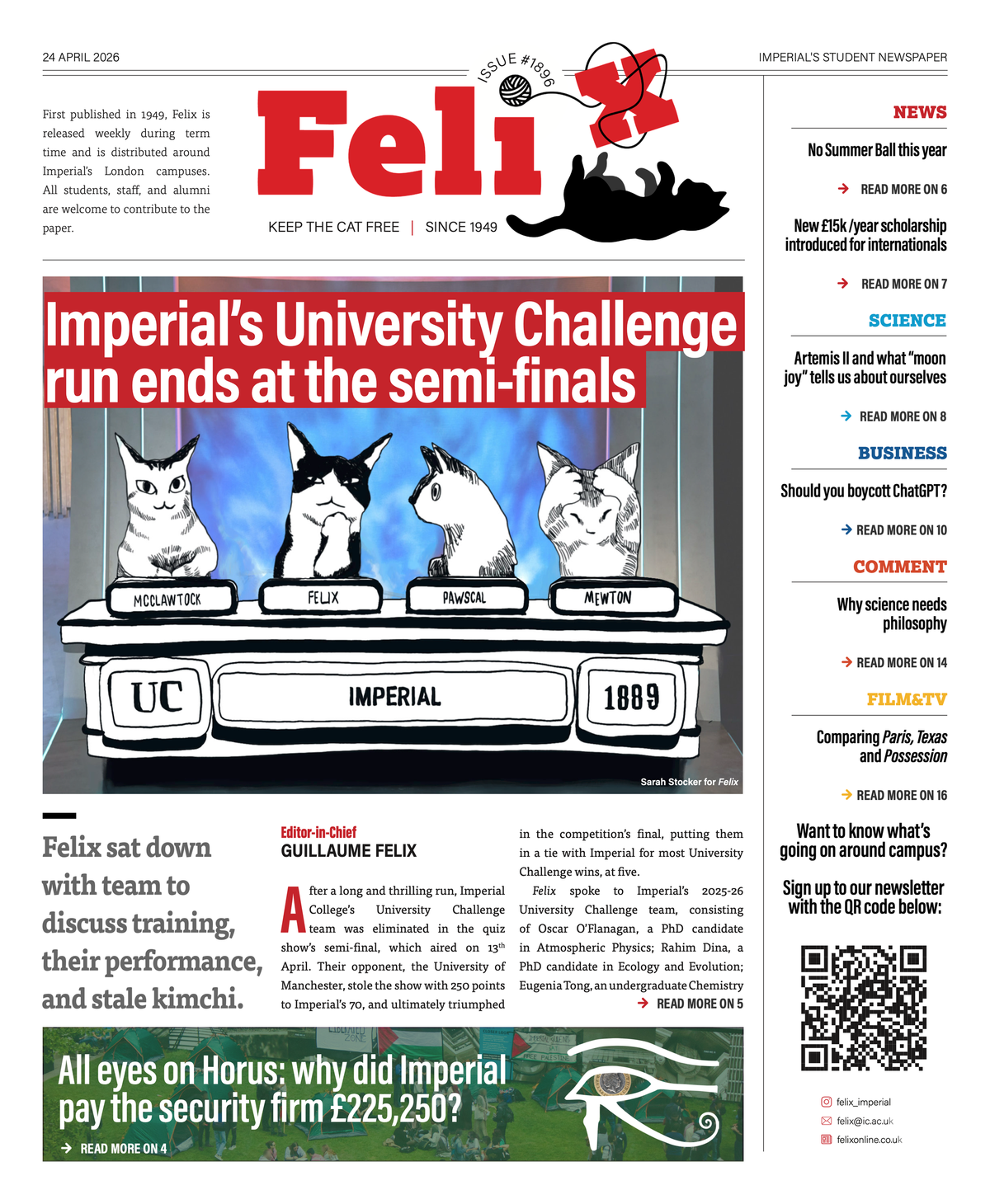
Imperial’s University Challenge run ends at the semi-finals
Felix sat down with team to discuss training, their performance, and stale kimchi.
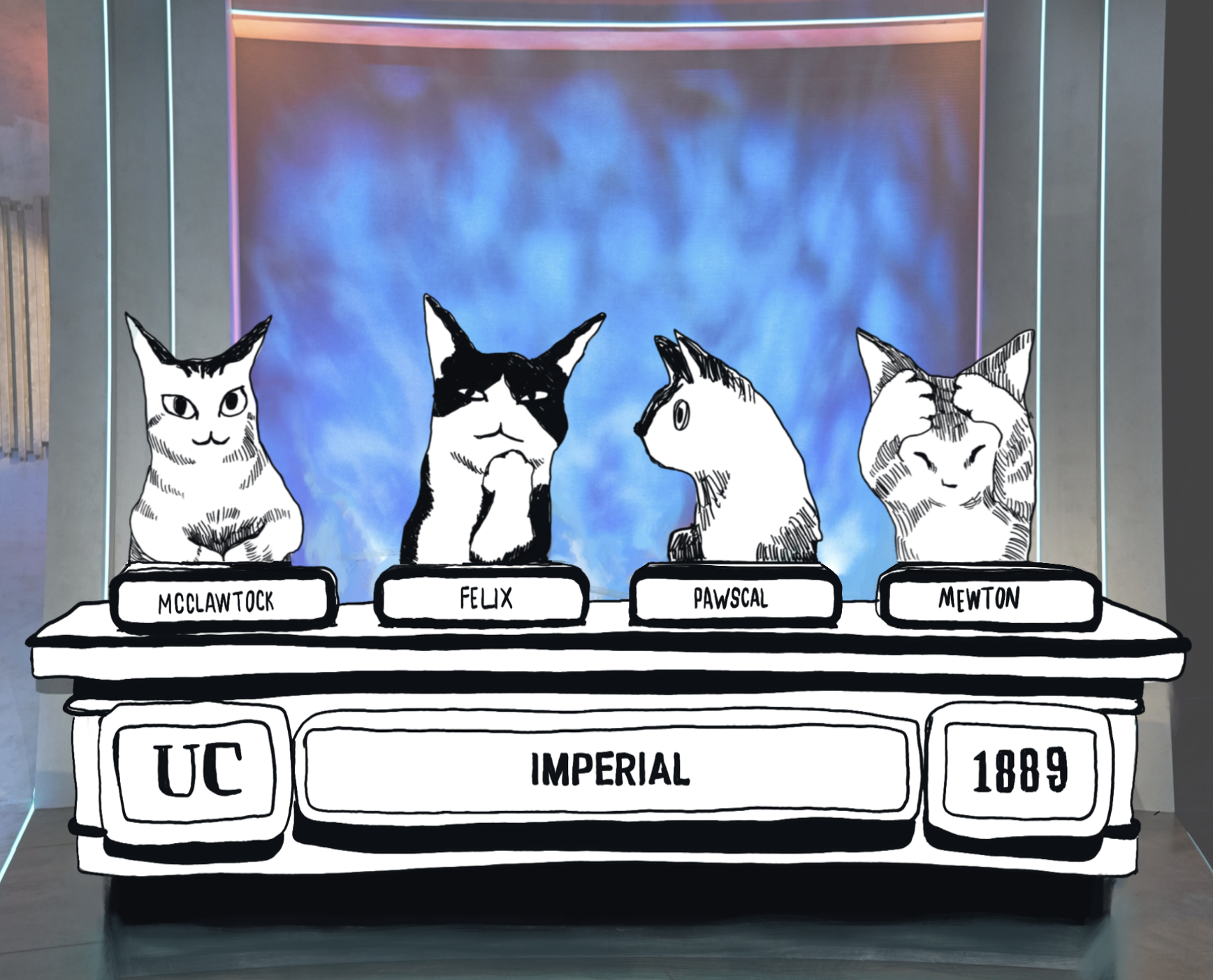
After a long and thrilling run, Imperial College’s University Challenge team was eliminated in the quiz show’s semi-final, which aired on 13th April. Their opponent, the University of Manchester, stole the show with 250 points to Imperial’s 70, and ultimately triumphed in the competition’s final, putting them in a tie with Imperial for most University Challenge wins, at five.
Felix spoke to Imperial’s 2025-26 University Challenge team, consisting of Oscar O’Flanagan, a PhD candidate in Atmospheric Physics; Rahim Dina, a PhD candidate in Ecology and Evolution; Eugenia Tong, an undergraduate Chemistry student; and Justin Keung, a Computing undergraduate at the time of the competition.
Achilles’ heel to Anki heal
To train for the competition, the team put together a spreadsheet summarising their respective strengths as well as areas needing consolidation. They then moved on to the daunting task of memorisation, one Anki card at a time – although team captain O’Flanagan reckoned only about a fifth of the answers he provided on the show came from flashcard training, with his prior general knowledge accounting for the rest.
“When we do the try-outs, they ask you to write down your specialism, and – verbatim – what I put was ‘random shit’,” O’Flanagan said. “I like it when it’s something that I know and didn’t expect to come up.”
The competitors were each assigned topics to focus on, based on their affinities. While Tong was most interested in geography and history, Keung crammed philosophy after the team failed to name Rousseau (“it never came up”), and Dina focused on pop culture, film, music, and economics. The team “ostensibly” split Nobel Prize winners, an ineluctable topic, although their memorisation of the thousand-odd laureates was admittedly half-hearted (“I didn’t actually card them”).
Joshua Bobin, a reserve player for the team, explained that his main role was to “keep up team morale”, in addition to participating in practice. “It’s very fun,” he said. “Less pressure, definitely.”
In addition to the high expectations placed on them, the team had to contend with balancing academic pursuits and quizzing. “I was doing past papers while we were filming [the show],” Tong recalled.
Facing Manchester: the Madgwick massacre
Imperial had already lost to Manchester in a practice match, and expected a challenging round – with particularly tough competition coming from trivia behemoth team captain Kai Madgwick, who provided ten of Manchester’s fifteen correct starter questions. “[Madgwick] is also good at Physics and History”, O’Flanagan quipped, “but a lot better than me at Physics and History”. One comment left on YouTube asked, “Does Madgwick have a trivia Ratatouille in his cap?”
In spite of the knockout, the team rather took their defeat in good spirits, and are seen laughing on the recording as they struggle to name the designer of the Tottenham Court Road station mosaics (Eduardo Paolozzi). “It did get to a point where we were losing so badly, it was genuinely funny,” O’Flaganan recalled, adding that some of the footage of him “los[ing] it” was cut away. “It’s a weird feeling where you know locking in will not change the result, but you still have to lock in because you’re on TV,” Keung mused.
The classical music questions were especially challenging – “deranged”, as the team put it. Imperial was at one point asked with recognise the melody of Italian composer Muzio Clementi’s Symphony No. 3 in G major, a relatively obscure piece without its own Wikipedia page.
“The most famous jar of kimchi in the universe”
This year, Imperial’s mascosts attracted particular attention. The team brought a penguin plushie to their first game – mostly because it looked “cute”, although they later pretexted a semantic link between Imperial and emperor penguins.
After narrowly qualify for the game’s second round thanks to bonus questions Korean cuisine, the contestants purchased a jar of kimchi as a second mascot – which the game’s host Amol Rajan called “the most famous jar of kimchi in the universe right now” after its owners’ eventual demise. O’Flanagan assured the cabbage wasn’t wasted: “I put it in fried rice, it was quite crap.”
The team’s jaunty approach to the contest proved very popular amongst online quiz aficionados. One commenter lauded “the brooding but charming O’Flanagan flanked on one side by [K]eung, with his colourful, dramatic reactions, and by Dina and Tong on the other, seemingly constantly surpressing infectious grins like conspiratorial schoolchildren in class.”
The contestants recall being recognised on and around Imperial campuses, as well as by occasional strangers. Yet the spotlight is still stolen by Max Zeng, a Singaporean contestant from the victorious 2021-22 team who was heavily featured by his home country’s media: “At the Freshers’ Fair… people will still go up to me and ask at the stall, ‘Did you know Max Zeng?’”
University Challenge games are pre-recorded, with filming taking place in three separate sessions over the academic year preceding broadcast. “I’ve managed not to spoil anything,” said O’Flanagan, adding that people “not actually involved in the show” are more likely to spoil things.
Dina, who attends a weekly pub quiz in Peterborough that sometimes overlapped with filming dates, says fellow contestants there speculated on Imperial’s performance based on gaps in his attendance. The Pentagon Pizza theory has nothing on the Dina Disappearance one.