Murakami: movement to survival
A comparative analysis of Murakami's A Wild Sheep Chase and Dance Dance Dance
Haruki Murakami’s A Wild Sheep Chase (1982) and Dance Dance Dance (1988) are part of his loosely connected “Rat Trilogy”, which also includes Wind/ Pinball (1973) and Hear the Wind Sing (1979). The novels follow the same unnamed narrator, a detached Tokyo advertising writer navigating loneliness, loss, and increasingly surreal encounters. In A Wild Sheep Chase, the narrator is drawn into a strange investigation after a powerful right-wing figure demands he locate a mysterious sheep pictured in a photograph sent by his old friend, the Rat. Accompanied by his girlfriend Kiki, he travels to Hokkaido and encounters the enigmatic Sheep Man and the isolated Dolphin Hotel, both of which become central symbols in Murakami’s surreal world. Dance Dance Dance revisits the narrator several years later as he returns to the rebuilt Dolphin Hotel searching for Kiki, only to become entangled with characters including the lonely teenage girl Yuki, the actor Gotanda, and the hotel receptionist Yumiyoshi. Across both novels, Murakami blends detective fiction, magical realism, and existential reflections, using recurring disappearances, dreamlike spaces and the supernatural “Sheep” mythology to explore alienation, modernity, and the search for meaning in contemporary life.
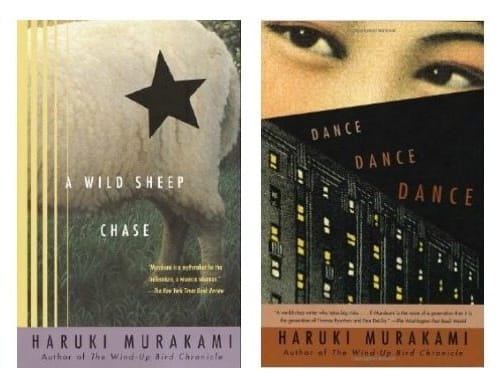
Haruki Murakami’s A Wild Sheep Chase and Dance Dance Dance trace a shift from the search for meaning to the endurance of meaninglessness. Murakami suggests that survival in a spiritually empty modern world requires continuous motion and fragile human connection, while stagnation leads to spiritual disappearance. Renowned for his blending of the surreal with the alienation and isolation of adulthood, these novels depict different stages of the narrator’s existential journey. Taking place four years apart, they follow the same protagonist as he attempts to cope with continual loss and the apparent meaninglessness of his life.
Movement
The narrator’s movement changes across the two novels. In A Wild Sheep Chase, his travel is purposeful and goal-oriented: he is actively searching for the Rat and, consequently, the Sheep. After receiving a letter from his long-lost friend with an image of a strange sheep enclosed, he begins a journey to track down the animal in order to find the Rat and uncover the mystery behind the image. Movement in this novel is investigative and tied to discovery; travelling forward means getting closer to an answer. By contrast, in Dance Dance Dance, the narrator continues to move, but it is no longer in pursuit of a solution. Instead, he moves because he must. What once functioned as a search for meaning becomes a survival mechanism. Early in the novel he reunites with the Sheep Man after the events of A Wild Sheep Chase, who tells him, “Dance while the music is playing.” This advice becomes integral to the narrator’s philosophy of living. Stagnation, rather than uncertainty, becomes the true danger, suggesting that remaining engaged is the only way to avoid being consumed by emptiness.
The supernatural system of the novels undergoes a similar transformation. In A Wild Sheep Chase, the Sheep moves between hosts and shapes history, functioning as an active metaphysical force that manipulates power and political structures. The narrator’s journey is therefore not simply personal but connected to a hidden system that governs the world around him. In Dance Dance Dance, however, the Sheep disappears, and the Sheep Man shifts from an ominous figure to a guide. The disappearance of the Sheep signifies the collapse of this supernatural order. Without it, the narrator is left in a world that is no longer controlled by hidden structures but is defined by absence and uncertainty. Where meaning once seemed to exist within an external system, the narrator now must generate his own sense of direction through movement and connection.
Women
A common criticism of Murakami is his treatment of women, and this issue is very much on display in both novels
Both novels also revolve around the recurring disappearance of women. A Wild Sheep Chase opens with the death of one of the narrator’s former partners and the end of his marriage, and closes with the disappearance of his current partner, Kiki. In Dance Dance Dance, several women the narrator crosses paths with similarly vanish soon after entering his life. Their absence repeatedly pushes him into motion, forcing him to investigate, search, and attempt to reconnect. Characters such as Yuki’s absent mother, unstable romantic relationships and the literal disappearances that occur throughout both novels function as gateways to the metaphysical world. The narrator is drawn deeper into the strange systems underlying reality through these absences. Yet while disappearance drives the narrator’s movement, it never leads to full or lasting connection, reinforcing the novels’ atmosphere of instability and loss.
A common criticism of Murakami is his treatment of women, and this issue is very much on display in both novels. All the female characters function more as narrative catalysts than fully developed individuals, existing primarily to motivate the narrator’s emotional or physical movement through the story. Dance Dance Dance contains one of the most uncomfortable examples of this dynamic, in the inappropriate friendship between the 13-year-old Yuki and the 30-something narrator. Although their relationship is not sexual, the narrator repeatedly suggests that if she were older, they would date, and at times their interactions felt troublingly close to grooming. There are other moments that highlight Murakami’s tendency to objectify women, such as the scene in which the narrator returns home with the very drunk Dolphin Hotel receptionist, Yumiyoshi, and considers taking advantage of her, thankfully landing on no – but only because it would not be “fair”.
As an avid Murakami reader, I thought I would be accustomed to his portrayal of women, but I found Dance Dance Dance particularly unsettling. While I believe Yuki and the narrator had a genuine, though socially unconventional friendship, several of their conversations feel gratuitous and could easily have been omitted without affecting the narrative.
The Dolphin Hotel
The hotel functions as a mysterious and liminal space with a strong connection to the supernatural
Just as the narrator evolves between novels, so does the Dolphin Hotel. In A Wild Sheep Chase, the hotel functions as a mysterious and liminal space with a strong connection to the supernatural, somewhat reminiscent of Oshima’s cabin in Kafka on the Shore. The old Dolphin Hotel is family-run, and one of its residents is the owner, a sheep researcher who permanently occupies a room in the building. His presence becomes crucial to the plot: without the owner, the narrator and Kiki would never have encountered the Sheep Man or begun to understand the significance of the Sheep and the fate of the Rat.
In Dance Dance Dance, the narrator returns to the hotel because he believes he is somehow connected to it. He returns to find it has been completely rebuilt into a modern corporate hotel. The space has become sterile, commercial and disconnected from the supernatural atmosphere it once possessed. This transformation can be read as a metaphor for memory itself. Modernisation has buried the deeper layers of reality beneath polished surfaces, replacing a space that once held meaning with something static and impersonal. However, despite the hotel’s transformation, the narrator eventually discovers that the new dark, otherworldly space where the Sheep Man resides still exists beneath the new building. Hidden behind the polished surface of the modern hotel is the same shadowy realm he encountered years earlier. This suggests that although capitalism and modernisation may bury the deeper layers of reality, they do not fully erase them. The metaphysical world has not disappeared entirely; it has simply been concealed beneath the surface. The narrator’s ability to access this place implies that movement between realities is still possible, even in a world that appears sterile and controlled.
Despite the narrator’s growing sense that the world lacks inherent meaning, his relationships remain the most important aspects of his life. Whether romantic, platonic, or even purely transactional, these connections keep him engaged with the world around him. His bond with Kiki, his friendships with Yuki and Gotanda, and even his interactions with characters such as Mei and June create moments of connection that interrupt the otherwise isolating emptiness of his existence. Helping others becomes the narrator’s primary way of avoiding despair. Rather than withdrawing from the world, he remains involved in the lives of those around him, allowing these relationships to provide structure where metaphysical meaning once existed.
Skeletons
Understanding the climax of Dance Dance Dance requires returning to the role of the Sheep in A Wild Sheep Chase
Dance Dance Dance climaxes in the recurring dream sequence, in which the narrator finds himself in a hotel room with Kiki and six skeletons. The skeletons appear to represent those in his life who were consumed by the void of disappearance – individuals whose connections to the world have collapsed, leaving behind only the remnants of their existence. Yet the narrator can only clearly identify five of them. The presence of a sixth skeleton suggests the unsettling possibility it represents the narrator himself.
Understanding this scene requires returning to the role of the Sheep in A Wild Sheep Chase. The Sheep is not simply a supernatural being, but the centre of a system of control and power. The Sheep moves between hosts, manipulating history and political structures and creating a hidden metaphysical order beneath ordinary reality. When the Rat ultimately kills himself while possessed by the Sheep, he destroys this system and breaks the cycle of the Sheep’s movement. In doing so, the Rat performs the trilogy’s most decisive act of resistance. By sacrificing himself to destroy the Sheep’s control, he prevents the continuation of a system that turns people into mere hosts for power. Yet his act also removes the final structure that gave the world a hidden order, leaving the narrator to navigate a reality that is no longer controlled, but fundamentally empty Dance Dance Dance therefore takes place in a world after this collapse. Without the Sheep, there is no controlling force, hidden meaning or organising system behind reality. The world becomes empty rather than controlled, which is why the narrator’s life feels directionless.
Seen from this perspective, the skeletons in the dream can be interpreted as the remains of those who were connected to that lost system. They represent what is left after the supernatural order collapses: empty remnants of meaning. The room becomes a kind of metaphysical graveyard. If the sixth skeleton is the narrator, the dream suggests that, without the Sheep, he too risks becoming one of these lifeless remnants, another person left behind in a world that has lost its structure. The scene therefore functions as a warning. Without movement and connection, he could easily become spiritually stagnant. This interpretation also directly clarifies the Sheep Man’s advice to “Keep Dancing”. If the old metaphysical system has vanished, meaning will not emerge from supernatural forces, historical structures or destiny. Instead, people must create their own meaning through action, movement and connection. Dancing becomes a metaphor for continuing to engage with life despite uncertainty. In contrast to the stillness of the skeletons, dancing represents life itself: movement, interaction, and the refusal to disappear.
Parting thoughts
Where A Wild Sheep Chase depicts the narrator’s search for meaning, Dance Dance Dance portrays life after meaning collapses. Murakami ultimately suggests that the solution is not to rediscover a lost system of answers, but to continue moving forward regardless. In a world defined by disappearance and uncertainty, survival depends on maintaining connections and remaining in motion – continuing to dance while the music is still playing, even in a world where meaning itself has disappeared.