The Elements

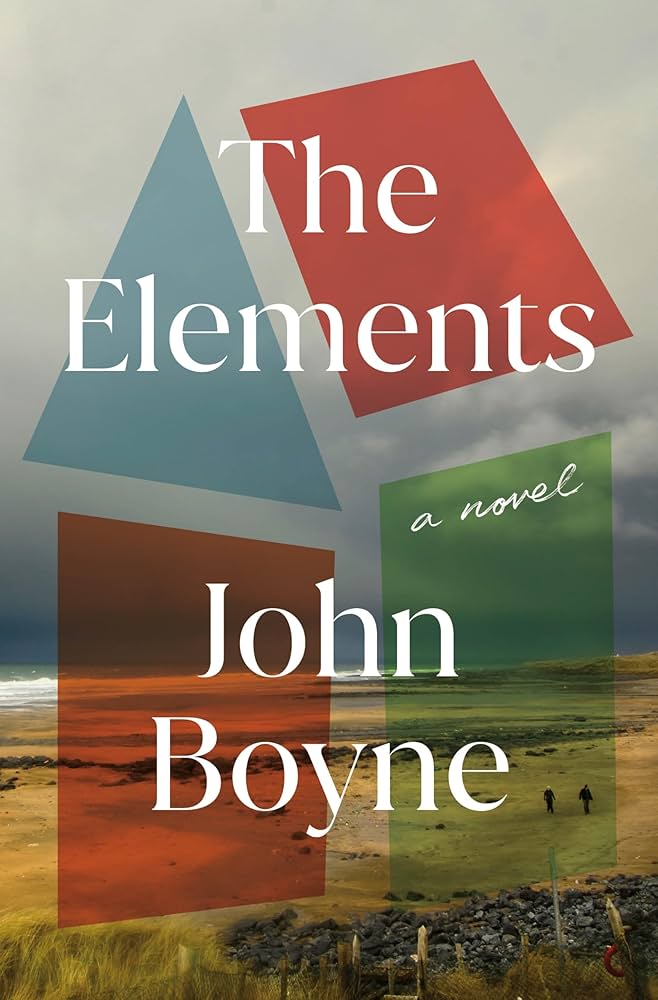
What I thought would be a quick pitstop at a local bookshop in Chiswick turned into a half-hour chat with the owner where I realised I hadn’t read a life-changing book in a while. The conversation inspired a strong urge to change that; I grabbed a copy of The Elements by John Boyne, initially drawn by the abstract simplicity of the cover, and became convinced by the owner’s recommendation.
The Elements is composed of four separate yet interlacing novellas titled “Water”, “Earth”, “Fire”, and “Air”, which surround a single central event: a crime of an abusive nature. Each part is from the perspective of one of of the parties involved – victim, accomplice, bystander, and perpetrator respectively – whose first-person narrative, of utmost importance, tackles the most complex of emotional profiles. Boyne manages to surpass the standard set by his most celebrated work, The Boy in the Striped Pyjamas, proving that devastating subject matters, when handled with honesty and profound humanity, can be delivered elegantly. In The Elements, this is most evident through his masterful portrayal of guilt, grief, and every other difficult feeling that makes us human.
Propelled by a dialogue often closer in pace to screenplay than prose, this first-person narration provides the clearest pathway for bringing the moral complexity of humans to life. What is by far my favourite element of the book is Boyne’s use of the reader’s scepticism as a tool to probe the limits of their own moral certainty, particularly evident in “Fire”. While the narrator’s actions remain unforgivable throughout, their hurt and desperate yearning for healing and redemption are unexpectedly understandable, filling the reader with an uncomfortable kind of relatability.
As the owner asked me if I wanted a loyalty card, he warned me to prepare myself for heavy topics. And rightfully so. Boyne handles the subject of abuse with a very careful balance of delicacy and realism, accurately painting the consequences of the heinous crimes as a Pandora’s box of a long, complicated aftermath of hurt. This mannerly portrayal, particularly shown in “Water” and “Air”, marks this book as a heavy read but a very respectful one, a distinction that for some readers will matter more than they can express.
Characters being unexpectedly interlinked is a common plot twist employed in literature, so that it was the owner’s highlight of the book surprised me. In reality, John Boyne creates a network of extraordinarily contorted relationships and events, making it stupidly addictive to attempt to decipher, but impossible to fully do so.
I will, with no doubt, be going back to this bookstore. And when I have lived enough to further dig into our poetic, layered existence, I will be returning to this book too. It is a quartet in more ways that just a four-part piece, with the stories working together as an orchestra where harmony is only possible because of every member’s daily dedication to mastering their own tune and key: synergy is fundamental. John Boyne has written about humanity’s deepest flaws and traumas in a way that makes me fall in love with our species even more.