The at-risk researchers now working at Imperial
Felix spoke to Cara, the charity that offers academics in danger a place in British universities.
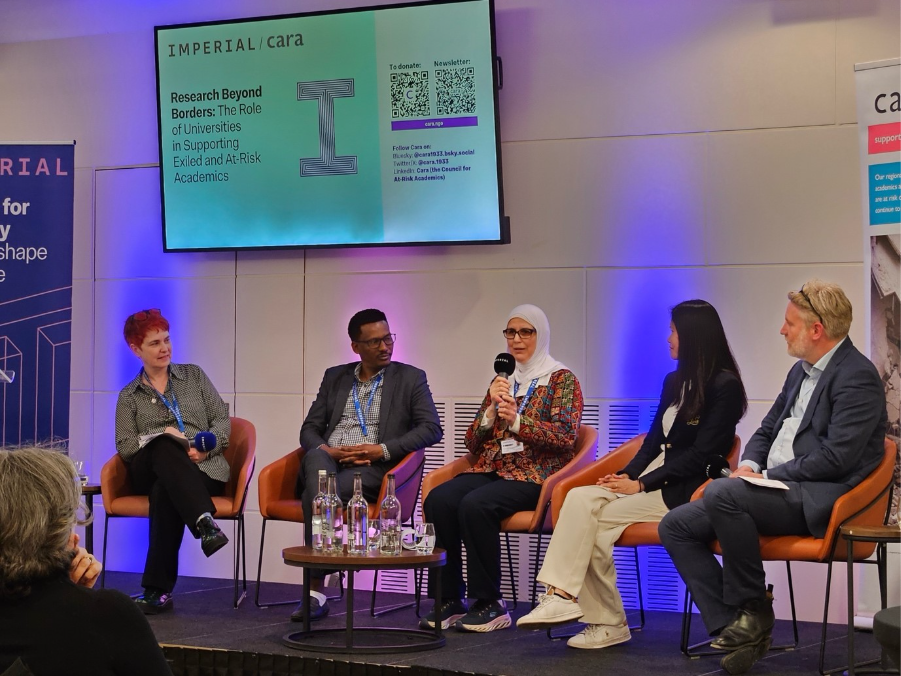
The Council for At-Risk Academics (Cara) is a British charity that helps vulnerable academics around the world to relocate to the United Kingdom so they can safely continue their research.
Cara’s predecessor organisation was founded as a temporary structure in 1933, when the Nazi party rose to power in Germany and expelled leading academics from universities for racial or political purposes.
“Unfortunately, we’re still having to do the same work that we were doing 93 years ago,” said Matt Foster, the charity’s CEO. Cara now offers academics threatened by conflict or political persecution a fellowship programme, which currently allows over 200 fellows to undergo two- or three-year placements within its 135 partner universities in the UK.
“This has been particularly important over the last few years,” Foster said, “where we’ve had a 400% increase in inquiries in our fellowship programme since 2020.”
Over the years, Cara has helped researchers from war-torn countries such as Afghanistan, Ukraine, and Sudan. It is now exploring “Virtual Fellowships” to assist academics remotely, and is in advanced stages of planning such a programme specifically for Palestine.
Imperial has hosted Cara fellows since 2020, with seven at-risk researchers currently working at the university. On 12 May, the College organised a panel featuring two of its Cara fellows, Dr Zenebe Siyum and Professor Hala Elkhozondar, to highlight the importance of this partnership.
“It would be wrong to think that this is just about supporting and helping academics, important though that is – the current fellows also really add a huge amount to our own ecosystem here,” said Imperial’s Vice-Provost for Research and Enterprise, Mary Ryan. “They’re brilliant academics in their own right, they bring new perspectives, diversity of thought, and they add enormously to our ecosystem and research.”
Dr Zenebe Siyum, an expert in forestry working on climate change-related projects within the Centre for Environmental Policy, was trapped in his native country of Ethiopia when the Tigray War broke out in 2020. He described a “total blackout" for the two years of the conflict which made research impossible: “The academic institutions were demolished… It was really difficult, it was a question of survival.” Having been able to publish multiple papers during his fellowship, focusing most recently on the environmental impact of conflicts, he called Cara “an institution that really makes science excel, without borders.”
Professor Hala Elkhozondar, who was born in the Gaza Strip, was two years old when the Six Day War broke out, and remembers a life shaped by conflict. As a physicist at Birzeit University in Palestine, her research was plagued by disturbances and uncertainties, from helicopter sounds to blackouts causing food and water shortages. She hopes her research at Imperial, which focuses on renewable energy and gold nanoparticles, will inspire aspiring scientists at home.
“I wanted my research to be valuable,” she said. “I wanted it to be something that’s not stuck in a journal paper… I hope that my experience will be an example for young researchers who are in similar circumstances, to […] continue and do research even in very harsh circumstances.”
As conflicts rage on and authoritarianism rises worldwide, Cara expects applications to its programmes to remain high in the future. “We’re not just offering a way out of crisis,” Foster said, “we’re offering a way to keep the flames of knowledge alive.”
An interview with Matt Foster, Cara’s CEO
Note: quotes have been lightly edited for clarity.
The Cara fellowship lasts about two to three years. What do academics tend to do afterwards, and does Cara support them beyond their placements?
We provide them with training and support in how to adapt to the UK higher education system, which often is a massive change because you’ve come from a totally different higher education system. This includes: how do you network? How do you do research publications? Because that is the main way in which people are going to build a career beyond.
If you look at the destinations for PhDs in the UK, I think about half are going to industry, half stay in academia. But more of our Cara fellows stay in academia than not. They either stay within their host university, or they get a job in a different university in the UK, or in some cases, they join another scheme with one of our European counterparts.
Cara is the biggest organisation of its kind in Europe, but I understand you partner with others in the US and Europe.
We’ve got two counterparts in the US, one in France, one in Germany. And there is a new European Commission-funded initiative, which aims to build a Cara programme, but across the European Union, which is called the SAFE programme. It’s at the pilot stage, with only about 60 fellows, but if that does move into full scale, it could be quite significant.
How do you select applicants to the fellowship?
First and foremost, we look at academics who can demonstrate they’re at risk. That can be for a lot of reasons, but we can simplify it to two main causes.
First, academics could be at risk because of conflicts, and they are increasingly targets because knowledge is under attack. Number two would be persecution. That might be due to the nature of their research: the space for them to work is being squeezed, or they’re being threatened because they’re proving a threat to an authoritarian regime.
We treat both the same.
Is there a risk that threats might carry on into the UK? For instance, Cara assists academics facing persecution in Russia, a country that is known to target dissidents even abroad.
I think the main thing we do is to make them fully aware of the risks, because those risks are changing all the time, and then we ask for their consent before they take part in a placement that might expose them to those risks. Transnational repression is a big, growing theme that we’ve seen from certain places.
How do you deal with the language barriers of academics coming to the UK?
People need have a certain standard of English to be able to work effectively in their new work environment, so English language ability is one of the key criteria along with academic record and demonstration of risk.
We do provide support. We get funding, for example, from Duolingo, who provide us with free tests so people can test themselves without having to pay anything.
But we have to be very clear from the outset that the bar is quite high, because our demand far exceeds the number of places we have.
We’re also increasingly looking at programmes that support academics in their home country or home region, because not everybody can meet that bar. And there’s still lots of academics at risk that we can’t support in the UK.
When at-risk academics are supported in their home countries, is Cara directly in charge of them, or do UK universities supervise them?
A bit of both. For the Palestine programme, we’re going to use something called “Virtual Fellowships”, where academics stay in their home country, but are assigned to a UK university. That gives them access to all the academic support you have on campus, but virtually. It gives you access to an email address, which might sound quite trivial, but it unlocks all the resources in the university for you that are available, ideally at no cost.
So some people retain their affiliation with their home university, but we build programmes of support around research collaborations, building their English language skills for academic purposes, or academic professional development.
Do you offer psychological support to academics that might be traumatised by their past experiences?
Yes. All our staff are trained in trauma-informed practice, so they can identify and refer to other services. They don’t try to provide that service themselves, but they know how to have the right conversations with our academics and to offer referrals to them to trained counsellors if they need them. The circumstances will vary quite a lot depending on people’s immediate experiences: if somebody’s been living in a war zone for a number of years, they’re going to eventually need quite a bit of support, whereas some others might have been able to get out sooner.
But people are also connected to their families and their communities, their colleagues, and that can also be hugely traumatising.
Is there anything specific that students can do to get involved or support these academics in any way, beyond financial support?
Financial support is obviously welcome, and if that was the case, we can make sure people’s donation is used to direct support the mission.
I think the main thing that student groups can do is continue to talk to your university about supporting this work. Coming to these events [like the panel] is a great thing. The student voice is very, very powerful, actually – use it as much as you can. Keep asking the university what it’s doing, and even what more could it do.
I think the risk would be that people see this scheme as a charity or an optional thing, rather than seeing it as something that brings mutual benefit right to the university.