Union President and DPE visit China
The OTs published a report on the trip, which was partly organised and funded by a group with ties to the CCP.

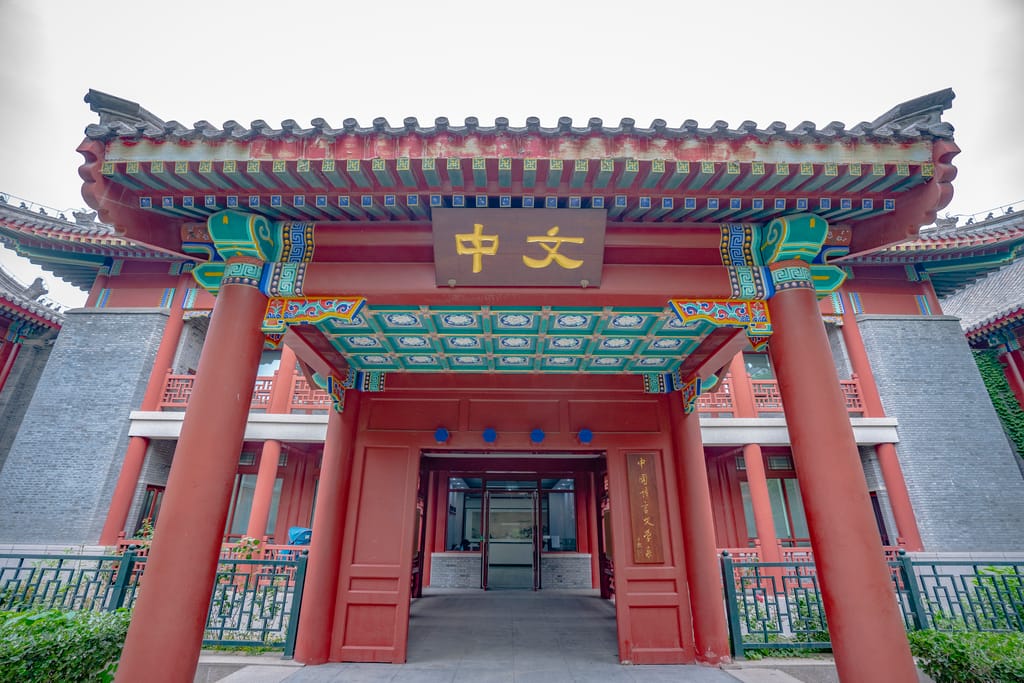
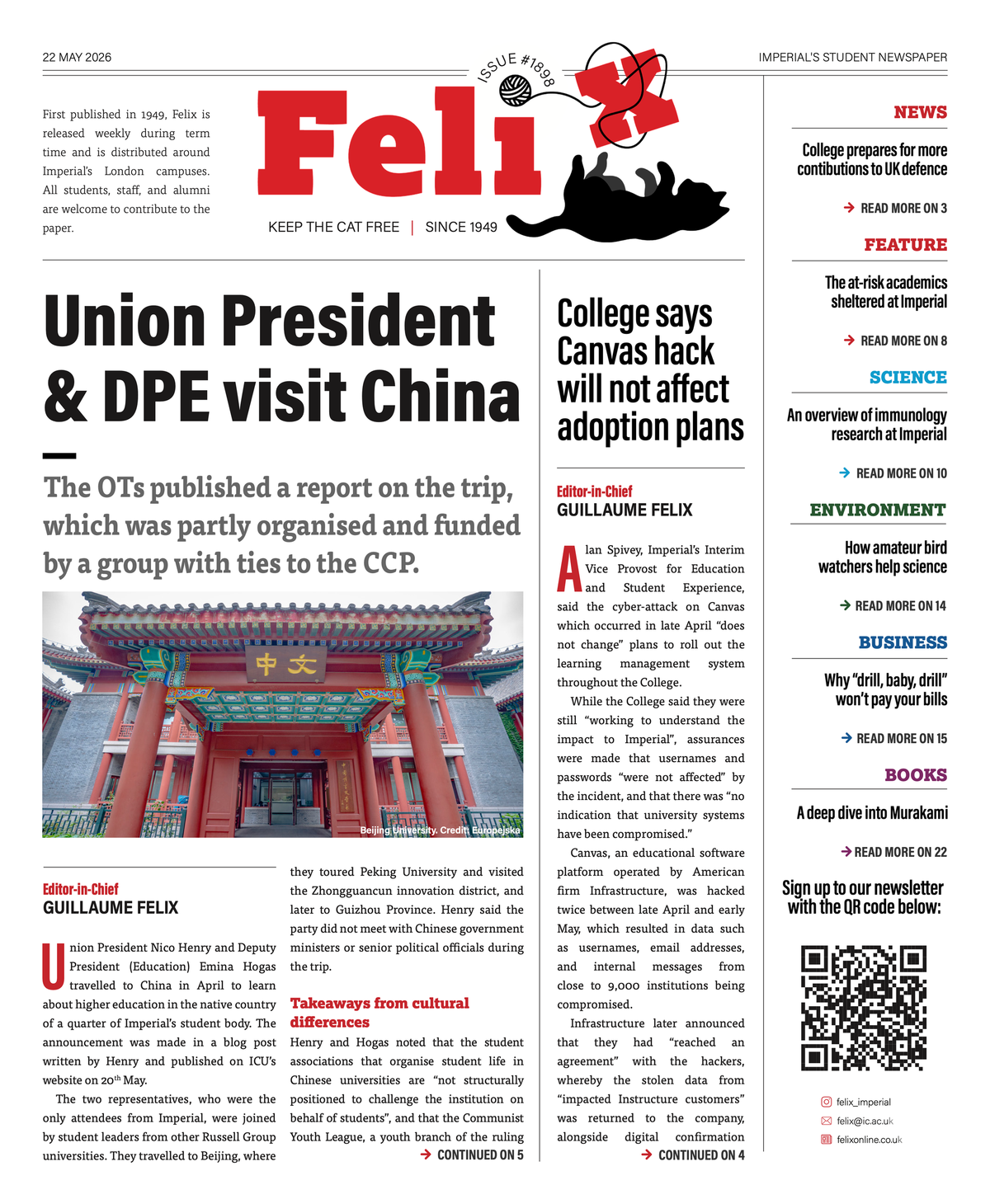
Union President Nico Henry and Deputy President (Education) Emina Hogas travelled to China in April to learn about higher education in the native country of a quarter of Imperial’s student body. The announcement was made in a blog post written by Henry and published on ICU’s website on 20th May.
The two representatives, who were the only attendees from Imperial, were joined by student leaders from other Russell Group universities. They travelled to Beijing, where they toured Peking University and visited the Zhongguancun innovation district, and later to Guizhou Province. Henry said the party did not meet with Chinese government ministers or senior political officials during the trip.
Takeaways from cultural differences
Henry and Hogas noted that the student associations that organise student life in Chinese universities are “not structurally positioned to challenge the institution on behalf of students”, and that the Communist Youth League, a youth branch of the ruling Chinese Communist Party (CCP), wielded influence on campus. “[I]t explains something we observe at Imperial: the idea of a students’ union as an independent body that holds the university to account can feel unfamiliar, even uncomfortable, to students who have never encountered it,” the report said.
The Chinese government requires that undergraduate students undertake compulsory physical education courses at university, with Henry and Hogas observing that exercise was considered part of the academic mission at the institutions they visited. “The question for us is whether we can make physical activity a genuine default at Imperial rather than an optional extra,” they wrote.
The Officer Trustees also noted the advancement of Chinese AI research, the lush green spaces on Peking University, and the preventive approach to wellbeing on Chinese campuses.
Henry told Felix that “the report does not endorse the Chinese government or its policies, and it was not written to do so. We are explicit in it about our values: we believe in free students’ unions, freedom of expression, and the right of students to organise without interference.”
Concerns with CSSAs
The Officer Trustees’ report highlighted the “documented connections” between the Chinese government and university societies known as Chinese Students and Scholars Associations (CSSA). CSSAs are present in many universities outside China, including at Imperial College, to support Chinese students.
The report cited concerns that some CSSAs were used to monitor student activity, but assessed that there was “no reason to believe” this was the case at Imperial. “What we do know is that the CSSA does welfare and community work that formal university structures cannot match,” including support in Mandarin and on Chinese social media, Henry and Hogas wrote.
“Extensive ties to the Chinese Communist Party”
The trip was funded and organised jointly by Providence Academy, a Beijing-based organisation that supports Chinese students studying abroad, and the 48 Group Club, a London-based company that promotes trade between China and the UK. Henry said no costs were incurred by ICU or Imperial College.
The 48 Group Club, which was approached for comment, has come under scrutiny for its ties with the CCP, with the Group’s founder Stephen Perry having notably met Chinese President Xi Jinping. Last month, US and UK lawmakers wrote to the Group to demand transparency on its “extensive ties to the Chinese Communist Party.”
Asked about the ethics of this visit to China, a country with a dire human rights record, the Union President said: “Participation in the programme was discussed with relevant Imperial College stakeholders and at the ICU Board of Trustees. We assessed all risks before going just as anyone would with any other country. The consensus was that a students’ union representing 24,000 students, a quarter of whom are Chinese, has a duty to understand the context its members come from, and that the right way to do that was carefully, transparently, and with a published account of what we found, namely this blog.”