Nature or Nurture: Zadie Smith's White Teeth
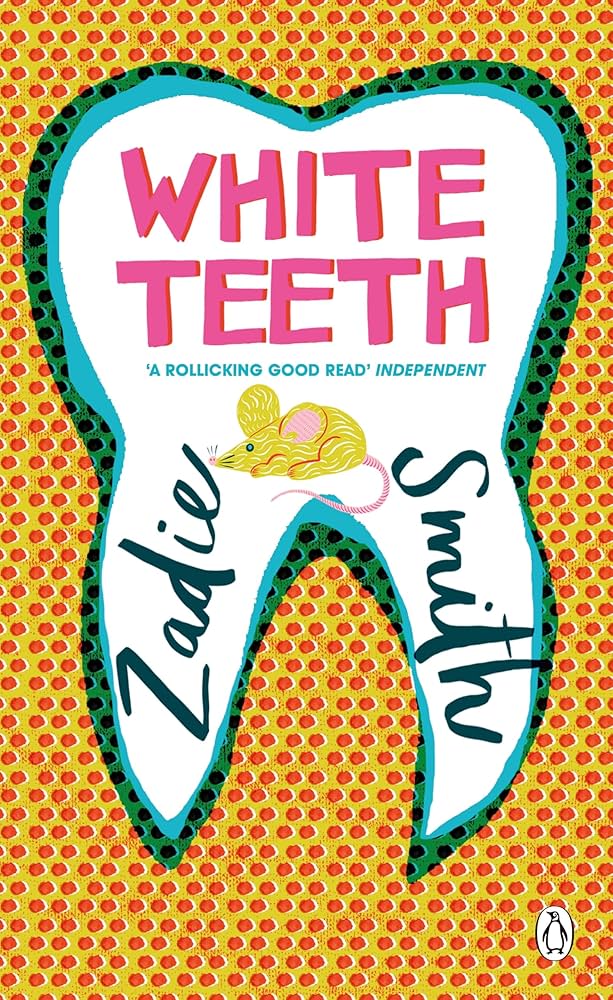
Zadie Smith’s postcolonial family saga White Teeth is a vibrant ode to London’s multiculturalism. Its blend of humour, history, drama, and even biology(!) made it a favourite of mine almost immediately. It follows Archie, an Englishman, and Samad, a Bangladeshi man, who meet during World War II. Samad and his wife Alsana move to London in the 1970s and have twins, Millat and Magid. The twins are children of immigrants, a position which means they have to navigate discrimination and cultural differences.
The question of nature vs nurture can be applied to how children of immigrants are viewed in British discourse. They have been brought up in the UK but are sometimes rejected by British society based on their origin. For many 20th century second-generation immigrants, the question of whether they belong to the country they are born in, or to their country of origin, hovers – whether they are “determined” by their nurture or nature.
In White Teeth, even Samad seems to see Millat’s heritage and upbringing as at odds with each other, thinking: “Millat was neither one thing nor the other, this or that, Muslim or Christian, Englishman or Bengali; he lived for the in between, he lived up to his middle name, Zulfikar, the clashing of two swords.” As well as the evocative imagery of two swords clashing, there’s a repetition of twos here (“this or that”, “Englishman or Bengali”). This is an interesting depiction of the binary that immigrants were faced with: having to belong either to Britain or to another country. White Teeth was written in the 1990s – I would argue progress has been made insofar as that Brits with immigrant backgrounds are better understood and accepted now.
A twin study is a classic way to compare the influences of genetics (nature) and environment (nurture). Identical (monozygotic) twins have the exact same genes and are usually raised in the same environment (in the same family, in the same place, with similar diets, etc.), so twin experiments often look for monozygotic twins that through circumstance (e.g., adoption) are raised in different environments. If the separated twins end up the same, then genes have a strong influence on how someone will turn out (their phenotype). If not, environment might be more important.
Millat and Magid are the novel’s twin study. Both born in the UK, they are separated at age eight when their father, in a bid to rid himself of the guilt of cheating on his wife, decides to send one of his sons to Bangladesh (he can’t afford to send both), believing it will give him a strong religious education.
Samad’s scheme yields unexpected results: Magid returns from Bangladesh an atheist, while Millat becomes very religious. Religion is not a genetically determined trait, but I argue Smith is using this echo of a twin study to challenge assumptions about the different environments of Bangladesh and England. It is also a comment on the randomness of how people develop. Twin experiments are useful, but there are many traits that are better understood as an interaction between nature and nurture than as being wholly genetic or wholly environmental.
I find there’s a bit of something for everyone in White Teeth – I especially recommend it to anyone interested in British immigrant identities or the incredible patchwork of cultures in London. But for any life scientists, don’t worry, there’s plenty more biology in this novel (even a genetically modified mouse!).