Behind Freshers’ Week
Felix and LSE’s The Beaver investigate the social, business, and financial underpinnings of London’s biggest week on the social calendar.

Freshers Week is a student's first glimpse into the world they have been promised to live the best years of their life in. Starting at university feels lonely, so making friends is typically number 1 on students’ to-do list during this week.
Amidst the hustle of moving in and the quietness of the first night without a home-cooked meal, incoming freshers all around London are flooded with WhatsApp notifications.
Tens of ultimate, SUPER EPIC, can’t-miss-or-you’ll-have-FOMO-forever Fresher events (fire emoji, alarm emoji, shocked face emoji) bombard groupchats intended for bonding over student life and meeting those with similar interests.
As if there wasn’t enough to figure out when starting a new chapter, Freshers Week incites a flood of questions that only spark anxiety: “at which of these events will I find the people that I’ll experience my university years with?” Or “Where should I put my money?” Or “Can I be sure this is legit?”
What are the hidden social, business, and financial dynamics behind the drunken club nights that kick the year off? The Beaver and Felix have collaborated to unpack the biggest week on a London student’s calendar.
Why are you spammed so much? And how are the ads everywhere?
Let’s imagine you’re a fresh-faced 18-year-old excited to start university. You decide to follow a Freshers’ Week social media account. On the surface, these accounts primarily serve as a platform to help freshers connect before term starts by posting their submitted photos alongside a few quirky facts. However, follow these accounts for longer than a day and you’ll quickly be bombarded by stories promoting various Freshers Week event tickets and wristbands.
Through these stories, and links conveniently placed in their bios, these accounts funnel you into group chats on numerous other social media platforms, where you’re spammed by these same promotional messages for wristbands, ticket bundles, and all sorts of time-limited offers.
WhatsApp community announcements from London Freshers Week-branded accounts link back to Instagram accounts that claim to be run by incoming students.With little direct access to the admins, it’s difficult to confirm whether or not these accounts are run by actual students. After sending off messages and DMs to the admins of these Instagram accounts and WhatsApp group chats, we were met with either no response or were immediately blocked and removed from the group chat.
One exception was the owner of the LSEFreshers2026 Instagram account. When asked about where they heard about the events they were regularly promoting on their story, they claimed they were just sharing events recommended to them by second-years at an open day. This account was linked back in the London Freshers Week-run WhatsApp communities in promotional announcements, suggesting some form of agreement between the two exists.
Students are generally aware of the tactics used by promoters, and sceptical about who actually runs the group chats. One fresher from UCL shared screenshots with us showing either “real people or bots … talking about how the wristbands are ‘selling out soon’ and that we needed to buy them ASAP.” They suggested that this was a method of generating a sense of scarcity around the wristbands to push sales. Freshers from Imperial were similarly critical, with one suggesting that the unofficial Freshers Week events and the accompanying chats were run by “students or companies trying to rinse freshers.”
Beyond this, we found a similarly confusing relationship between different events marketed towards different London universities. These wristbands are explicitly branded with university names (“LSE Freshers Week”; “Imperial Freshers Week”) but are not led by the respective Student Unions of these universities. Moreover, in the case of London Freshers Week’s wristbands, despite being sold on different pages to different university fresher cohorts, links to the same events and clubs on the same nights: university branding appears to be primarily a marketing tactic rather than an indication of university-specific experiences.
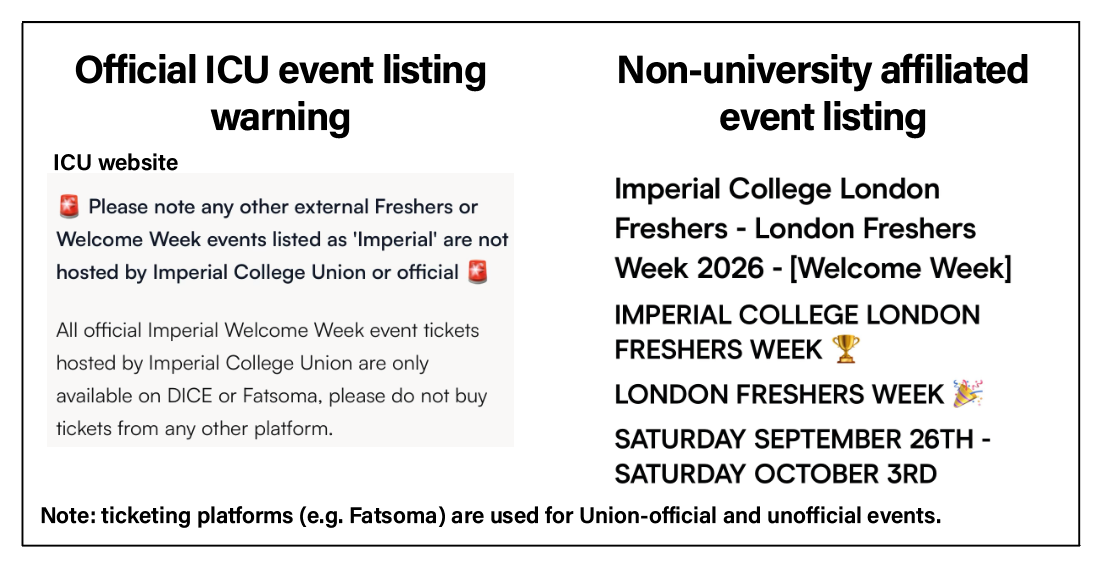
This leads to mixed reactions from students: whilst most are “aware some [events] are official and some aren't,” others report believing there is “only one official wristband” or that they are “not fully sure about the difference between [the various wristbands]”, whilst “some things advertised that large artists such as Drake were playing, that seemed unofficial.” Due to this confusion, freshers report hesitancy around purchasing wristbands. Two freshers from Imperial claimed they did not know anyone in real life “who actually got the tickets - most people got official Union ones.” An LSE fresher said they “heard there are counterfeits as well.” The higher price of around £50 per wristband increased hesitancy, with freshers opting for individual, official Union tickets. On the Imperial College Union (ICU) welcome week website, there are explicit warnings in place to distinguish those official and unofficial events.
How do Student Unions view these non-affiliated events?
Student Unions are naturally aware of any external events that students might be interested in. An ICU spokesperson tells Felix the Union is familiar with most promoters, but not in direct relationships or partnerships with them.
“Student safety is of the utmost importance to us, and there is an extensive list of how we adhere to this,” commented an ICU spokesperson. As official university staff cannot check how safe external events are, regarding aspects such as capacity limits and dedicated medical/welfare teams, the Union expressed a frustration: “it is a shame, as we cannot guarantee that students going to these events are getting the proper Imperial event experience.”
Speaking on behalf of the LSESU, the Activities and Communities Officer, Iris Fu, confirmed that the Student Union is aware of the “long-running issue that many SUs face,” and assured that: “where organisations use the LSESU logo to promote events without permission, we have worked with the School in the past to raise this and, where appropriate, ask for events or promotional material to be renamed or removed.”
Moreover, Iris advised that: “the best way to check whether an event is official is to look for it on the LSESU Events or What's On pages, or on Milkshake’s Fatsoma page, and to check that it carries the official LSESU logo.”
What does this mean for students?
The marketing strategy employed by event companies is designed to seize upon a need unique to anxious freshers: that of needing to meet and connect with people in their new environment. The numbers speak for themselves: in August, one event company’s first 6 wristband releases were already sold out. By the 7th release, freshers should expect to pay 45 pounds to access all the organized events, almost twice the price as the initial release.
Students are sceptical on whether friendships made in the first week, particularly through freshers events, would last. An LSE fresher said “I don’t think making best friends is very important during the first week,” whilst a UCL fresher reflected “I think making friends in the first week of university isn't necessarily too important, because you'll have the opportunity [to make friends later on].”
Simultaneously, there was a definite undercurrent of fear of missing out. The same UCL fresher mentioned that “I would sort of feel left out if I didn't attend many [events], because I wouldn't want to miss out on the opportunity to meet new people.” Another LSE student said they felt “slightly pressured to attend these events as I am aware that ‘social groups’ often form early on and if I don’t make friends early then it would be harder for me to join later on.” Even those who did not necessarily feel pressured to attend events mentioned they purchased a wristband anyway “because I want the option of going out or not.” Although students understand that these events are not a silver bullet to a lasting group of friends, nearly every student did not want to miss out on the opportunity to cast a wide net when establishing their potential social circles for the next 3-4 years.
The Beaver and Felix would like to leave freshers with an important but often overlooked message. We’re often sold the idea of meeting the friends that will carry us through the rest of our three years in that first week. Whilst for a lucky few this is true, university life provides boundless opportunities to connect with people. The strategies used by event promoters rely heavily on the notion that there is no week beyond the first, which cannot be further from the truth.