Imperial’s plan to help the planet
What you need to know about the 2026-31 Imperial Sustainable Strategy.

Imperial launched its second five-year sustainability strategy late June of this year, ahead of the summer now confirmed as the UK’s hottest on record by the Met Office.
Less footprint: net-zero campuses by 2040
The 25-page strategy overall aims to “accelerate a sustainable transformation for industry and society”. It is mainly built around simultaneously minimising Imperial’s environmental footprint, and growing its handprint, defined as positive changes that enable others outside a company’s own value chain to reduce their impact.
On footprint, net zero campuses in direct emissions by 2040 star as the main goal, as Imperial wants to lead by example on the energy source transition.
Harriet Wallace, Director Sustainability at Imperial, highlights Imperial’s phased rollout of heat pump technology to substitute traditional gas-fired heat and power engines.
“The grid is getting cleaner and the global picture is changing”, she says.
More handprint, but who do we hold hands with?
As part of maximising Imperial’s positive handprint, the College’s partners will continue to be held accountable to their decarbonisation strategies as Imperial “expect[s] to disengage from all academic and research collaborations with companies that do not meet our criteria”.
Since 2025, the framework that details the criteria used to evaluate sustainability in Imperial’s partners is the Imperial Zero Index (IZI). The main criteria include financial commitment to fulfil decarbonisation intentions, climate policy engagement, and forward-facing emission reduction targets. Approved companies currently include BP, Shell, and Petronas; Woodside Energy was removed from this list earlier this year after failing to pass the index.
A Felix investigation published earlier this year revealed available IZI 2025 criteria lack explanations on evaluation metrics weightings or reports on how approved partner companies carry out their environmental goals.
The College will continue to use the IZI as part of their sustainability plan, as Imperial will research with fossil fuel companies only if said company “demonstrates a credible strategic commitment to achieving net zero by 2050”. No further detail is given on the definition of “credible” in the document.
IZI index results will be shared with the community annually, with an increase in partner’s IZI score being the only measure of progress mentioned in the strategy.
Not least, but last: AI emissions aim to be understood only by last year of strategy
Imperial is yet to measure its AI-related emissions and impacts. “I would love to [measure] it faster too. We just don’t know how to do it yet”, comments Harriet Wallace.
Imperial has newly established a Professional Services AI working group with a Responsible AI subgroup that are working on clarifying timelines to accelerate the deadline.
Tackling indirect emissions indirectly
As for 2031 deadlines, Imperial aims to cut scope 3 indirect emissions related to procurement (the process of purchasing goods and services) by 15% and striving for 28%.
Procurement, accounting for almost half of all scope 3 emissions, is being tackled by obtaining sustainability data from Imperial’s top 250 suppliers through the Net Positive Supplier Tool. Imperial has also hired the consultancy Eunomia to find plausible decarbonisation strategies in this area.
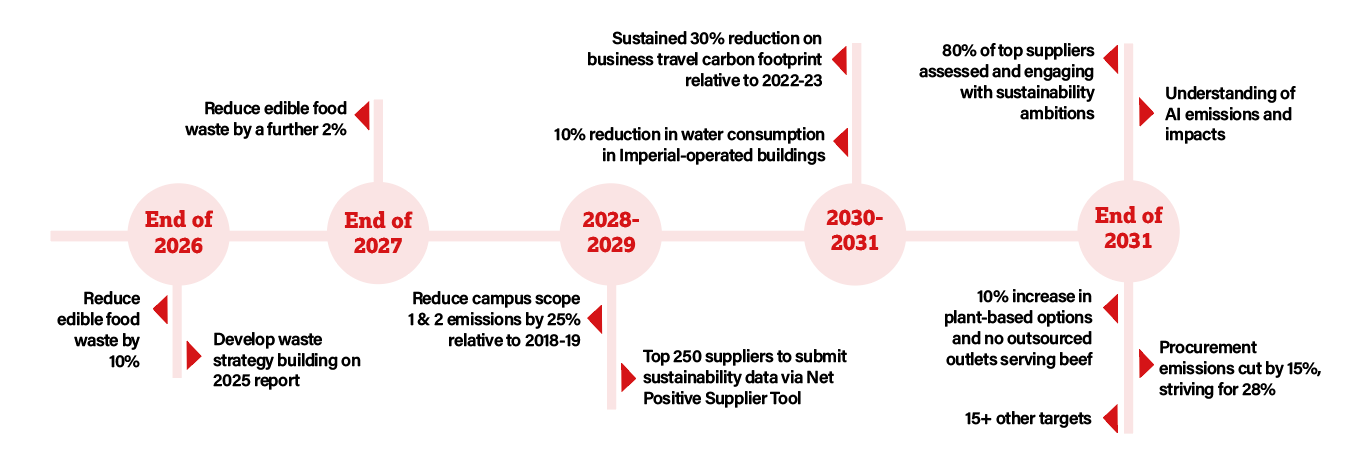
See the graphic below for a timeline of the Sustainable Imperial Strategy’s main goals.
The main milestones and their deadlines of Imperial's Sustainable Strategy 2026-31