Italy is sitting on a gold mine: leave it there
Despite sitting on one of the world’s largest gold piles, the Italian government cannot use it pay down their mounting debt
Eurozone countries’s central banks such as the Dutch Central Bank (DNB) continue to repatriate their gold for crisis preparedness, wanting the commodity where it can be turned to cash fast enough as a hedge against US policy risk. However, Banca D’Italia (the central bank of Italy) has displayed no intention of making a similar move despite their own fiscal issues. Italy holds the world’s third-largest national gold reserve with 2,452 tonnes (sitting just above France and below Germany) worth around €290bn, with roughly half of it stored in the capital Rome and the rest between the New York Fed, the Swiss National Bank, and the Bank of England. Similar to foreign currency reserves, gold represents a fragment of the monetary assets that underpin the credibility of the single currency and is used for monetary stability rather than a fiscal resource. As one of the Eurozone’s most indebted governments, ranked 6th globally in debt-to-GDP ratio at around 138% of GDP, the temptation for Italy to tap on that reserve seems hard to ignore.
Even though they have always been considered as a reserve for national benefits, the reserves are formally recorded on the Bank of Italy’s balance sheet to keep it available for financial stability and away from short-term budget decisions. Therefore, “Who controls the gold?” has been a political question for years. In November 2025, Lucio Malan, a Member of the Senate (upper house of the Italian Parliament) for the Prime Minister Giorgia Meloni’s “Fratelli d’Italia” far-right party, proposed declaring that the reserves “belong to the State, on behalf of the Italian people.”
The ECB pushed back twice, arguing that the provision’s purpose remained unclear after revisions as the draft text lacked explanation on why a new ownership declaration was necessary. The pushback renewed a recurring Italian debate that has resurfaced since 2005 when the Berlusconi government passed a law to transfer the gold to the Treasury, as a governance reform, but it was never put into effect. Nevertheless, behind the amendments are EU rules which forbid central banks from financing their governments to cover the public spending. In 2019, the ECB warned that moving the gold to the State could sidestep the rule. Though, even if avoiding the ban was possible, would selling the gold actually make a difference?
No legal changes followed. The Minister of Economy and Finance Giancarlo Giorgetti assured the ECB president that the Bank of Italy still has full custody and management of its gold under the EU rules. In August, the public debt stood at €3,200bn. If the reserves are drawn, the country can pay off 9% of the debt. It would save interest between €9 to 13bn a year. It represents a significant one-time reduction in the stock of debt, without addressing the deficit planned to rise to 3.4% of GDP (2027): an indirect cost hides behind this liquidation.
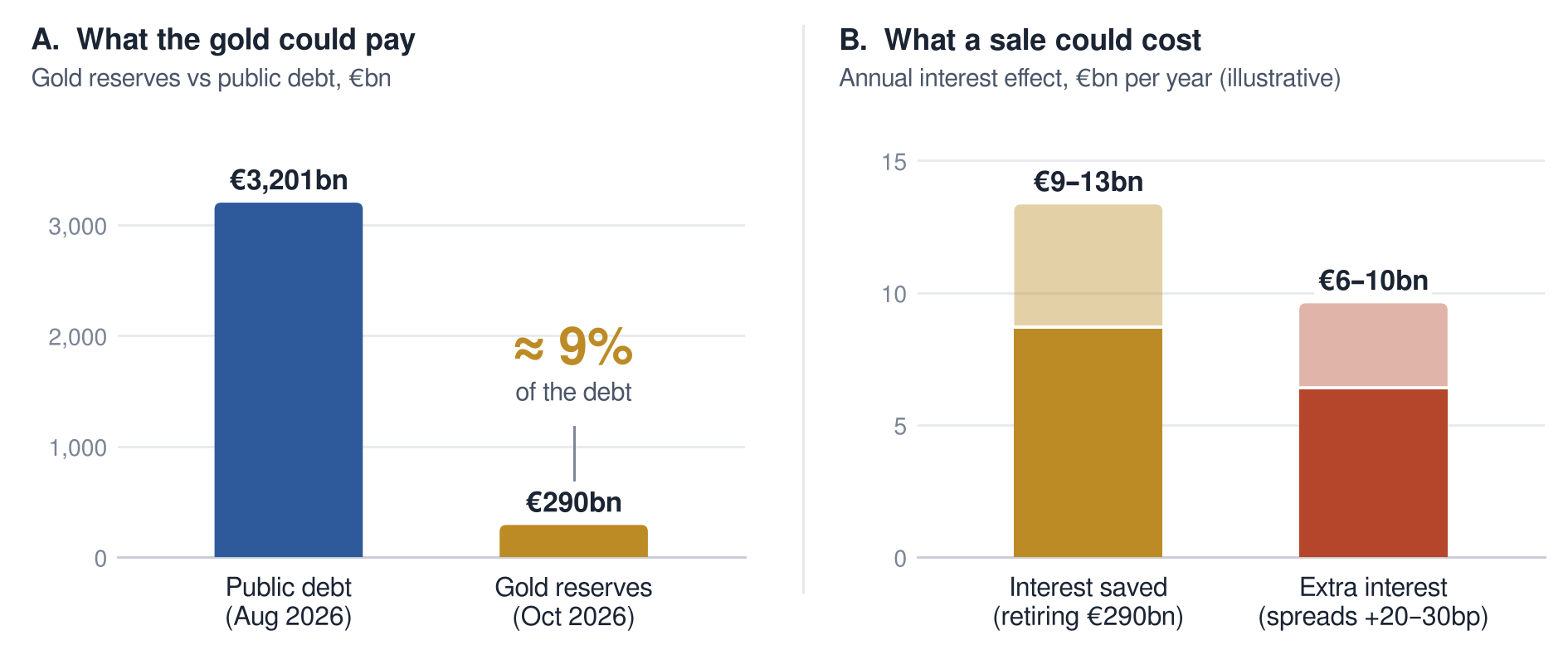
This is not the first time that the bond markets have punished Italy for its fiscal issues in recent years. In 2018, the announcement of a higher deficit target made the gap between Italian and German 10-year yields (also known as the “spread”) jump to over 300 basis points in two weeks, compared to the current 100 basis points. German government debt (German bunds) is considered to be the safest debt in the Eurozone, and acts as the zone’s risk-free benchmark rate. The spread from the risk-free benchmark often indicates how much extra interest investors demand to take on another country’s debt. As the market scrutinises Italy’s fiscal responsibility, the gold sale will look like a fallback revealing a weakness and spooking investors. Consequently, leading to a rise in the spread, but even a small rise of 20 to 30bps would cost €6bn to €10bn a year in extra interest while the debt is refinanced.
The DNB’s strategy was to move their gold from New York and Ottawa to London, to keep it tradable during a crisis. For Italy, holding it carries an option value. It is a liquid reserve that Italy could draw on. Italy has the eurozone’s second-largest debt ratio after Greece. The presence of gold shows a tangible sign that Italy has their own resources to lay on. It also makes investors more confident and willing to accept lower interest rates. Drawing on the reserve would easily forfeit that safety buffer.