Cashing Out on Chips: The Chip Selloff
Chip stocks have suffered their worst losses since 2006. The decline began with OpenAI revealing a concerning revenue outlook and a claimed chip-design breakthrough by CXMT, while U.S. inflation made the markets’ fears worse.
The last few weeks have been brutal for global equity markets. Technology stocks have fallen across the world as increasing borrowing costs for a heavily indebted industry have started to make investors worried about their long-term outlook. Between 6 October and 22 October, the Nasdaq Composite fell by 5.96% and the S&P 500 by 2.50%. The companies that had benefited most from the AI boom were now among the biggest losers. This was clearest in the Philadelphia Semiconductor Index (SOX), which fell by 18.45% in the same period.
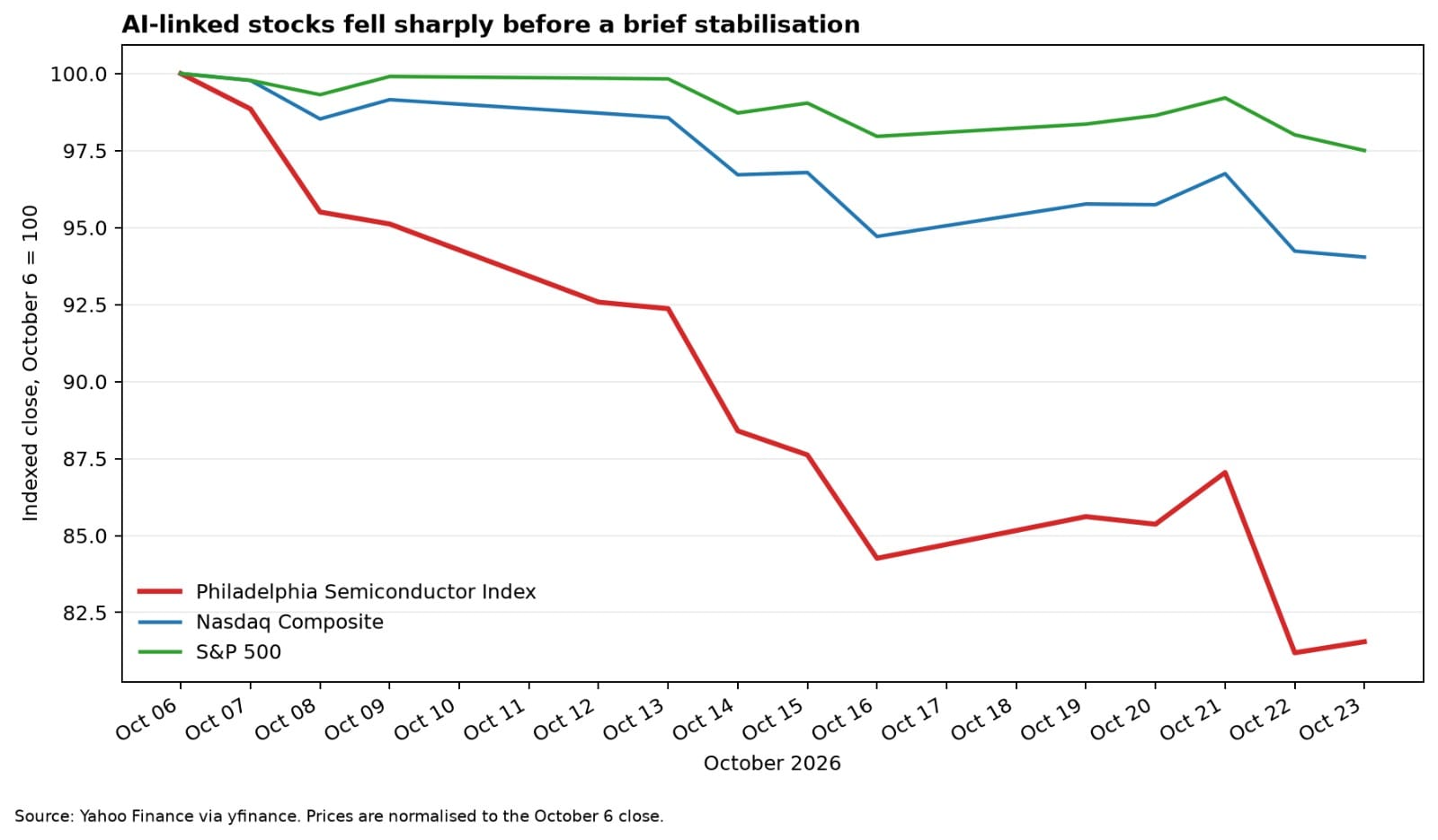
The pressure had been building as investors were wondering whether the earnings promised by the AI boom would arrive quickly enough to justify the prices they were paying. As the revenue potential of all the major firms started being analysed, investors became more selective about which companies could support their growth with actual earnings and cash flow.
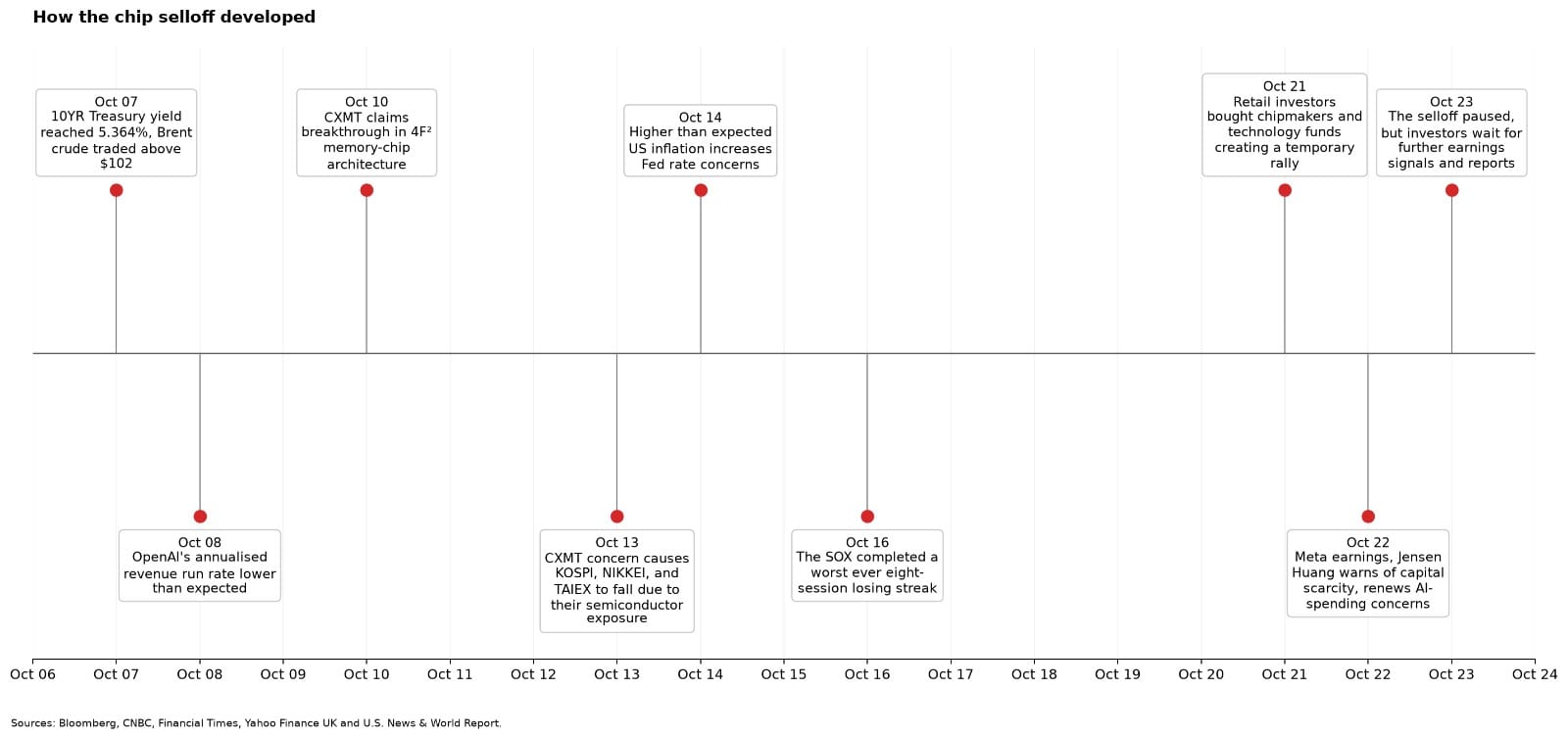
On 7 October, the yield on the ten-year U.S. Treasury reached 5.364%, its highest level since April 2002, while Brent crude traded at $102.59 a barrel, with most analysts expecting its price to rise. Higher yields meant that the future earnings expected from technology companies looked less attractive, as the risk-free rate provided by government bonds had risen. Not only this, but the higher yield also meant that the rate at which firms were borrowing for their AI infrastructure had risen, increasing the costs they faced.
As the rise in Treasury yields has been slow, markets are expecting higher rates for some time and therefore the correction in technology stocks has been limited. However, it has left the sector more exposed to negative news.
On the following day, news started to spread that OpenAI had told its investors that its annualised revenue run rate was roughly $50 billion, below the $70 billion figure it had reportedly cited the previous month. Despite the figures not being directly comparable because they treated the revenue generated by their cloud subsidiary companies differently, it was enough to raise alarm bells among investors.
Chinese chipmaker CXMT also said at an industry conference on 10 October that it planned to produce state-of-the art chips using a 4F2 design by the end of 2026. The architecture would increase the density of its memory chips and improve manufacturing efficiency while reducing its dependence on high-cost, advanced lithography machines supplied by ASML, the world’s largest supplier of extreme ultraviolet lithography systems.
This sparked immediate concerns among Asian memory-chip makers like Samsung and SK Hynix, which are among the companies most exposed to CXMT’s claim. Both are South Korean companies that have been trying to make similar advances in chips for years. CXMT had reportedly risen to 10% of the global dynamic random-access memory (DRAM) market in the second quarter, from 4% at the same point the year earlier, according to Counterpoint Research. The situation raised concerns that the South Korean companies could lose their leadership of the DRAM market, unsettling investors in these established producers.
This resulted in heavy selling on the KOSPI, with circuit breakers being triggered on the 13th and 15th. The selling also spread to Japan, with shares in Kioxia and Advantest falling. TSMC also declined, despite reporting strong profits driven by demand for artificial intelligence products. This suggests that despite current strong demand for AI and therefore strong demand for chips, share prices are beginning to be affected by a loss of investor confidence in how much growth will be delivered in the future.
After SOX had its eighth consecutive day of losses, the market finally started a slow recovery on 16 October. Retail investors became active and bought the same stocks that had fallen sharply in the previous week. JPMorgan data showed that technology stocks were being bought at the highest levels since the July momentum cooled off. Moreover, weekly purchases of technology ETFs reached their second-highest level on record.
However, the recovery happened as retail investors were reducing their exposure to the Magnificent Seven. This likely means that investors were becoming less willing to pay premium prices for the largest AI companies.
The sector rebound did not last long and collapsed again on Thursday, 22 October. This time around, the main driver stemmed from Meta’s earnings announcement. The earnings showed that Meta had a decrease in free cash flow and planned to issue new stock in order to help fund its expansion into data centres. To add to this, on Thursday morning Jensen Huang, CEO of Nvidia, stated during a conference that there was a lack of cash reserves limiting growth in AI. This caused concerns among investors that the cash needed to fund the industry’s AI infrastructure was starting to affect companies’ cash reserves and would therefore lead to more borrowing.
Against this backdrop, tensions have risen between the U.S. and Iran. Reports that the U.S would re-engage after its midterm elections and that Israel would reengage after its elections contributed to Brent crude to rise above $116 on Friday. This rise in fuel prices increased concerns that inflation would remain elevated and that hopes of interest-rate cuts could be delayed.
The news from Meta and Nvidia showed the market that companies will continue to pay high borrowing costs, despite the continued concerns with inflation. Taking all of this into consideration, institutional investors have massively increased short positions in certain parts of the technology sector.
However, the market did settle on Friday and now appears to be in balance in terms of valuing the AI sector. The fact that the market has stabilised suggests that investors are no longer investing blindly across the whole sector. Investors are now looking to invest in companies with stable cash flows. Companies which require large amounts of cash in order to develop their infrastructures will be under more scrutiny. This can be seen as a positive development after the chaos, as companies will now be assessed more closely when they release their earnings information.