Youth despair is driving markets to the extremes
The volatility of the KOSPI is a warning to all other economies that have been ignoring the prospect of the younger generation.
The KOSPI circuit breaker (a halting of trading activity for 20 minutes to calm panic selling) has been triggered nine times due to 8%+ flash crashes for the index. Excessive concentration of the market in SK Hynix and Samsung has been the talk of the town, with these two stocks (and their leveraged ETF products) accounting for more than 80% of the trading volume of the KOSPI on some days. Yet, under the revealed dangers of market concentration and leverage, the behaviour of the KOSPI more concerningly shows the dangers of hopelessness and despair in the youth.
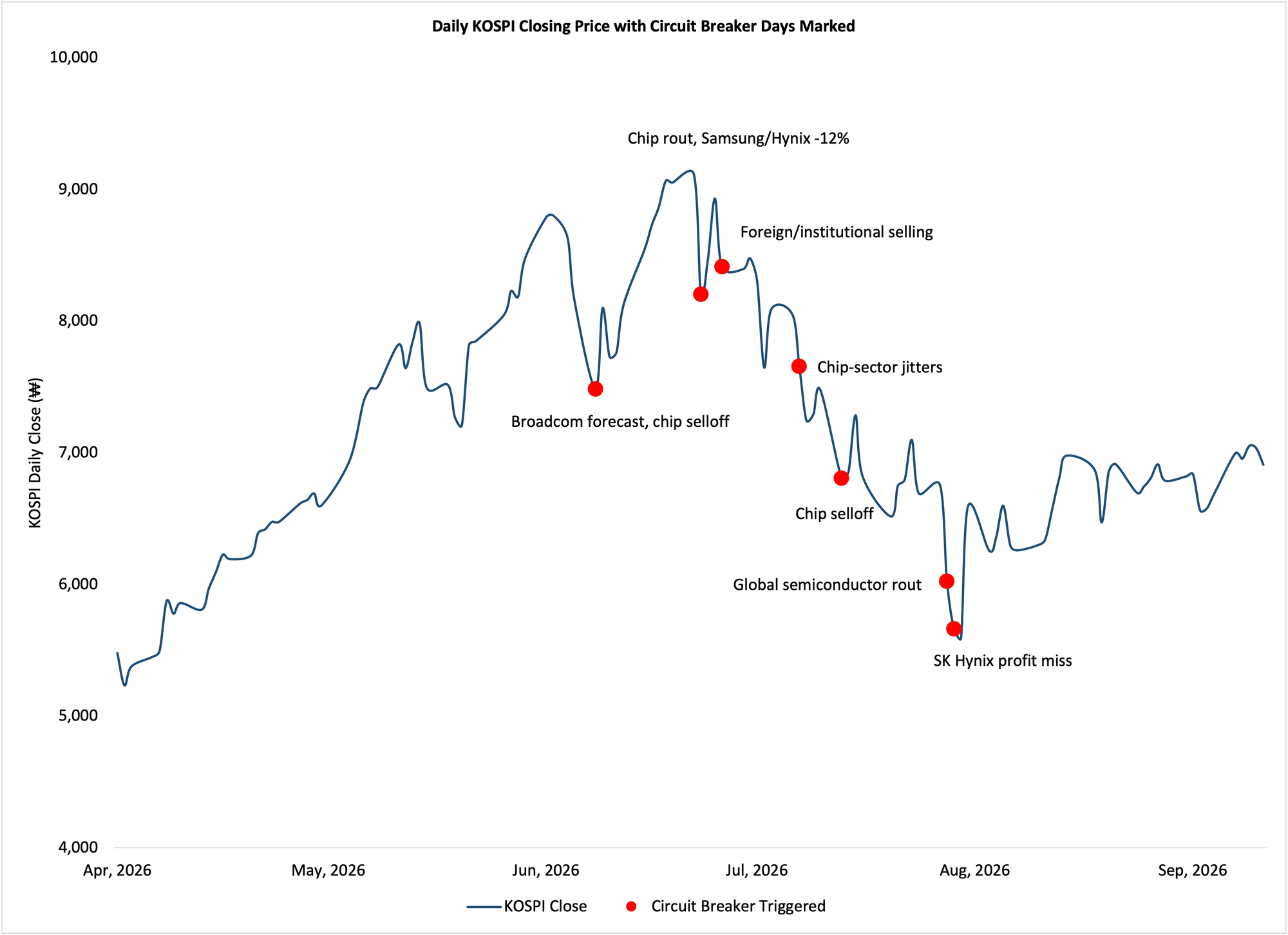
Broadly, a crash like KOSPI's happens through a loop triggered by a shift in AI hardware sentiment. When there is doubt about AI hardware, SK Hynix and Samsung (two of Korea's biggest companies by market capitalisation) and their leveraged ETFs get sold, as they are some of the biggest names related to this sector. To run these 2x leveraged ETFs, the ETF managers work with banks to settle a daily contract, where the bank holds the leveraged position for the ETF managers for a fee. When the prices of the ETFs fall, the bank dumps the stock to hedge, furthering the downward price pressure on the stocks. As a massive number of South Korean retail investors bought the leveraged ETFs using borrowed money from brokers, their brokers automatically liquidate their positions if the value of their positions would cause the broker to lose their loaned money. The multitude of downward pressure on these two stocks caused the KOSPI to drop aggressively in price as it is a marker capitalization weighted index. This is what triggers the circuit breaker.
According to research by Imperial College Professor Danilo Mandic in "Financial stress evaluation: a complexity science approach," a healthy market is "complex". This means that the market's movements are irregular and hard to predict because countless investors are reacting independently to different information. By contrast, a stressed market is reflected as a collapse of the market's complexity, where investors move as one. The result is that the price signal becomes self-reinforcing, making the KOSPI's liquidation spiral a textbook case. The framework laid out by Professor Mandic describes what a stressed market looks like. Thus, the pressing issue to investigate is the source of the systemic stress that has set off this spiral repeatedly in the past 6 months.
A member of South Korea’s parliament, Lee Jong-wook, stated that the Korean stock market “has turned into a casino.” The term "casino economy" is a system where stalled upward mobility makes taking a gamble for a chance at escaping this hopelessness rational. This is exactly what South Korea is experiencing as told through the recent KOSPI crashes. Not only were 90% of investors in the leveraged ETFs retail investors, more than 60% of accounts that were wiped were investors in their 20s and 30s.
This is a reflection of the "Youth Recession" that is hitting the Koreans who have just entered, or are about to enter the workforce. On the surface Korea's economy has been chugging along compared to its peers, GDP is projected to grow 3.0 percent in 2026 and headline unemployment at around 2.7 percent. Yet focusing on the youth tells a completely different story.
A large part of South Korean economy surrounds a phenomenon known as "Chaebol centering", where many view that a viable path to a middle-class life is through employment in one of the three Big South Korean MNCs: Samsung, Hyundai, or LG. The formation of these "Chaebols" (massive, family-owned industrial conglomerates) emerged after the Korean War under significant government intervention, and now have a symbiotic relationship with the political and economic system of South Korea. For the average person, these companies offer significantly higher wages, job security, and extensive benefits that set up the workers' entire family. However, youth hiring at major corporations has slowed from 24.8 percent in 2022 to roughly 21 percent in 2024.
The dwindling of opportunities in these MNCs in combination with the hyper-competitive education system in South Korea starting even before university (pre-university students regularly recount their experience studying at least thirteen hours a day to prepare for their university entrance exam), have lead many to forego this path all together. As of July 2026, youth unemployment has fallen for 45 consecutive months, despite overall employment holding steady. Moreover, nearly half a million youth were classified as "resting" when surveyed on their work status, despite this category typically being reserved for retirees. Even though the Bank of Korea cites that many of the youth say that they want to just work for an SME, the shifting economic conditions have even led SMEs to focus on immediate profit, meaning that they are looking for experienced hires. More specifically, workers in SMEs over 50 years old have increased 12.4 percent in the last 10 years despite the government trying to incentivize youth hiring with subsidies and tax credits.
This feeling amongst the youth of dwindling opportunities despite a supposedly positive economic outlook is something that has been labelled as a "vibecession" (a term coined by author Kyla Scanlon, meaning a gap between good economic data and bad public feelings about the economy). The helplessness that comes when "you do everything right and still feel underwater" is something that Kyla Scanlon views as a core ingredient that leads to the tendency to participate in this "casino economy". More concerningly, South Korean youth believe that it only gets worse, as "Six out of 10 young adults expect Korea's economic and social conditions 20 years from now to be worse than today." So the only way to feel economic inclusion and be able to participate in a normal middle-class life is through a win on one big bet, which in the most recent case has been the AI trading cycle and its leveraged products.
South Korea's case may seem like a perfect storm of despair, economic inequality, and dangerous financial products, yet other countries should beware of the illusion of invulnerability that they may feel. For instance, the US has seen leveraged ETF assets experience a 50% rise in daily volume. According to the Investor and Financial Education Council in Hong Kong, the proportion of people trading for short term profits is up 30%, barely trailing the amount of people who trade for long-term capital growth, citing the top reason being for "quick profits". In India, 88.5% of under-30 traders lost money, with some low-income traders having a trading intensity (the value of trades executed relative to their portfolio) of 75 times their portfolio value. There is by no means a one-size fits all solution across all these economies, but the KOSPI's volatility has proven that ignoring the youth's economic prospect will ripple back into the economy in a meaningful and painful way.