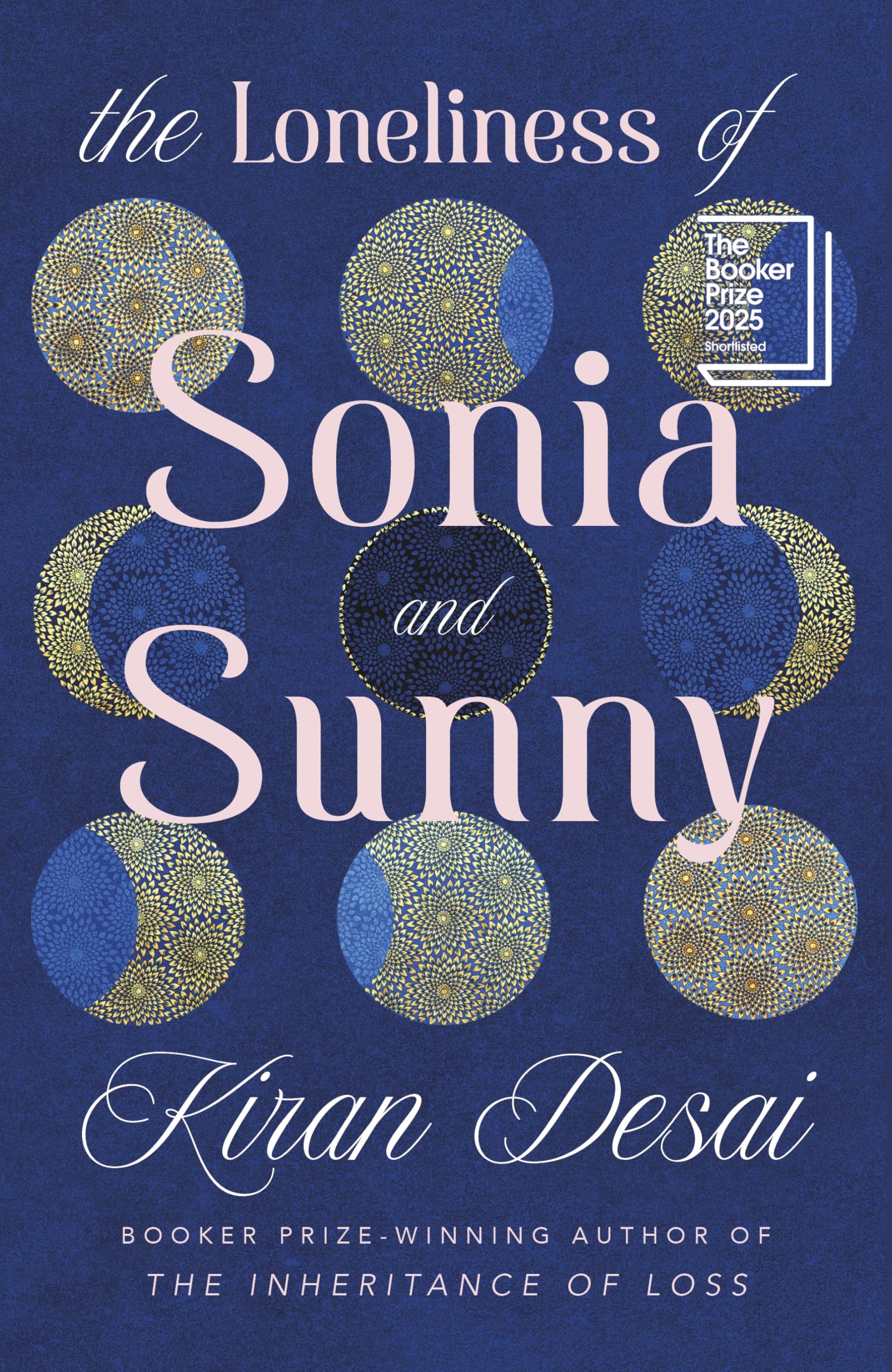
The Loneliness of Sonia and Sunny by Kiran Desai
A review of the messy but rich novel, shortlisted for the 2025 Booker Prize.
Desai’s prose is extravagantly detailed, endowing the characters with every minuscule nuance of their cultures and the pain that inadvertently accompanies it.
Opening with illustrations of two sprawling family trees, Kiran Desai acquaints the reader with Sonia Shah and Sunny Bhatia, two young people quietly aching with identity, aspiration, and displacement. Their lives converge and diverge across India and the United States, pushed and pulled by family obligations and the unsettling incapacity to identify where they belong.
Desai’s prose is extravagantly detailed, endowing the characters with every minuscule nuance of their cultures and the pain that inadvertently accompanies it. From a family’s precious kunduns (gemstone and gold jewels) to the steel tiffin boxes passed down generations, Desai truly leverages imagery with a magical realism, leaving the reader mystified and misty-eyed, immersed in the coexisting decay and sustenance of tradition.
Layering memories, migration histories, family myths, and personal failures, Desai creates a dense, textured portrait of the modern Indian and diasporic experience. Across Vermont, New York, and India, she carries the reader through individual and often isolating experiences that echo across the globe.
Desai does not fall victim to melodramatic characterisations. Sonia returns to India after a painful affair with an older painter, and Sunny attempts to distance himself from his extended family. These experiences read as deeply human struggles shaped by culture, class and the messiness of desire, united with the doubts, yearnings, and attempts to nest in an environment that doesn’t always nurture them. The plot digresses frequently into the stories of several minor characters, culminating in a richer, albeit non-linear, occasionally slow progression. The meandering nature of the plot, in my opinion, mirrors the messiness and complexity of what we inherit from our families.
Sonia and Sunny are forced to confront the stories and curses they’ve inherited to find connection and satisfaction.
Family is not always a source of comfort, and solitude is not always an absence. In fact, in this story, it is perhaps the third protagonist. Sonia and Sunny (and the reader) are forced to confront the stories and curses they’ve inherited and the selves that they’ve invented in an attempt to find connection and satisfaction. Despite what the title may suggest, Sonia and Sunny’s eventual relationship is hardly the central plot engine, but rather a subtle, careful emergence of the negotiations of identity, desire, and longing to find home.
By no means is this 700-page read a clean, linearly progressing romance between two culturally displaced individuals. The Loneliness of Sonia and Sunny is a story of exile; an elaborate, nuanced, messy painting of the convoluted identity nested in cultural dislocation, and the capacity for isolation to creep in even whilst surrounded by community.