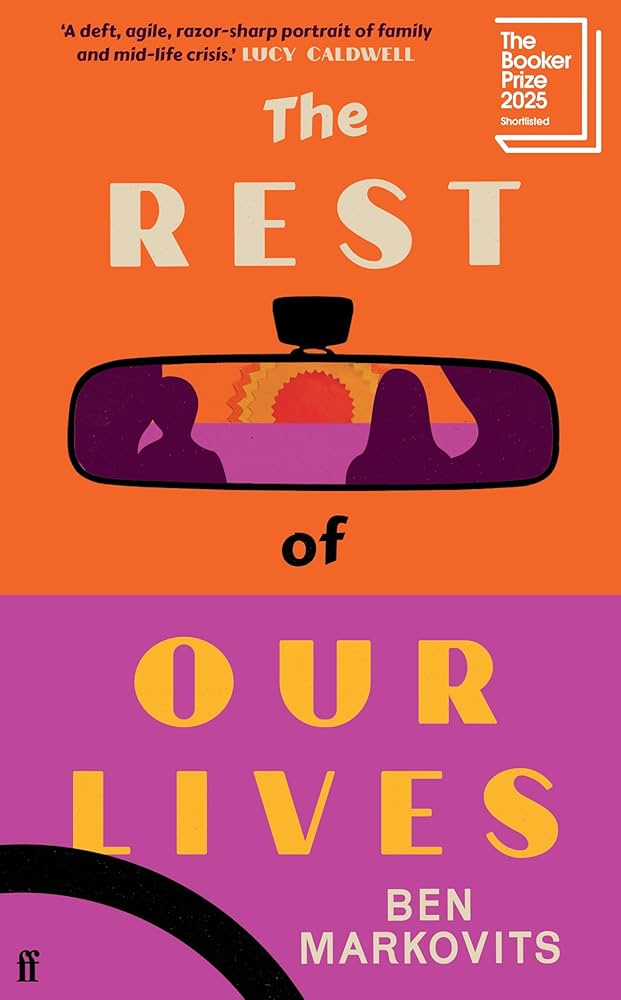
The Rest of Our Lives by Ben Markovits
Shortlisted for the Booker Prize 2025, Emrys reviews The Rest of Our Lives.
The Rest of Our Lives by Ben Markovits tells the story of Tom Layward, a prototypical middle-aged, white American man who embarks on a cross-country road trip 12 years after discovering his wife’s affair. Once finished moving his youngest daughter into university, he drives west, staying alternately in stopover budget inns and old friends’ homes. With a commitment to verisimilitude, Markovits delivers a straightforward road-trip story brimming with potential.
Tom is meant to be an approachable protagonist, if not necessarily a likeable one. He is a white man who feels he has been wronged, by both his wife and society at large. Shortly before the start of the novel, he is encouraged to take a leave of absence from his position at Fordham Law School due to his involvement in a reverse-racism suit. Beyond the workplace, Tom asserts that “transvestite” is a “perfectly good word” for genderfluid or non-conforming people. His politics can be alienating, but they are never consciously malicious. Rather, as I followed Tom’s journey, it became clear to me that he is overwhelmed by his own bitterness. Despite all his time spent reminiscing, he is unable to accept his own missteps in his life and marriage. These traits are not uncommon, and worth exploring in fiction, but spending a novel alongside someone like Tom can be disappointing at best and frustrating at worst.
It leaves the reader asking, “What’s wrong with him?”
Tom’s journey is one of perpetual motion. As he says heading into the last leg of his trip, “I had a kind of momentum on the road that was a useful distraction,” though from what is not made explicit. Readers are meant to assume it is the drawn-out end to his marriage. Yet, as the novel progresses, we learn of Tom’s chronic facial swelling, shortness of breath, dizziness, and fainting, diagnosed by his doctor as “long COVID” (spoiler alert: it’s not). This illness confuses any attempts at a plot focused on self-reflection. The potential sharpening of Tom’s emotional intelligence through self-reflection is immediately dulled by this Chekhov’s gun of medical mysteries: instead of inspiring the reader to interrogate their own life and its momentum, it leaves them asking, “What’s wrong with him?”
What sets the book apart from other stream-of-consciousness works is Tom’s familiar tone. His voice is casual and reticent, lacking poetic language. This authentic narrative voice is, in my view, both the greatest strength and greatest weakness of Markovits’s style. While quick to digest, the straightforward prose often lacks the substance promised by the cover’s blurbs, and with a limited plot, readers may bore easily. I believe that the promise of the novel’s emotional resonance was not quite met, even if its commitment to capturing a cultural moment is commendable.
Though The Rest of Our Lives is not a novel I’ll remember for the rest of my life, it has its merits and is worth the read if you enjoy realistic literary fiction with a straightforward plot.