“This is a genocide”: Iran’s anguish, in the words of Iranians at Imperial
Felix speaks with three Iranian members of the Imperial community about the desperate situation in their home country.
Dead bodies of protesters lining the streets. Security forces raiding hospitals, abducting patients from their beds. Medics targeted and threatened for trying to save protesters’ lives. Demonstrators shot point-blank in their eyes and heads and targeted with chemical weapons.
These are only some of the sickening atrocities happening right now in Iran, according to Maryam, Rostam, and Kaveh, three Iranian members of the Imperial community with whom I spoke this week. I have used pseudonyms for my interviewees for the purpose of this article to protect their anonymity.
Maryam, who grew up in Iran and receives intermittent reports from family and friends back home, tells me that families wishing to collect their children’s bodies are reportedly forced to pay large sums to authorities to do so.
“It’s called a ‘bullet fee’,” she says, “for killing their child because they were spying, because they were brainwashed, because they shouldn’t be opposing their government – [the regime] makes up all kinds of lies.”
Two interviewees tell me they have heard of authorities refusing to release women’s bodies to their families. I hear haunting stories of protesters facing sexual assault whilst in custody.
Rostam, who lived in Iran during his childhood, tells me everyone he speaks to who is still in the country describes it as “literal hell.”
The atrocities committed by the country’s theocratic regime have led many Iranians to turn against Islam, Rostam tells me. “They built the Islamic Republic on complete lies,” Maryam says, “their laws are nowhere near what the Quran sets out.” However, despite the population’s resulting dissatisfaction with religion, converting from Islam is punishable by death.
I have seen that with my eyes, in the streets of Tehran. They were shooting people.
Even hospitals are not safe for protesters in Iran – stories circulate about authorities raiding emergency rooms and abducting injured demonstrators. Maryam tells me the story of Dr. Alireza Golchini, a medic who is facing the death penalty for attempting to treat injured protesters.
Amid sharing endless stories of atrocities committed by the regime’s Islamic Revolutionary Guard Corps (IRGC), Maryam stops for a moment. “The fact is, these people don’t have any mercy,” she says.
She tells me about a message she received from someone inside Iran about Amin Pourfarhang, a young man sentenced to execution for participating in a protest. Amin is a student at Sharif University of Technology, the same university that Maryam’s boyfriend attended. She refers to Sharif as “the Imperial of Iran” due to its competitiveness, and points out that many Imperial students are alumni of the school.
“That could have been my boyfriend, that could have been any of us,” Maryam said.
Kaveh lived in Iran for most of his life before moving to the UK. He described to me what he witnessed on the streets in 2022, when mass protests broke out after a 22-year-old Iranian woman, Mahsa Amini, was killed by the authorities for not wearing a hijab.
“Even at that time, they were shooting people,” he said, “I have seen that with my eyes, in the streets of Tehran. They were shooting people, and at the same time they were claiming ‘we don’t have any weapons.’”
Speaking with friends who witnessed these scenes alongside him, Kaveh shares “Now they say to me, you cannot imagine how terrible it is compared to 2022. They said they have witnessed a lot of injured people on the street, crawling somewhere to get help, but these IRGC militias reach over them and shoot them dead.”
The country has been under an Internet blockade since January 8th. Connection has at times resumed momentarily, during which outsiders have been able to receive fragments of information, often shared on social media.
Everyone is praying for the US to strike.
“Some of the things I’ve seen and heard in the past two weeks … I’ll be downstairs in the lab working, and then I’ll go to the bathroom, I’ll cry, and then I’ll come back and continue working,” Rostam tells me, remarkably stoic in the moment.
Speaking with each interviewee, I cannot help but notice the urgency with which they are sharing their stories, as if they have been waiting for someone to listen. “It’s not like the Western media normally talks about Iran,” Maryam remarks.
“I would expect if something this terrible was going on somewhere around the world, it would be top news,” Kaveh says. “People every day there – they’re being killed. They’re being massacred. This is a genocide.”
The death toll from the violence is itself a contested figure in the media. I read a figure provided by a widely cited, US-based human rights agency to Maryam, which just exceeded 4,000 deaths at the time of our conversation. “That’s just so wrong,” Maryam replies.
As of Tuesday 27 January, the Guardian referenced an overall death toll of above 30,000. Iran International – considered by my interviewees as an unbiased, reliable source and cited by other media outlets – reported that this death toll may have been surpassed in just two days of violence.
People every day there – they’re being killed. They’re being massacred. This is a genocide.
Whilst these conversations take place, reports are emerging that the United States is preparing to strike targets in Iran in retaliation for the atrocities committed by the regime. All three interviewees tell me they would be supportive of such military action.
Maryam perks up as I mention the US, telling me “everyone is praying for the US to strike.” She tells me about a meme circulating on social media that reads “I fear I’ll go to bed and I’ll miss the final moment of the regime’s fall.”
Rostam says reluctantly, “I’m not necessarily a Trump supporter, but I have to be right now because he’s the only one on our side.”
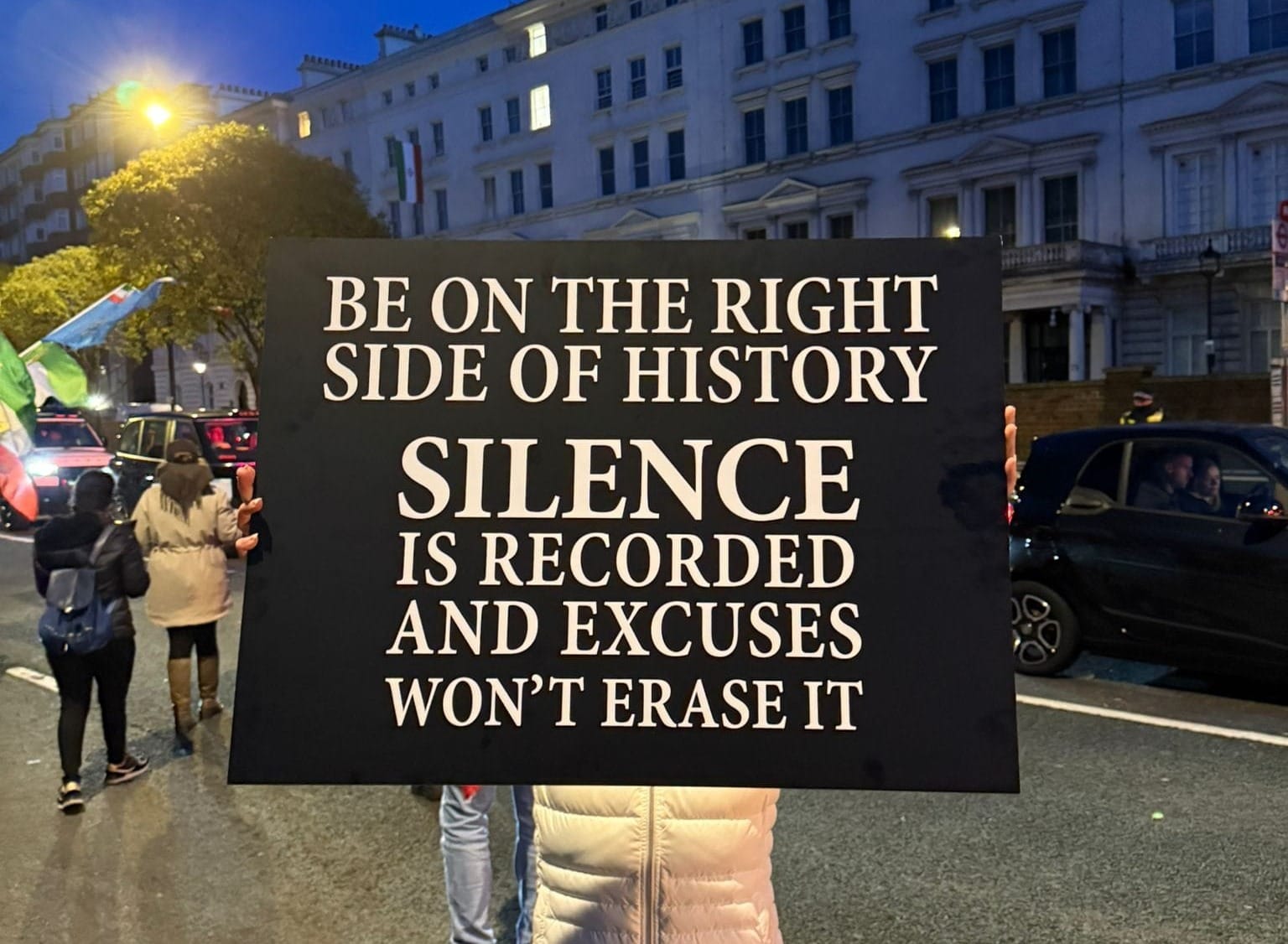
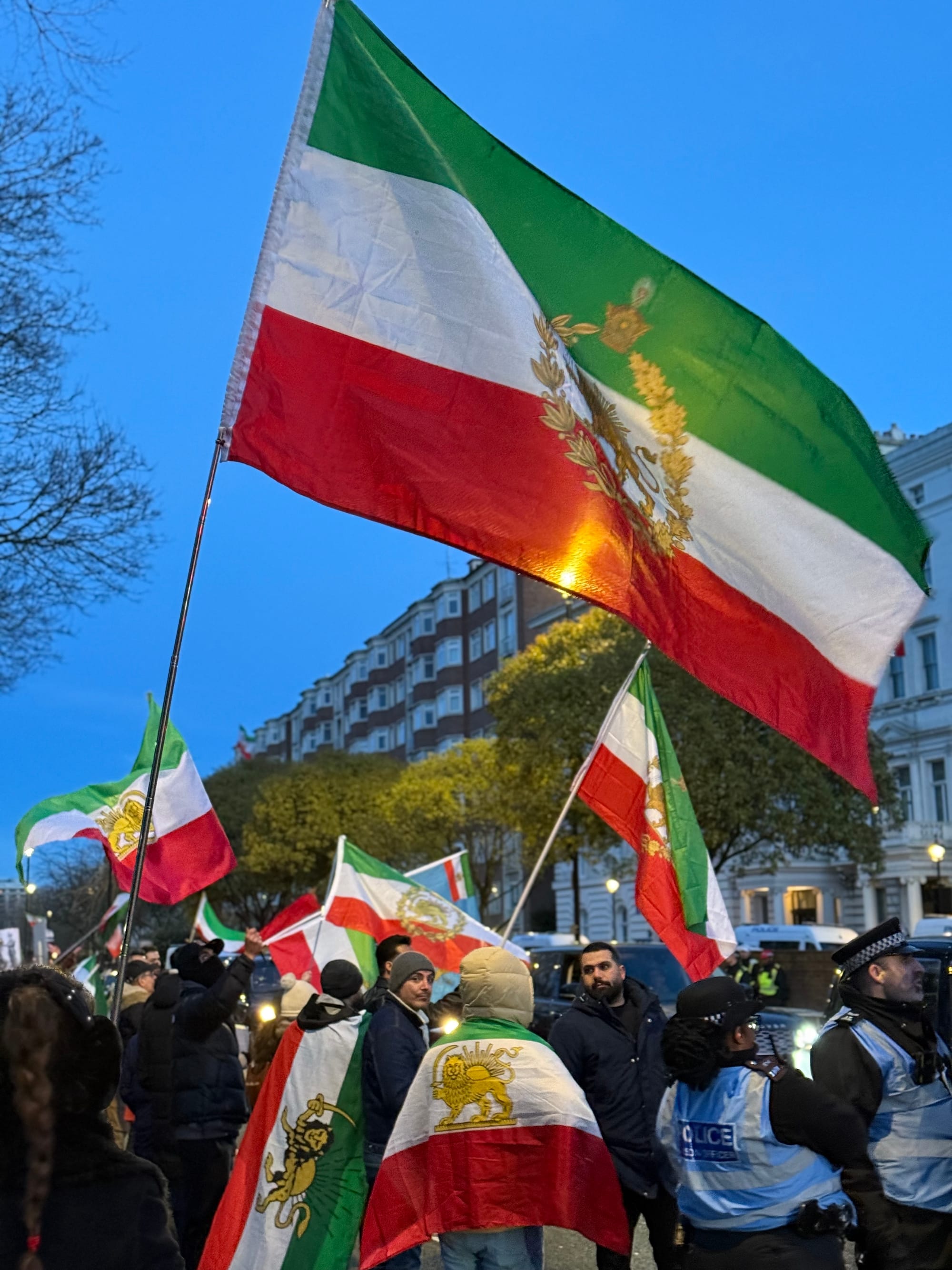
A demand repeatedly made by protesters outside the London embassy is for the UK to proscribe the IRGC as a terrorist organisation. Kaveh says this move is essential to prevent international funds from reaching the hands of the militia.
The people of Iran believe a regime change is the only way forward. If the regime faces no consequences now, Kaveh says, it will only be empowered to kill thousands more civilians the next time around.
I ask Rostam if he hopes to return to Iran one day. “I am hopeful that we’ll become a free, open, democratic, secular country” that he can safely return to, he responds. “Then again, I’m the most optimistic person I know.”