Chelsea FC feel the Blackett Blues
Premier poachers dribble over the peer-reviewed

Last season, Chelsea Football Club poached a new ‘free kick specialist coach’, formerly of Brighton and Hove Albion Football Club. Unbeknown to them, the specialist, Levin Kydford, came from the Physics Department at Imperial College London. His process involves explaining the science behind free kicks, long cross-field passes, and corners to the players. We decided to get in contact with the goalkeeping coach to see if they were also looking to employ this method.
“Lev has been setting the boys four problem sheets a week, but the lads already abandoned two of the modules by week two,” said Ren Boberts, current Chelsea goalkeeping coach, also previously working for Brighton. “We won’t be using this for goalkeeping, because the long and short of it is, we just lump it up the pitch, mate.”
Kydford wrote his undergraduate BSc project during his time at Brighton Polytechnic on “Analysing the Kinematic and Aerodynamics of Free Kicks and Long-Range Crossfield Passes in Association Football: A Comprehensive Computational and Experimental Study”. The study involves multiple simulations using Python, Fifa 06, and experiments using a foosball table, yet we could not find mention of any practicals involving men on a physical pitch. Kydford took an extensive look at previous data from White Hart Lane, the late Spurs stadium, where there seemed to be a proliferation of goals conceded by the home team from corners.
To understand the art of free kicks, NegaFelix reached out to two football players renowned for their success with them, to gather their perspective. When asked “so what do you think of physics?”, football legend Dave Peckham answered “I loved physical education in school.” We then followed with further clarification and gathered the response “all I learned is what goes up must come down – Newton’s fourth law of Norwich City.” Although we managed to secure a quote from Thames Alexander-Ronald, unfortunately none of our interviewers could decipher what the Scouser was saying.
Chelsea “soccer” fans have mixed feelings on this tactic. When approached outside Fulham Broadway station, many quoted “I don’t know which way we’re going”, revealing the uncertainty felt, feeling the need for “direction”. We conducted a simple survey and found that there was only 55% satisfaction among fans with the Imperial College Physics lecturer.
Chelsea’s decision to target Brighton’s expertise becomes clearer when examining the numbers behind long term set-piece success. Felix has compiled a table ranking a selection of relevant clubs by the number of goals arising from set pieces, to highlight the results of this theoretical football approach. To further contextualise these numbers, we have also provided the net spending per goal scored from set pieces over the 20/21-23/24 seasons in GBP.
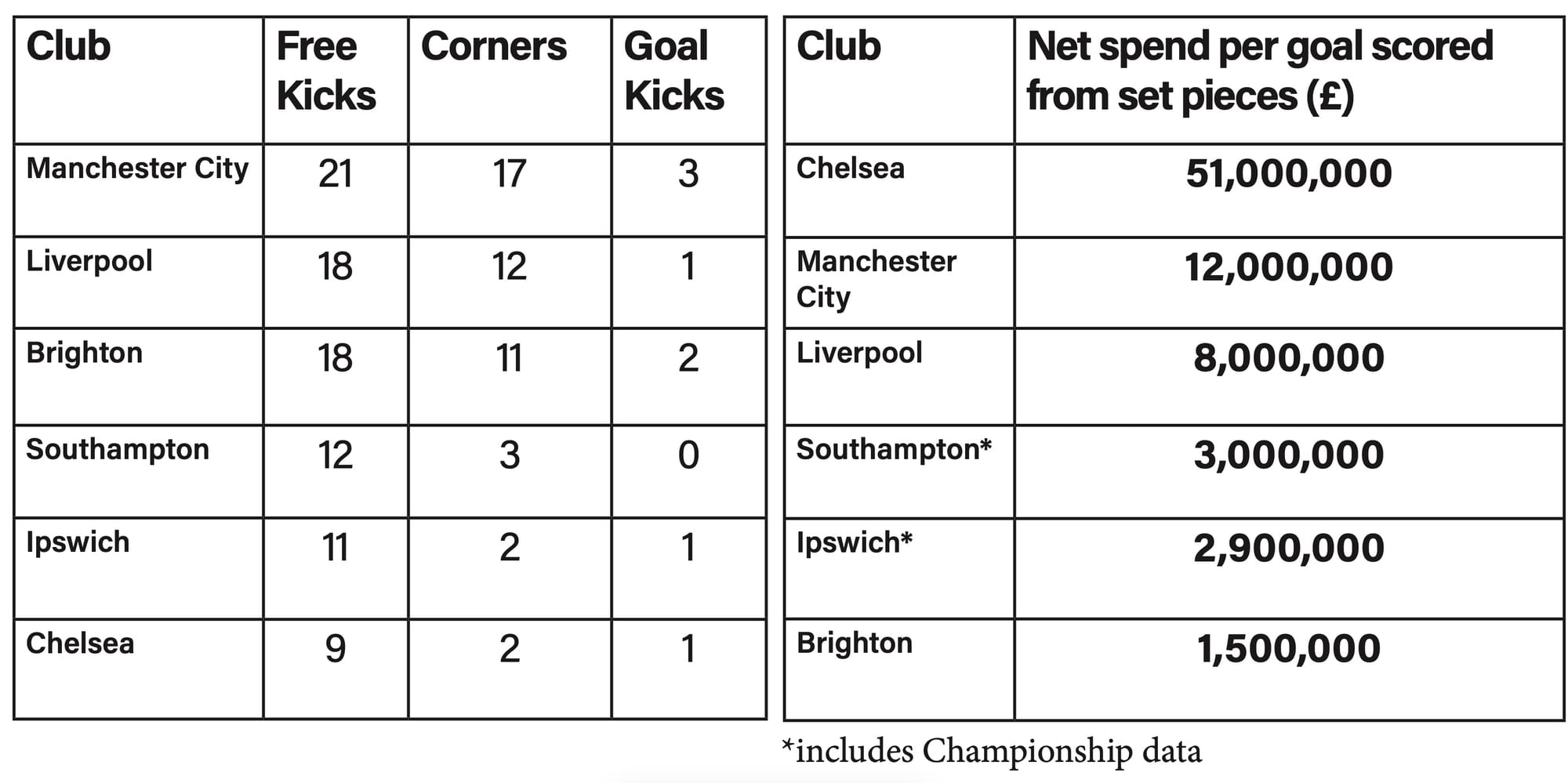
Chelsea FC have signed Levin for a forty-year contract.