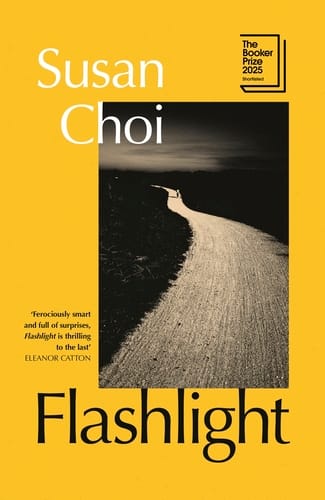
Flashlight by Susan Choi
A review of the gut-wrenching Booker Prize 2025 Shortlist novel, Flashlight.
Sparked by a disappearance, Susan Choi’s Flashlight is primarily a mystery novel. It opens with Japanese-Korean immigrant Serk Kang and his ten-year-old daughter, Louisa, walking along a beach in Japan with a flashlight. The next moment, Serk is gone, possibly drowned, leaving only a distraught Louisa who insists her father was “taken away” but remembers nothing more.
This single, catastrophic event fractures the lives of Serk’s wife, Anne, and their daughter, setting the stage for a novel that weaves three lives through a complex, elliptical timeline. Ultimately, Flashlight plunges into the hidden history of the Japanese-Korean diasporic community, telling a story as deeply personal as globally significant.
The brilliance of Flashlight lies in its fractured structure. Rather than moving chronologically, the narrative frequently alternates between Serk’s impoverished, tumultuous childhood in the 1940s and 1950s, Anne’s reflections on her marriage to Serk plagued by secrets, and Louisa’s chaotic university years through to adulthood. This non-linear approach masterfully mirrors the nature of inherited trauma: history is not a straight line, but a current that pulls you back, constantly shaping the present.
Choi deliberately anchors her characters’ lives to real-world historical events: the end of WWII, the Cold War, and the kidnapping of Japanese citizens by North Korean agents. Most of these events directly touch Serk’s closely guarded past.
However, despite his desperate attempts to hide this history from his family, they each find unexpected ways to connect with him Following Serk’s disappearance, Anne meets Walter, a neighbour with a deep interest in Korean culture, leading her to confront the heavy cultural weight her husband carried. Concurrently, Louisa’s seemingly unrelated struggles during her university years help her connect to her father’s lifelong feeling of being an outsider.
Perhaps we are all swimming through the relentless current of history, weaving our own heartbreaking, yet resilient, narratives.
Flashlight asserts a clear truth: erasing or forgetting a painful past does not make it disappear. The diasporic community’s survival depends on facing that history, fighting for it, and demanding a spotlight for their own narratives.
Like Serk, who returns to his daughter; and like Louisa, who finally faces her father, fueled by the memory of the flashlight that shone briefly on their shared path, perhaps we are all swimming through the relentless current of history, weaving our own heartbreaking, yet resilient, narratives.