Restoring biodiversity, building sustainable cities
Probiotic Cites Symposium II discusses: does the microbiome hold the key to combating climate change in cities?
As we reach the end of summer, the cooler weather brings relief after a series of scorching heatwaves. The heatwaves may be gone, but they leave humanity with a big question: where is climate change leading us to? Research continues to find both social and scientific methods of mitigating the damage.
Urbanisation has been shown to be a leading cause of climactic warming, mainly due to heat-absorbing properties of concrete buildings and roads and rapid deforestation, leading to loss of natural cooling offered by the trees via transpiration (1). Another implication of deforestation on the environment is the loss of biodiversity. Just like plants and animals, microorganisms too are crucial components of biodiversity. They form a large community on Earth, just as on the human body, called the “Microbiome”. In his book, “Dark Matter”, Professor James Kinross from Imperial College London mentions that we have co-evolved with microbes so much that they’re indispensable to us, something that is famously known as the “old friends’ hypothesis” and that the lack of exposure to these microbes is linked to various diseases like asthma and, allergies.
Unfortunately, our modern lifestyles, from food to habitat, have not only exacerbated biodiversity loss, but also disturbed environmental patterns, of which heatwaves are a live example. Just like plants and animals, the microbiome too is facing an existential crisis both on a human and on an environmental scale. As many gut scientists, nutritionists, microbiome researchers around the world make efforts to study the gut microbiome and restore diversity in the gut to treat inflammatory diseases, equal amounts of efforts are being undertaken by many ecologists to restore environmental microbiome loss.
With urbanisation becoming common along with air pollution and increased disease burden due to antimicrobial resistant (AMR) bugs, the composition of the air around us has changed drastically, detrimentally impacting human health. The second edition of the Probiotic Cities Symposium hosted at Bartlett School of Architecture of University College London addressed this very concern. The symposium was based on the theme, “The Urban Exposome” to contribute towards the efforts to map “The Global Exposome (a mix of environmental and chemical exposures driving most diseases)” backed by UNESCO and international science advisory bodies. Researchers specialising in environment and ecology gathered on the 4th of September in London to discuss their on-going research concerning the urban exposome. The exposome is the combination of environmental factors a human experiences in their life by studying a range of samples such as chemicals, food, air, and more.
Many of the researchers shared their experimental work that seeks to map the urban aerobiome (microbiome of the air), while others shed light on how public policy, pedagogical research and Arts can help overcome the cultural barriers towards microorganisms, shifting them from being regarded as unsafe or infectious to being seen as helpful.
Jake Robinson, a restoration ecologist from Flinders University, Australia, one of the organisers, discussed his work on utilising spider webs as passive samplers of the aerobiome. By combining spider webs with DNA profiling methods, his research aims to reveal distinct aerobiome composition across vegetation and land use. Later, Xin Sun from the Chinese Academy of Sciences, talked about the importance of soil microbial communities on plant performance, pathogen regulation and its incorporation into One Health strategies. She argued that soil should be treated as essential component, a “biological infrastructure”, with potential implications for urban greening and biodiversity conservation.
On the note of “urban greening”, Heather Rumble, from the University of West of England, Bristol, highlighted the critical importance of functional ecological processes that take place behind the scenes of plant-microbiome interactions. She is putting efforts to redefine urban greening from being merely about visual elements (more trees, parks, etc.), to interconnected holobiont systems (where plants, animals and microbes form a collective unit). Further exploring microbiome’s role in urban greening, Marja Roslund (University of Helsinki) noted that individual plant cultivars host distinct microbial communities and demonstrated how spraying them in day care centres optimizes children’s microbial exposure.
From an architect’s perspective, Richard Beckett, from UCL’s Bartlett School of Architecture, shared his vision of how novel bio-integrated design can make buildings active contributors of microbes to the indoor environment. Key to his work has been the development of bioreceptive materials that harbour probiotic bacteria on the walls, facilitating outdoor-indoor air transfer and microbially rich biomass on interior surfaces. With this vision in mind, his PhD students Hangchuan Wei and William Scott, shared their on-going work on testing the habitat adaptation of microbes on prototype ceramics that will host beneficial microbial communities bringing together laboratory enquiry and design practice.
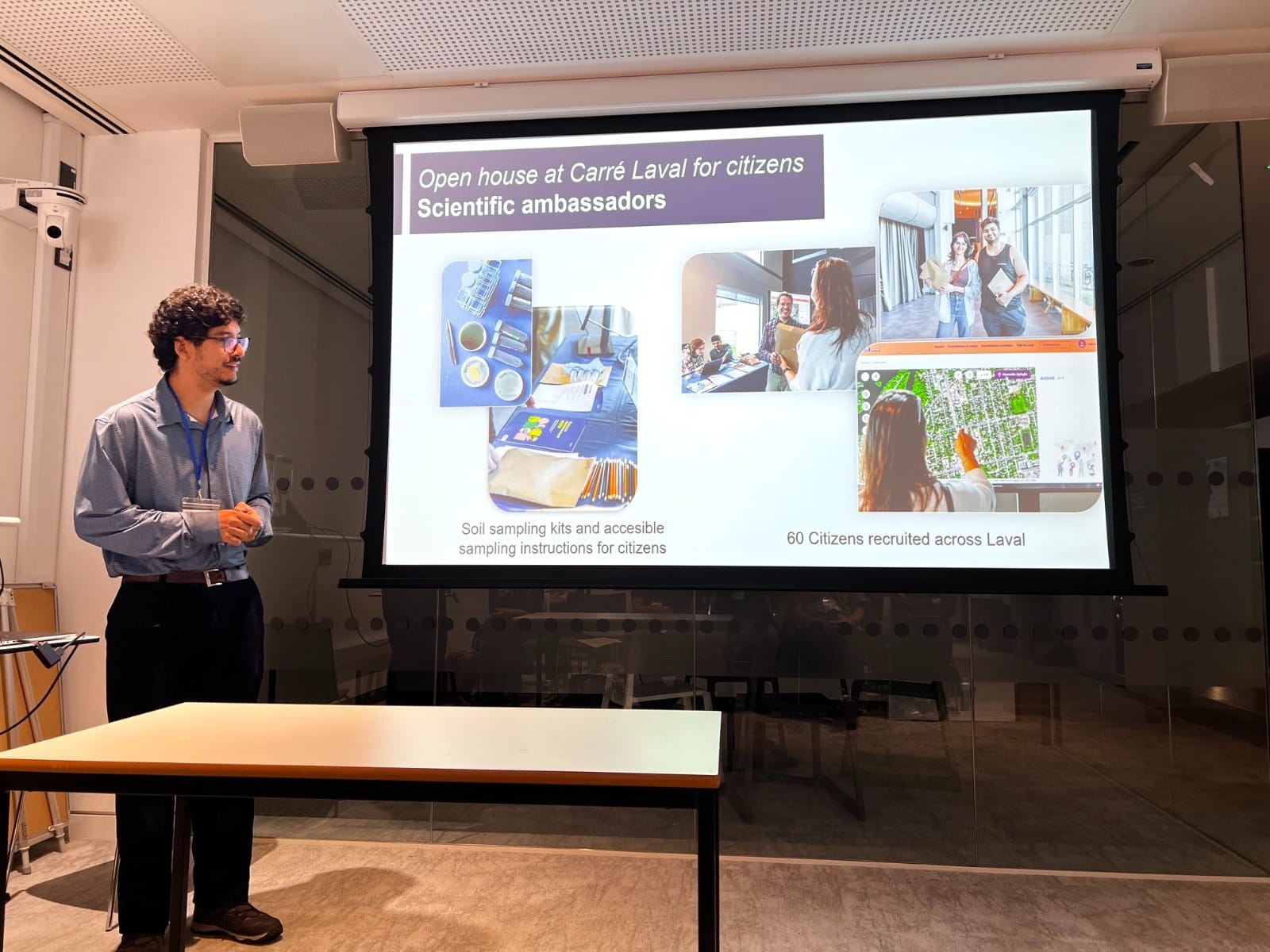
Moving from the experimental/ scientific part, the symposium hosted speakers from the Institute of Scientific Research, Canada, Philippe Constant and Adriel Pinilla who talked about their ambitious “Microbiome City Network Project” where they emphasised the importance of combined functioning of citizens, scientists, industries and municipal officials in promoting Green Infrastructures (GI) by applying “One Health” principles. They shared their benchmark research on restoring microbial diversity in the barren degraded land of the Carré Laval district by identifying microbial functions in the neighbouring city of Laval, Canada, which will be implemented for GI design and monitoring its impact on citizen and animal health.
Another interesting insight was shared by Alexia Barrable at Queen Margaret University of Edinburgh, who presented her pedagogical research on co-designing dirty play labs with children to promote their interaction with natural, microbially-rich environments. Working with children of age 5-11, playful, participatory activities organised in outdoor environment has made children find outdoor activities enjoyable and exciting. Lastly, Graeme Reid from the Royal College of Arts, London, discussed that while research is increasingly providing evidence of the positive impacts of having microorganisms indoor, there is a huge cultural barrier (biophobia - fear of microbes), reducing support for such practices. Having asked London renters to keep an microbially-inoculated oak artefact for six weeks to examine participant response, his ethnographic research found mixed reactions (some delivering normal care just like they do for plants while others grew wary of it).
On a concluding note, with global temperatures warming every single year and as heatwaves become a new normal in different cities across the world, the collective role of ecologists, microbiome researchers, architects, and interdisciplinary scientific research in designing livable cities becomes crucial. Policy makers, governments and artists also play a key role in delivering the key message to common mass and driving investments to build sustainable innovative products. There’s a strong hope that with more public participation (as in the case of City of Laval in Canada), driven by citizen-science approach and cooperation from government can help us achieve Sustainable Development Goal 17, of “taking urgent action to combat climate change and its impacts” by 2030.