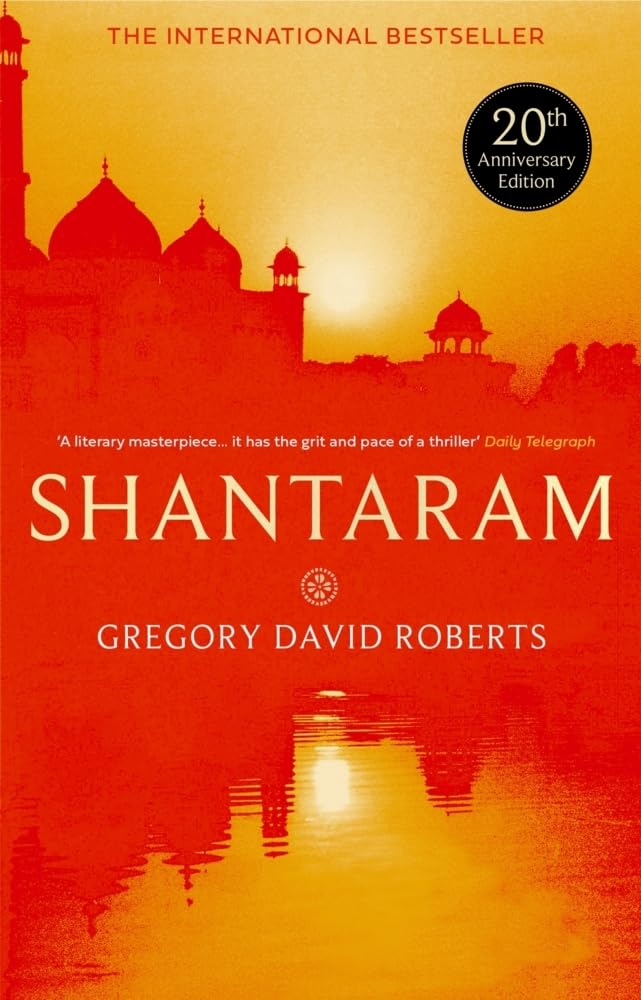
Shantaram
A semi-autobiographical novel that takes your breath away, one adventure at a time.
Shantaram begins with an opening line that foreshadows the profundity and scope of the novel: “It took me a long time and most of the world to learn what I know about love and fate and the choices we make, but the heart of it came to me in an instant, while I was chained to a wall and being tortured.”
We do not yet know the name of our narrator, and we never will; he is a passionate activist turned convicted armed robber and heroin addict. The protagonist has risked everything for his own freedom in a precisely mediated escape from an Australian prison to Mumbai (referred to, throughout the novel, by its colonial moniker: Bombay).
Finding himself on the busy streets of 1980s India, the man with a tragic past and an unbelievable future meets his fate under the disguise of a bright, vivacious Bombay guide, Prabaker. Under the alias Lin, our protagonist leaps into everything the vibrant city has to offer: he discovers Indian cuisine, social customs, diversity, and spirituality. Lin dabbles in Bollywood, discovers the joys and tragedies of living in a slum, finds love, grieves friendships, joins the Bombay mafia, and even gets a taste of Indian jail. If such an array of pursuits still seems unimpressive to you, he also sets out to fight in Afghanistan alongside the Mujahideen.
In a work of fiction, this all appears utterly absurd: how does one handle writing about all that? The real question to ask here, however, is how one manages to live through all of that and then write a Commonwealth Writers’ Prize nominated book about it? Yes, you understood that correctly – Shantaram is not just a glorified action novel, it is a semi-autobiographical one. Gregory David Roberts was, in fact, an Australian convict fleeing his homeland. He was welcomed with open arms into an unknown nation, and much of his own experiences are stunningly reflected on the pages of his masterpiece.
Every chapter is embellished with prepossessing descriptions that plunge you whole, mind and soul, to the fervent streets of Bombay: you can smell the aromatic chai, almost taste the homely chapati and sense the warm, industrial breeze caress your cheek. The persistence of the very committed descriptions is, to me, demonstrative of the author’s faithful love for the city, but it is a common criticism that the book is weighed down by the density of such prolonged illustrations.
There is a common feeling of overattributing importance to the most minor of details. Not every street corner merits a half-page account of its features, and not every conversation asks for a reflective dissection of its contents, but one loves to write about oneself, and there is no greater joy than adorning everything you can with a touch of your own perspective. At best, critical readers have mentioned struggling to fight through the extravagant prose to reach the “good bits,” and at worst have labelled the work as “narcissistic, sophomoric, and tedious.” Such accusations of narcissism in Roberts’s work stem from the too perfect Lin, who is always quick to say the most noble of thoughts and commit the most noble of deeds (excluding the armed robberies, of course). The unbelievable nature of the protagonist is also brought upon by the sheer realm of the story. Shantaram covers a lifetime, and our hero manages to do so much to the soundtrack of his occasionally synthetic-sounding narration that it becomes troublesome to believe that Lin is a plausible character.
Aside from this, Shantaram harbours many strengths. The first, and most notable, is Roberts’s ability to piercingly introduce every character, no matter how minor. With every individual Lin comes across, from his jolly sidekick Prabaker to a fleeting stranger on the street, one becomes intimately acquainted. Roberts possesses a magical gift to unveil the thoughts and traits of a man, just by describing his voice and how his upper body leans when he sits. These witty, methodical character descriptions are more welcome than their extensive, setting-centric counterparts.
Among the intermittently frivolous ‘depth’ of conversation mentioned previously, there are quite a few ponderworthy discussions. Khader Khan, a wise Muslim crime lord and eventually Lin’s mentor, who “never feels any one emotion without feeling something of its opposite”, argues for a school of thought that allows him to combine a religious lifestyle with a criminal career. The legal system concerns itself with the amount of crime in a sin while the mafia boss considers the opposite far more important. The Khan also offers an interesting metaphysical theory of “tendency towards complexity,” and how said tendency truly defines what is good and bad. Lin himself even puts forth an interesting point about anarchism that nurtures a love for the human race among all political philosophies, even if that point is not as developed as it could be.
Shantaram is also one of those books, whose title you ponder until the gratifying moment when its meaning clicks, and the previous pages fall a bit more into place. The highlights, of course, are the close attachments Lin forms with the people who flee their past and converge in Maharashtra’s capital – Lin’s strikingly different companions and their influences guide us throughout his developing acquaintance with India. Lin’s love for the culture and its representatives also leaves one to marvel at how home can be found amidst a neglect of one’s true identity, and how beautiful the pride and sharing of one’s culture is.
And so, Shantaram flows through piquant conversation upheld on complex human connections; it is a story that knows pain, loss, triumph, guilt, infatuation, love, anger, and growth. It is full of plot twists and that uncomfortable feeling in your stomach that you sometimes call dread, or sometimes excitement. The initial threat of its 900-something pages rapidly dissolves. A story about love for humanity, I encourage you to embark with Roberts on his long journey through Mumbai slums, scented streets, village rains, and Afghan hills.