The Beautiful and Damned
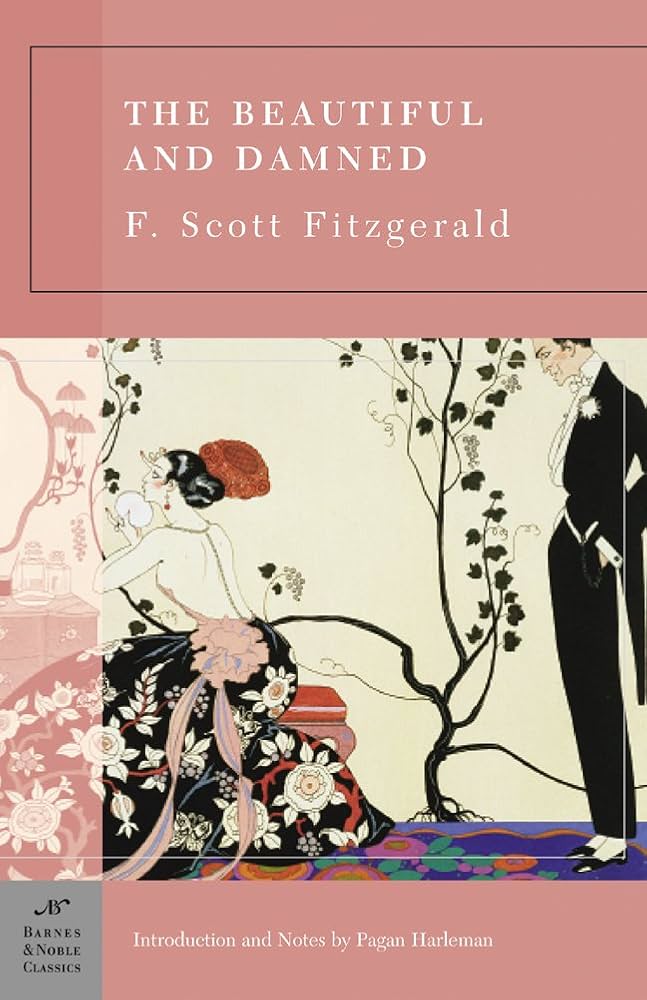
There is something to be said about the way F. Scott Fitzgerald’s sophomore novel The Beautiful and Damned appears to mirror its own contents. Its prose is nothing short of beautiful, full of sparkling phrases and sentences that don’t have a word out of step. It’s eloquent yet flowery without being overwritten, but at times the quality of the prose overrides its somewhat bloated narrative structure.
Detailing the events of Anthony and Gloria Patch’s (nee Gilbert) marriage, The Beautiful and Damned is primarily a cautionary tale, or rather a dark mirror into the lives of the upper classes. More personally it is an exaggerated account of Fitzgerald’s own lifestyle and early marriage to Zelda Sayre, a subject that would again be examined in Tender is the Night, albeit from the perspective of a much more bitter, older Fitzgerald. Tender is the Night reads like a justification, an apology in both senses of the word, by Fitzgerald, whereas The Beautiful and Damned is more neurotic, more abstract, and more removed from Fitzgerald’s life. It’s a neurotic book, fueled by Fitzgerald’s own fears now he had achieved everything he wanted, literary acclaim, a (rich) beautiful wife, and fame.
What does one do when they have everything they wanted? To Fitzgerald, it appears they slide into indolence and alcoholism. Anthony Patch is, although not Fitzgerald’s best character work, pretty good. He’s sidelined by his friends Maury Noble and Richard (Dick) Caramel. Caramel, an author whose debut is lauded and soon slides into the commercial trappings of writing, seems like a latent fear of Fitzgerald’s personified, and his own descent is more interesting than that of Patch’s. Fitzgerald’s work is full of self-pity, and Anthony exemplifies that aspect to almost the same extent as Dick Diver in Tender is the Night.
Gloria, meant to exemplify the worst aspects of Zelda Sayre, is still more interesting than Anthony. Her motivation isn’t flat, whereas Anthony’s is, in the sense his worries and inaction don’t seem real or authentic. I think the issue is Anthony, at times, is roused to action especially within the first book of the three that comprise the novel, particularly as he pursues Gloria. His sudden return, or regression into inaction (for love, despite Anthony himself seeming to be a character too languid for even strong emotions such as love to motivate). Gloria has consistent characterisation, an interesting internal philosophy, and she makes sense. Anthony feels jumbled up at times, much to the detriment of the novel where he is supposed to be the hero of the narrative. It comes across as indulgent - much like the sections of the novel where Fitzgerald opts for play-like dialogue, writing out a script with stage directions.
Parts of the book, such as a Flashback to Paradise, where a sort of pathetic fallacy or metaphysical narrative seeks to take place are not encroached upon again, standing out to the novel’s detriment. Similarly, the metaphor of Paramore, a paragon of virtue who works for a social enterprise ending up corrupted by the partying of the Patches and company is too heavy handed.
It’s Fitzgerald's first attempt at trying to apologise for his life, using his literary skills as a vehicle. I believe that is why the novel falls short of being a classic, but a damned good book nonetheless, because it hasn’t been critically evaluated or proofed. The concepts are good, the prose is stellar, but it falls short as Fitzgerald’s neuroses come to the forefront of the book.