Athena Lecture 2026
Dr Michele Dougherty on the icy moons of Jupiter and Saturn.
The annual Imperial Athena Lecture celebrates women and their achievements in the field of science, engineering and medicine. This year’s lecture featured Dr Michele Dougherty, Professor of Space Physics at Imperial, and the first woman to be appointed to the 350-year-old position of Astronomer Royal. The lecture focused on two missions where Dr Dougherty serves as a principal investigator for the magnetic instruments on board: the Cassini mission, which explored evidence of oceans on the Saturn moons Enceladus and Titan; and the JUICE mission, focusing on the Jupiter moons Ganymede, Callisto, and Europa.
The Cassini-Huygens mission legacy: about the moons Enceladus and Titan
The primary goal of the Cassini mission was to understand Saturn’s system in its entirety, from its rings to its atmosphere and moons. When the Cassini probe arrived at Saturn’s orbit in 2004, the moon Enceladus was thought to be a dead body; however, data from the magnetometer, the instrument that records magnetic field around a body, showed what Dr Dougherty describes as a small wiggle in the signal. That wiggle described the presence of a likely sheath that hinders with the magnetic fields deflecting them from Enceladus’s surface. To find out the reason for the disturbance, Dr Dougherty convinced the Cassini team to carry out a daring flyby about 173km from Enceladus.
The flyby was successful, and Cassini managed to capture the presence of water vapor plumes cracks present at the South Pole, identifying them as the source of the disturbance. Thermal sensing, along with sampling and analysis using the ion-neutral mass spectrometer, suggested the presence of water at Enceladus!
For Titan, Saturn’s largest moon, the magnetic field data was equally transformative. Titan was the primary target for the Cassini-Huygens mission due to its massive, thick atmosphere primarily composed of nitrogen and hydrocarbons like methane, similar to the Earth’s atmosphere before the presence of oxygen. The Huygen’s probe, provided by the European Space Agency, disconnected from Cassini and landed on Titan, transmitting data on Titan’s atmosphere during its two-and-a-half-hour descent and on its landing, and producing images of its surface for another 70 minutes.
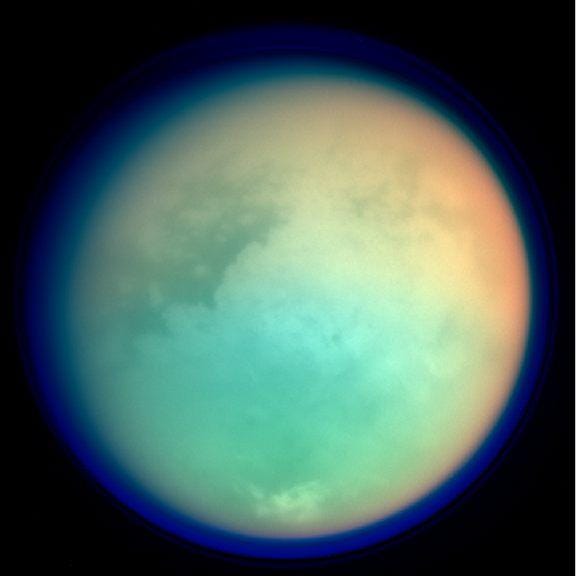
These images showed the presence of sand dunes along the equator and cryo-volcanoes erupting with water-ammonia slurry, along with dry lakes and riverbeds. After three years, Cassini captured a glint of sunlight reflected off the lakes on the north pole. During the wet season it witnessed and reported methane and ethane rains. Beyond these, gravity data from Titan confirmed the presence of subsurface liquid water below the icy crust.
The grand finale of the Cassini mission was a high-stakes conclusion designed to capture the Saturnian system while ensuring planetary protection. Since Enceladus and Titan proved to be probable habitable zones, a decision was made to destroy the spacecraft while entering Saturn’s atmosphere to prevent any contamination to the moons. During this time, Cassini flew slightly beyond the outer edge of the visible rings to sample the dust and gas in the environment around the rings. The probe also completed a series of 22 orbits that reached a 2000km wide space between the innermost rings of Saturn, a region where no spacecraft had entered before. Overall, Cassini’s data aided in deciphering the chemical composition of Saturn’s upper atmosphere, with the finale also helping with the understanding the planet’s internal magnetic field.
Redefining the snow line: extending the habitable zone through the icy moons
The Cassini mission fundamentally changed our understanding of the habitability in the outer Solar System. The discovery of water plumes and methane cycles (a methane-based version of Earth’s water cycle) on Enceladus and Titan suggested that environments capable of supporting life may exist beyond the “snow line”, defined as the distance from a star at which a molecular species can freeze.
The ESA’s JUICE Mission, launched in April 2023, focuses on the next part of the journey: exploring the thick ice crusts of Jupiter’s moons Ganymede, Callisto and Europa. As Jupiter rotates, its magnetic field induces secondary fields in the subsurface oceans of these moons, requiring the mission to use sensitive magnetometers. Along with other measurements, JUICE can help in determining lunar features such as depth and salinity. This highlights how the characterisation phase will help identify whether these moons possess these essential elements of life.