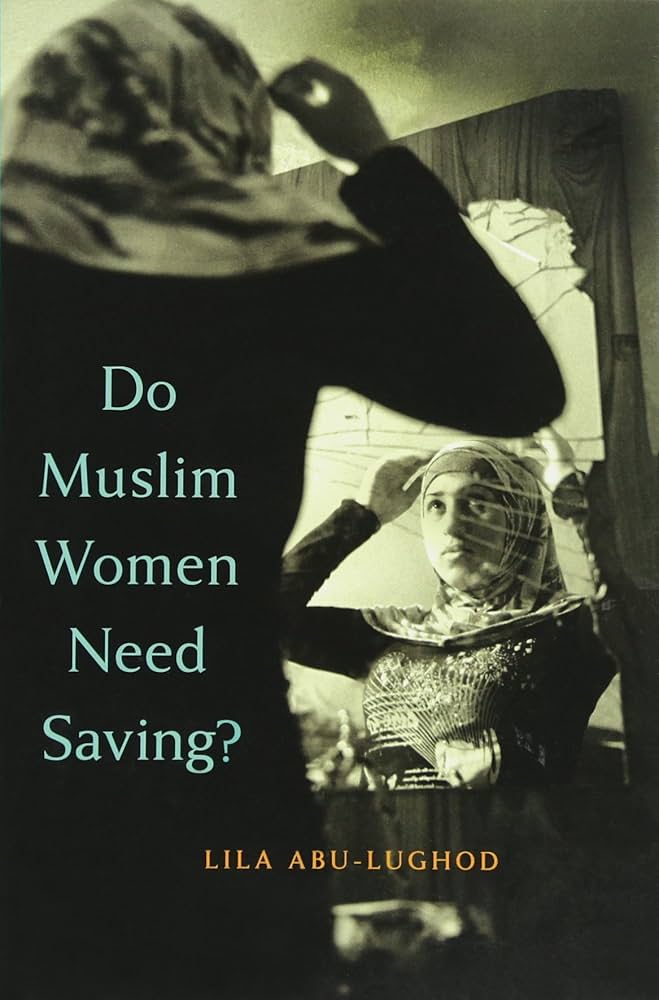
Do Muslim women need saving?
No – but not for the reasons Lila Abu-Lughod gives.

Lila Abu-Lughod’s Do Muslim Women Need Saving? sets out to interrogate how Western discourses of liberation and feminism have reduced Muslim women to a single archetype: voiceless victims in need of rescue. She aims to replace the caricature of these women with complexity, and to expose how the rhetoric of “saving” Muslim women has often justified imperial violence. It is an admirable and, in many ways, urgent project, but her execution does not live up to its promise. For a book that set out to restore Muslim women’s voices, it too often ends up speaking over them instead.
For all her insistence on specificity, Abu Lughod’s ethnography is confined almost entirely to Egyptian fieldwork. She uses Egyptian women – more specifically, a few Bedouin women in Egypt – as illustrative counterexamples to Western caricatures of what Muslim women are. The irony here is that in her attempt to critique Western generalisations, she replaces them with her own. While these views may reflect the experiences of some Egyptian women, they cannot bear the weight of representing hundreds of millions of others.
Perhaps the greatest disappointment of this novel is that its best insights – its exposure of how the “rescue” narrative feeds imperial ambition and Western self-congratulation – are buried under defensive, self-contradictory prose. AbuLughod is right that Muslim women are not monolithic, that oppression takes different shapes, and that Westerners must confront their own hypocrisies. But she goes too far in the other direction, dismissing genuine feminist struggles as naïve and insufficiently acknowledging the misogyny that undeniably exists in many communities.
She criticises the mistakes of Western feminism, but in doing so, she also dismisses Muslim women who do challenge patriarchal customs from within their own communities, implying that their activism is somehow inauthentic or compromised by proximity to Western frameworks. Women like Nawal El Saadawi and Fatema Mernissi, who have long fought for reform within Muslim contexts, are largely absent from her analysis. Instead, Abu-Lughod seems to suggest that gender inequality itself is a Western misreading of Muslim life.
Her treatment of specific practices such as veiling, seclusion, and honour culture also verges on apologism. Rather than acknowledging the diverse meanings these practices carry, she often portrays them as benign symbols of cultural difference, ignoring the very real constraints and violence many women face. To deny that these practices can be both culturally rooted and sometimes exploited through oppressive means is to refuse Muslim women the right to name their suffering.
In the end, Abu-Lughod’s book mistakes moral discomfort for moral depth. Its criticism of Western saviourism shades into a refusal to name any wrongs. It is possible to reject imperial feminism, but also to acknowledge that many Muslim women face systemic injustice. It is possible to disagree with someone’s values and still respect their agency.
So, do Muslim women need saving? No – but not for the reasons Abu-Lughod gives. No, because Muslim women, in their extraordinary diversity, are not a problem waiting for an external solution. Those facing injustice need solidarity, not rescuing. This means taking seriously the arguments of reformers within Muslim communities rather than dismissing them as Westernised, and supporting material change rather than performing moral concern.
I believe the question was never really whether Muslim women need saving. It was whether we are capable of helping without making ourselves the protagonists of someone else’s story.